
Google Ads for Motivated Sellers: Stop Buying Facebook Garbage and Target Real Intent (2026 Guide)
By Deepak Jaiswal | Real Estate Growth Specialist Reading Time: 10 Minutes
Every week, I talk to a real estate wholesaler or flipper who tells me the exact same sad story.
“Deepak, I’m getting Facebook leads for $15 a piece! But when I call them, they tell me their house is worth $450k because that’s what Zillow says. The house needs a new roof, the foundation is cracked, and they won’t take a penny under retail.”
I always give them the same answer: You are marketing to the wrong mindset.
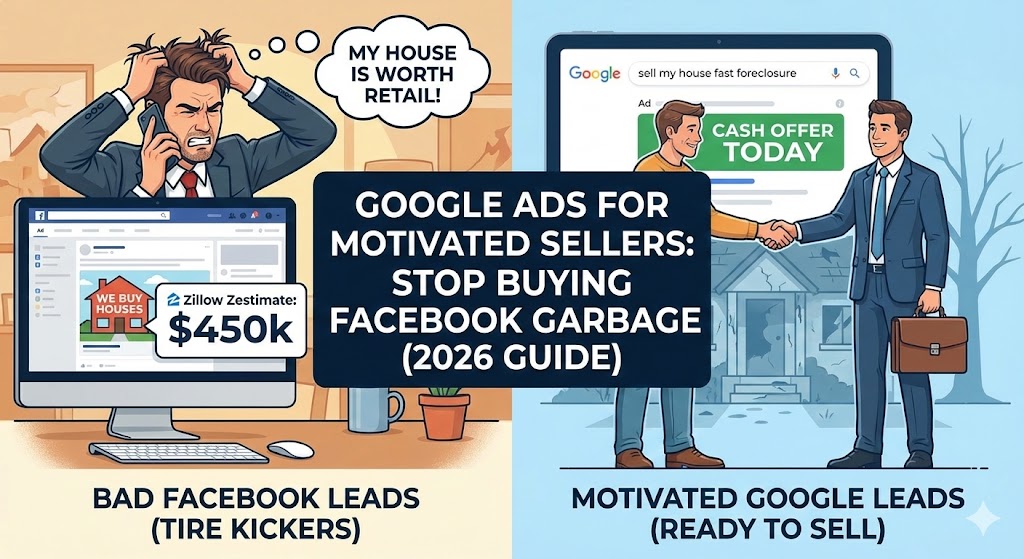
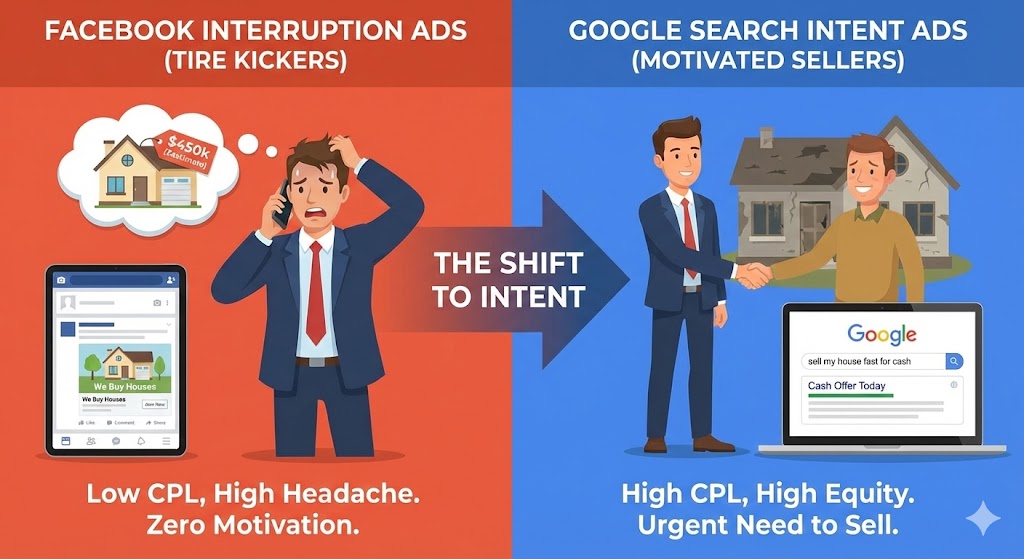
Facebook is a platform of interruption. When you run a “We Buy Houses” ad on Facebook, you are interrupting someone who is looking at photos of their nephew’s birthday party. They click your ad out of pure curiosity. They are not desperate. They are not motivated. They are just tire-kickers.
If you want to buy deep-discounted, off-market real estate in 2026, you need to stop begging people for their attention and start standing in front of the people who are actively begging for your help. You need to master Google Ads for motivated sellers.
When someone is facing foreclosure on Friday, getting a divorce, or dealing with a house completely destroyed by terrible tenants, they don’t scroll Instagram. They go to Google and type: “How to sell my house fast for cash in [City].” That is not curiosity. That is a cry for help. And if your ad is the first thing they see, you win the deal. Here is how to build a high-converting PPC machine that actually works.
The Intent Hierarchy: Why Google Leads Cost More (And Why You Should Gladly Pay It)
Let’s address the elephant in the room: Google Ads are expensive. A single click can cost you $20 to $50 depending on your market. A single generated lead might cost you $150 to $300.
Amateur investors see that $200 Cost Per Lead (CPL) and run back to Facebook to buy $15 garbage leads. Professional investors look at the Cost Per Acquisition (CPA) and realize Google is a goldmine.
Would you rather call 100 Facebook leads (spending $1,500) to get zero deals and 99 people yelling at you? Or would you rather pay $300 for one Google lead where the seller says, “The bank is taking the house in two weeks, please just make me an offer today.”
Data Table: Interruption vs. Search Intent in Real Estate
| Metric | Facebook “We Buy Houses” Ads | Google Search Ads (PPC) |
| Seller Mindset | Curious, Passive, Window Shopping | Urgent, Stressed, Ready to Sell |
| Price Expectation | Wants full retail value (Zillow) | Willing to take a massive discount |
| Cost Per Lead (CPL) | $10 – $30 (Cheap) | $100 – $300 (Expensive) |
| Lead-to-Deal Ratio | 1 deal per 80-100 leads | 1 deal per 10-15 leads |
| Time Wasted | High (Endless follow-up required) | Low (They want to close immediately) |
Step 1: The Long-Tail Keyword Strategy
If you go into Google Ads right now and bid on the keyword “sell my house,” you will go bankrupt in three days. You will be competing against Zillow, OpenDoor, and massive national hedge funds with bottomless budgets.
You cannot outspend the giants. You have to outsmart them using “Long-Tail Keywords.”
Long-tail keywords are specific, multi-word phrases that indicate massive distress and urgency. Hedge funds don’t bid on these because the search volume is too low for their algorithms. But for a local investor, these keywords are pure cash.
Stop bidding on:
“Sell my house”
“Real estate agent near me”
“What is my house worth”
Start bidding on:
“Sell my house fast with fire damage [Your City]”
“How to stop foreclosure auction tomorrow”
“Sell inherited house with stuff left inside”
“Cash home buyers who pay closing costs”
When you bid on hyper-specific pain points, your clicks are cheaper, and the conversion rate skyrockets because your ad copy can speak directly to their exact problem.
While Google PPC captures general distress, some of the highest-equity deals come from specific life events. Pairing your PPC campaigns with a targeted inbound funnel specifically designed for probate real estate leads is how you build a truly dominant, multi-channel acquisition system
Step 2: The "Anti-Corporate" Landing Page
Here is where 90% of local investors mess up their Google Ads for motivated sellers. They pay $40 for a click, and send the seller to a website that looks like a Wall Street banking firm.
Distressed sellers are usually intimidated. They are embarrassed about the condition of their house. They don’t want to deal with a guy in a $2,000 suit who is going to judge them. They want a local, blue-collar problem solver.
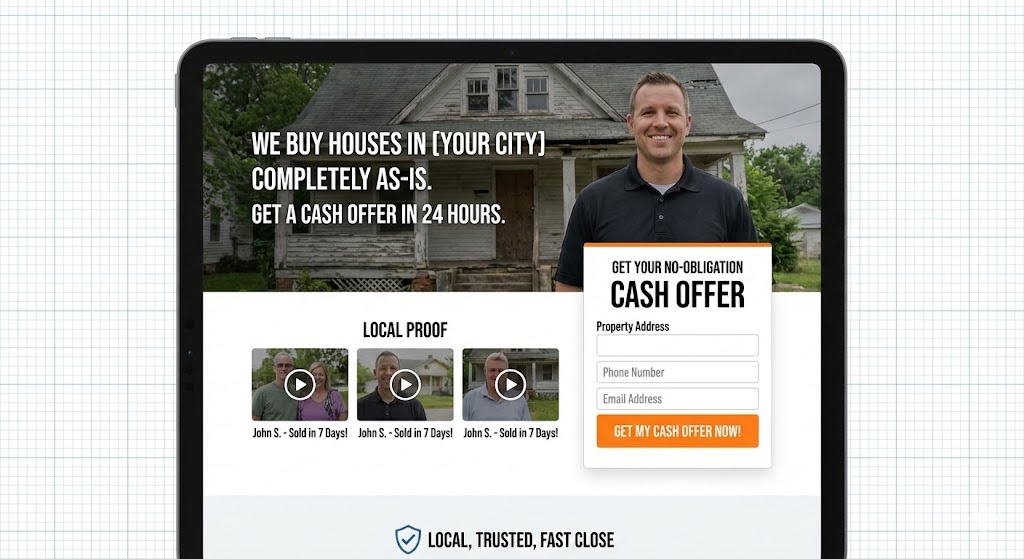
Your landing page needs to scream: “I am local, I am real, and I make this easy.”
The Hero Image: Do not use stock photos of smiling families handing over keys. Use a real photo of you standing in front of an ugly house in your city.
The Headline: Address the speed and condition. “We Buy Houses in [City] Completely As-Is. Get a Cash Offer in 24 Hours.”
The Proof: Put up local video testimonials of people saying, “I thought I was going to lose my house to the bank, but John bought it in 7 days and let me leave all the trash behind.”
The Form: Keep it dead simple. Address, Phone Number, Email. That’s it.
Step 3: Speed to Lead is Life or Death
Once your technical records are set, you still can’t send your pitch. New domains have a “neutral” reputation. If a 1-day-old domain suddenly sends 100 emails, it triggers massive red flags.
You have to “warm up” your inboxes.
You connect your new email accounts to a warm-up tool. This software automatically sends emails back and forth between thousands of other real people in the network. It opens the emails, replies to them, and marks them as “not spam.”
You must let your domains warm up for a minimum of 14 to 21 days before you send a single real sales email. This builds a pristine sender reputation with Google and Microsoft.
Step 4: Writing Human Copy and Selling the "Click"
If a seller types “need to sell house fast” into Google, clicks your ad, and fills out your form, you are on a ticking clock.
They are highly motivated. Do you think they only filled out your form? No. They clicked the top three ads on Google and filled out all of them. The investor who gets the deal is the one who calls them back first.
If you wait two hours to call a Google lead, they have already signed a purchase agreement with your competitor. You need a CRM system that instantly texts the seller the second the lead comes in: “Hey [Name], just got your property info for [Address]. I’m pulling up the comps right now. Can I call you in 2 minutes?”
You must call them within 60 seconds Period.
Conclusion: Trade Your Time for Good Data
Stop trying to convince retail sellers on Facebook that they should take a 30% discount on their pristine, move-in-ready home. It is a waste of your mental energy and your marketing budget.
By mastering Google Ads for motivated sellers, you transition from a salesperson to an order-taker. You are simply positioning yourself at the bottom of the funnel, waiting for the people who have already made the decision that they need to sell today.
Build your long-tail keyword list, create a local, trustworthy landing page, and answer your phone the second it rings.
Want Us to Build Your Motivated Seller Funnel?
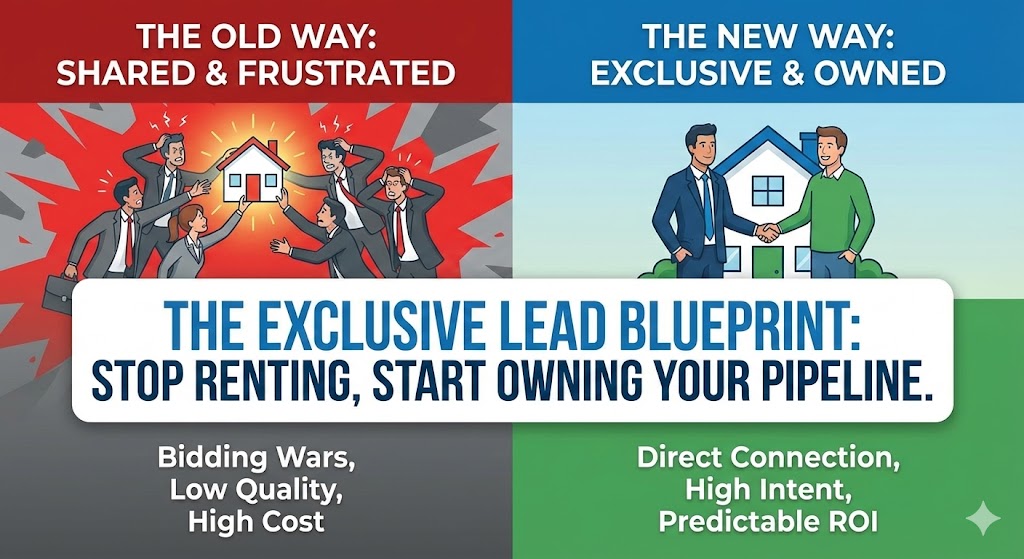
Tired of wasting money on bad clicks? My team specializes in building high-converting Google PPC campaigns specifically for real estate wholesalers and flippers. We handle the keywords, the landing pages, and the tracking. Click below to book a Real Estate Growth Audit and let’s get your phone ringing with real deals.
- All Posts
- Knowledge Hub

Frequently Asked Questions
1. What is a realistic monthly budget for real estate Google Ads?
To get real, statistically significant data and consistent deals, you should not start Google Ads with less than $2,000 to $3,000 per month in ad spend. If you only spend $500 a month, you might only get 2 or 3 clicks a day, which isn’t enough volume to optimize the campaign or guarantee a signed contract.
2. Should I run ads to a generic website or a specific landing page?
Never send paid traffic to your homepage. Your homepage has too many distractions (About Us, Blog, Contact pages). Send them to a dedicated, single-purpose landing page where the only action they can take is filling out the form to get a cash offer.
3. How do I stop competitors from clicking my ads and wasting my money?
Click fraud is a real issue in real estate PPC. You should use a third-party click fraud protection software (like ClickCease) connected to your Google Ads account. It tracks IP addresses and automatically blocks your competitors from seeing your ads if they click them repeatedly.
4. Do I need to use Negative Keywords?
Negative keywords are the most important part of your campaign. You must tell Google what words you don’t want to show up for. If you don’t add words like “Zillow,” “MLS,” “Realtor,” “Appraisal,” and “Rentals” to your negative keyword list, Google will waste your money showing your ad to people who aren’t looking to sell for cash.
5. Can I run Google Ads if I am virtually wholesaling in another state?
Yes, absolutely. That is the beauty of PPC. You can sit in Florida and target specific zip codes in Ohio. Just make sure your landing page has a local feel (use a local area code for your tracking number) so the sellers feel comfortable working with you.