
Google Ads for Solar Leads: How I Turn a $120 Click Into a $35,000 Exclusive Install
By Deepak Jaiswal | Performance Marketing & Automation Expert Reading Time: 12 Minutes
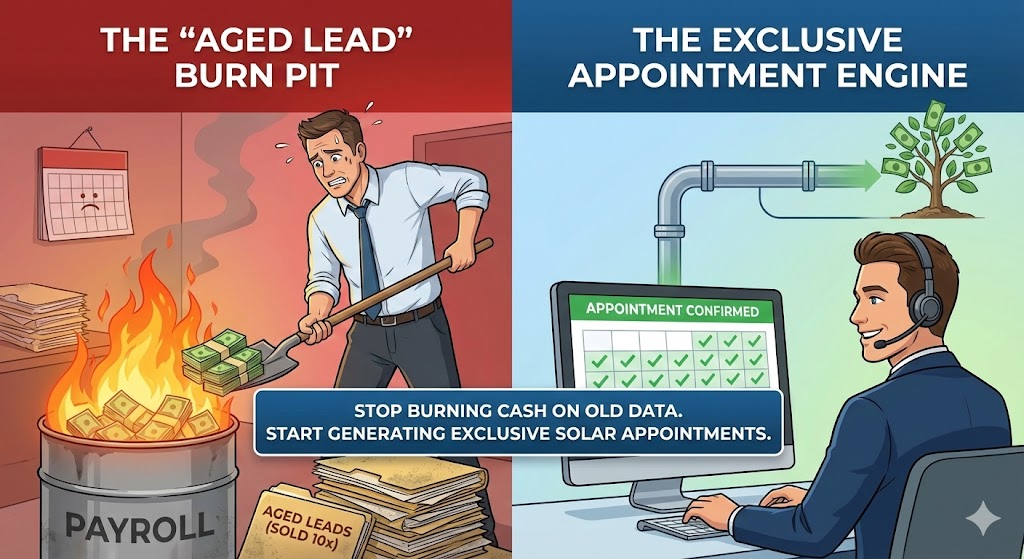
Let’s have a brutally honest conversation about the math behind your solar installation business.
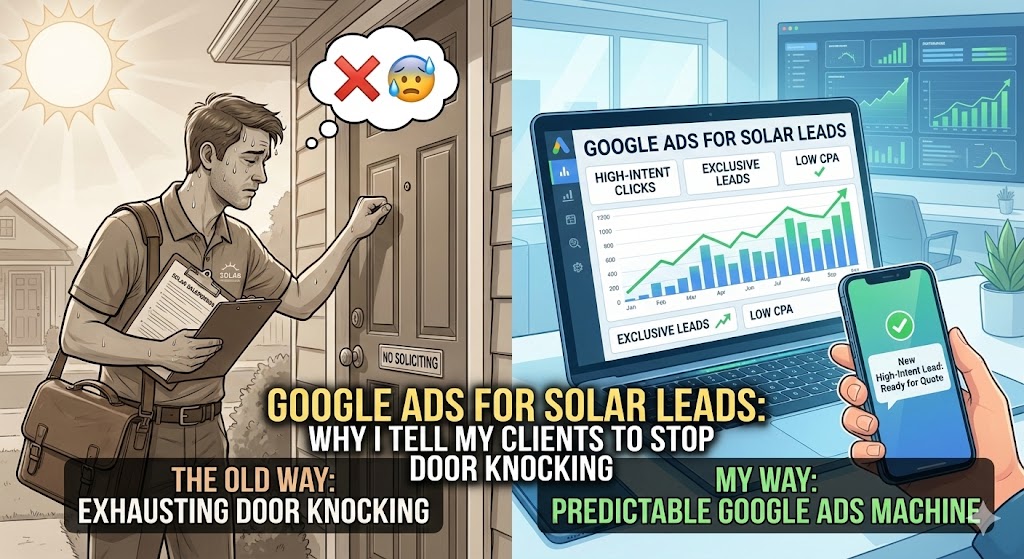
Every week, I talk to solar company owners who are terrified of Google Ads. They tell me, “Deepak, I tried Google Ads. The Cost Per Click (CPC) was $120 just for someone to click my link! It’s too expensive, I’m going back to door-knocking.”
When I hear this, I immediately know the problem. The platform isn’t too expensive. Your funnel is just broken. If you pay $120 for a highly motivated homeowner to click your ad, and you send them to a generic company homepage where they get confused and leave—yes, you are burning money. But as a performance marketer, I actually love expensive clicks. A $120 click means the homeowner typed in exactly what they want, and they have their credit card ready.
I don’t believe in begging for attention or getting chased by dogs in neighborhoods. I believe in capturing high-intent demand. In this breakdown, I am going to show you the exact math, funnel architecture, and backend automation I use to run Google ads for solar leads and predictably turn $120 clicks into $35,000 exclusive contracts.
The Math: Why I Don't Care About a $120 CPC
Most amateur marketers panic at high CPCs. But in the high-ticket solar industry, you shouldn’t be looking at the cost of the click; you must look at the Cost of Acquisition (CAC).
When a homeowner opens Google and types in “cost of solar panels in [City]” or “Tesla Powerwall installers near me,” they are problem-aware and doing active research. If my funnel converts that traffic at a massive rate, the ROI is mathematically undeniable.
Let’s look at the actual numbers of my funnel versus the traditional “cheap lead” approach.
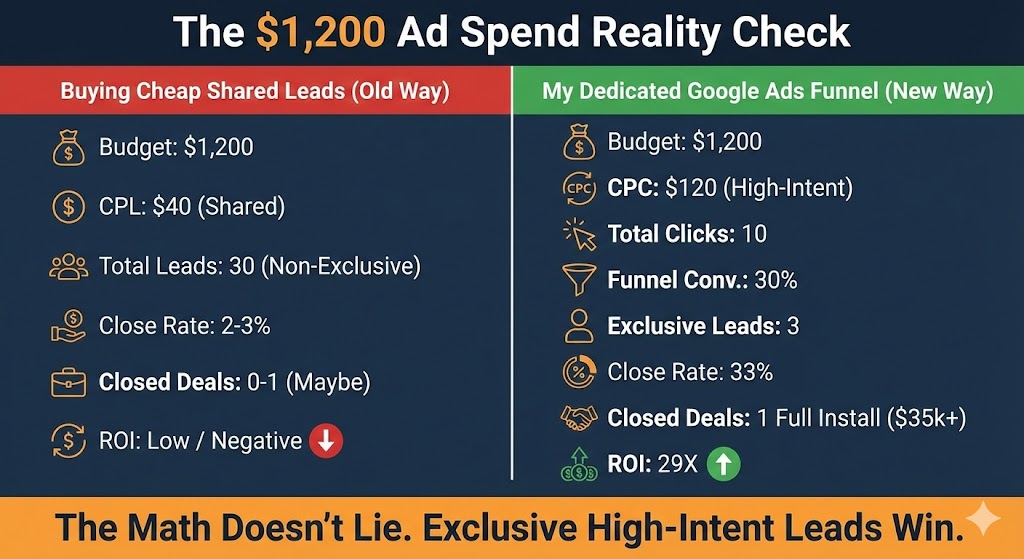
Data Table: The $1,200 Ad Spend Reality Check
| Metric | Buying Cheap Shared Leads | My Dedicated Google Ads Funnel |
| Budget Spent | $1,200 | $1,200 |
| Cost Per Click / Lead | $40 (Per Shared Lead) | $120 (Cost Per Click) |
| Total Visitors/Leads | 30 Shared Leads | 10 High-Intent Clicks |
| Funnel Conversion Rate | N/A | 30% (Optimized Calculator Funnel) |
| Exclusive Leads Captured | 0 (You share them with 4 others) | 3 Exclusive, High-Intent Leads |
| Close Rate | 2% to 3% (Race to the bottom) | 33% (1 in 3 close rate) |
| Closed Deals | 0 to 1 (Maybe) | 1 Full Install ($35,000+) |
| Return on Investment | Low / Negative | 29X ROI |
The math doesn’t lie. A 30% conversion rate on an exclusive funnel changes your entire business. Here is how I build it.
Step 1: Ruthless Bottom-of-Funnel Keyword Targeting
Generic marketing agencies fail at Google Ads for solar because they bid on the wrong keywords. They bid on broad terms like “how does solar work” or “solar energy benefits.” Those are college students doing research papers. I don’t want to pay $15 a click for a college student. I want buyers.
When I build a Google ads for solar leads campaign, I only target what I call “Bottom-of-Funnel” (BOFU) keywords. These are search phrases that indicate the user is ready to make a purchasing decision today.
The Exact Keywords I Bid On:
“Solar panel installation in [City]”
“Top rated solar companies near me”
“Get solar quote [Zip Code]”
“Finance solar panels [City]”
By restricting my budget strictly to these high-intent phrases, I guarantee that every dollar spent is put in front of a homeowner who is ready to talk numbers.
Step 2: The "Savings Calculator" Funnel Design
Getting the $120 click is only 20% of the battle. If I send that traffic to your generic website, the homeowner will get lost looking at your “About Us” page and leave without ever filling out a form.
I send 100% of my paid traffic to a dedicated, high-converting Landing Page Funnel. But I don’t just use a boring “Contact Us” form. I use a Micro-Commitment Calculator Funnel.
How My Funnel Works:
The Hook: The headline matches the ad perfectly. “See How Much You Can Save on Your [City] Utility Bill by Switching to Solar.”
The Micro-Commitments: Instead of immediately asking for their phone number, I ask them easy questions one at a time:
“Who is your current utility provider?”
“What is your average monthly electric bill?” (Under $100, $100-$200, $200+). Note: If they select under $100, I use conditional logic to disqualify them immediately so my clients don’t waste time on unprofitable roofs.
“What is your roof shading like?”
The Capture: “Great! We are calculating your custom solar savings. Where should we text the report?” -> This is where they gladly hand over their Name, Email, and Phone Number.
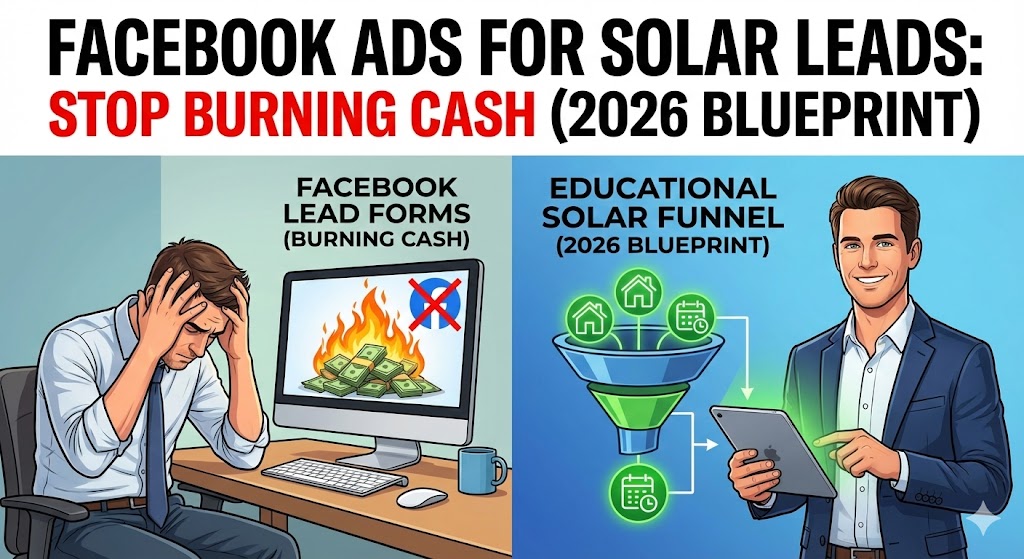
- Capturing the lead is crucial, but what if they bounce before finishing the calculator? You cannot let that expensive Google click go to waste. To plug that leak, I always pair my search campaigns with aggressive Facebook ads for home service to retarget your website visitors and stay top-of-mind until they come back and finish the quote.
tep 3: The 60-Second Speed-to-Lead Automation
This is where multi-million dollar solar companies separate themselves from the amateurs.
If a homeowner fills out my custom funnel, and your sales rep waits 4 hours to call them back, the lead is already dead. They went back to Google and called your competitor. In the home improvement space, the first company to make contact wins the deal 70% of the time.
I do not leave this to human memory. I build an impenetrable Speed-to-Lead Automation system inside the CRM.
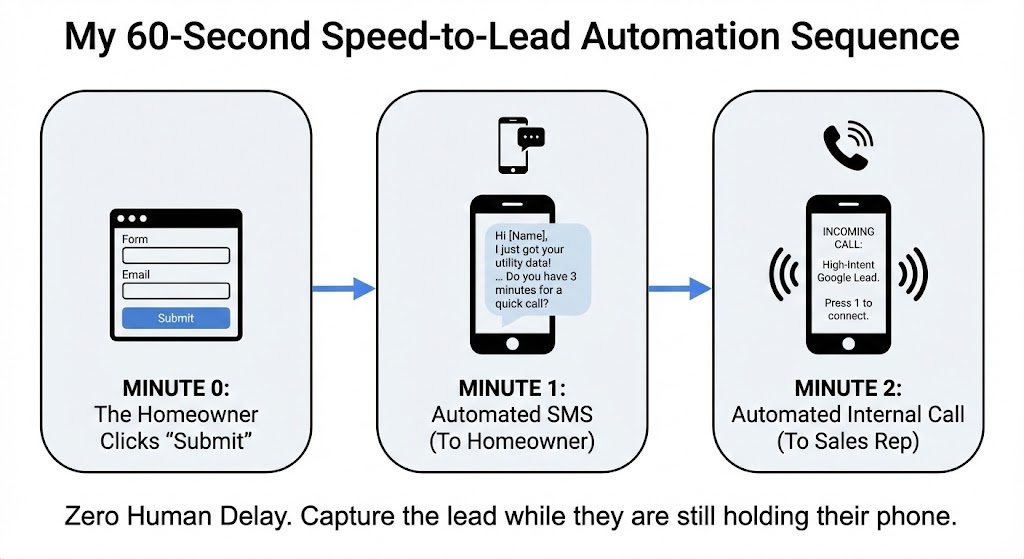
My 60-Second Automation Sequence:
Minute 0: The homeowner clicks “Submit” on the funnel.
Minute 1 (The Automated Text): The CRM instantly sends an SMS to the homeowner from a local number: “Hi [Name], this is Mike from [Your Solar Company]. I just got your utility data! Looks like you are paying way too much to [Utility Provider]. I’m at my desk running your roof via satellite right now. Do you have 3 minutes for a quick call?”
Minute 2 (The Internal Ring): The CRM forcefully rings your closer’s cell phone. An automated voice says, “You have a new high-intent Google lead. Press 1 to connect to the homeowner now.”
This automation forces your team to talk to the lead while they are still holding their phone, looking at their expensive electric bill.
Conclusion: Build a Machine, Not a Hustle
Door knocking will always have a place for absolute beginners who have zero marketing budget and a lot of shoe leather to burn. But if you want to scale to $1M+ months in revenue, you cannot rely on weather-dependent, high-turnover manual labor.
You need a mathematical acquisition machine.
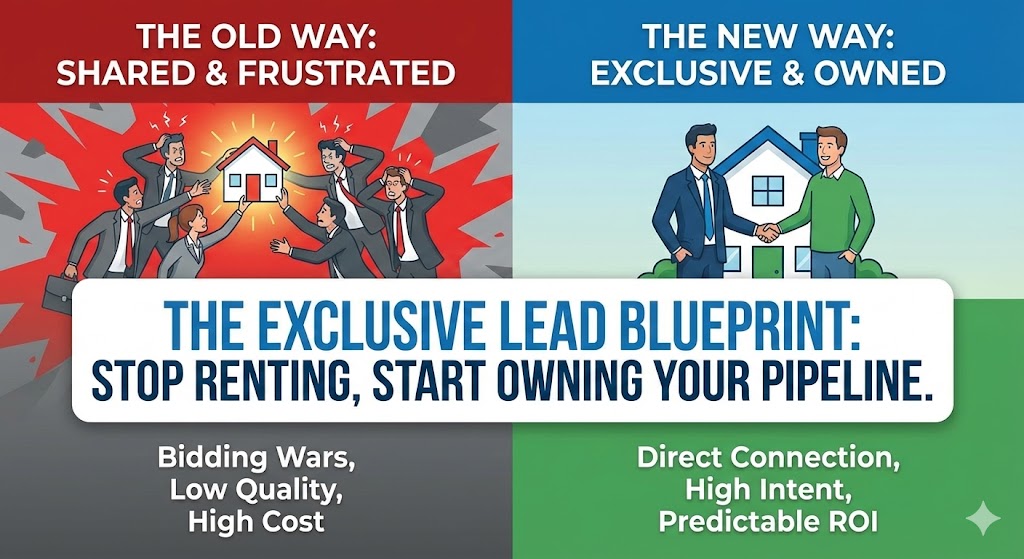
By running precision Google ads for solar leads, directing that traffic into a psychological calculator funnel, and backing it up with ruthless SMS automation, I help solar companies step off the hamster wheel. Stop looking at the cost of a click, and start looking at the cost to acquire a $35,000 contract.
Want Me to Build Your Solar Acquisition Engine?
Setting up high-converting landing pages, writing API webhooks for SMS automation, and managing complex Google bidding strategies is not what you should be doing. You should be running credit and signing contracts. I specialize in building end-to-end performance marketing funnels specifically for aggressive solar teams. Click below to book a Growth Strategy Call with me, and let’s map out your market domination.
- All Posts
- Knowledge Hub
Frequently Asked Questions
1. Aren't Google Ads for solar too expensive compared to buying shared leads?
A shared lead might cost you $40, but you will close 1 out of 50 (Cost to Acquire a Customer = $2,000) and waste 49 hours of your time. My Google Ad strategy might cost you $120 a click, but because the funnel filters for exclusivity and high-intent, you close 1 out of 3 leads. Google Ads are mathematically cheaper when you look at the final ROI.
2. Do I need a completely separate website for this funnel?
No, but you need a dedicated sub-domain (like quote.yoursolarcompany.com). I never send paid traffic to your main website. I build a standalone, lightning-fast funnel page designed for exactly one thing: getting the homeowner’s contact information.
3. How do you stop other solar companies from clicking my ads and wasting my budget?
This is a massive issue called “Click Fraud.” I use advanced 3rd-party IP blocking software integrated directly into my Google Ads builds. If a competitor or a bot farm clicks your ad more than once, my system permanently blocks their IP address from ever seeing your ads again.
4. Can I target specific zip codes based on credit scores or income?
Google recently restricted demographic targeting for housing and credit, but I get around this using “Proxy Targeting.” I analyze the data and restrict my ad campaigns to run only in zip codes that have a high average household income, high homeownership rates, and older roofs perfect for solar.
5. What if the homeowner doesn't answer the first automated text message?
My automation doesn’t stop after 60 seconds. If they don’t reply, the CRM puts them into an aggressive 14-day follow-up sequence. It drips out automated text messages, emails with case studies of local installs, and voicemails until they either book an appointment or tell us to stop.