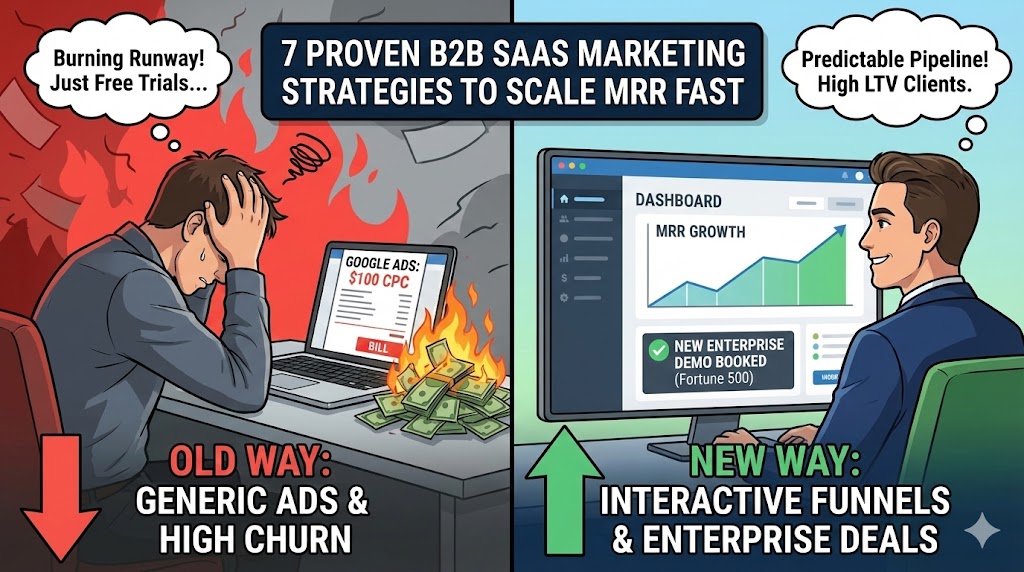
7 Proven B2B SaaS Marketing Strategies to Scale MRR Fast
By Deepak Jaiswal | Performance Marketing Specialist Reading Time: 12 Minutes
Let’s be completely honest about growing a software company today.
If you are a SaaS founder or a marketing director, you know that acquiring users is getting painfully expensive.
You are likely researching new B2B SaaS marketing strategies because your Customer Acquisition Cost (CAC) is completely out of control.
You are bidding on highly competitive software keywords on Google, paying $50 to $100 just for a single click.
Worse, the people clicking are often junior employees looking for a “free trial.”
They test your software for a week, never upgrade to a paid tier, and churn out entirely.
To build a $10M+ ARR (Annual Recurring Revenue) company, you cannot rely on low-intent free trials.
You need a system that targets decision-makers and books high-ticket enterprise demos predictably.
In this guide, I will share the most profitable B2B SaaS marketing strategies to help you scale your MRR without burning your runway.
Why Outdated B2B SaaS Marketing Strategies Burn Cash
The SaaS playbook from 2015 is completely dead.
Back then, you could write a few blog posts, run basic search ads, and watch the free trials roll in.
Today, buyers are overwhelmed with software choices. They ignore generic ads.
If your current B2B SaaS marketing strategies revolve around “Book a Demo” buttons pushed to cold audiences, you are wasting money.
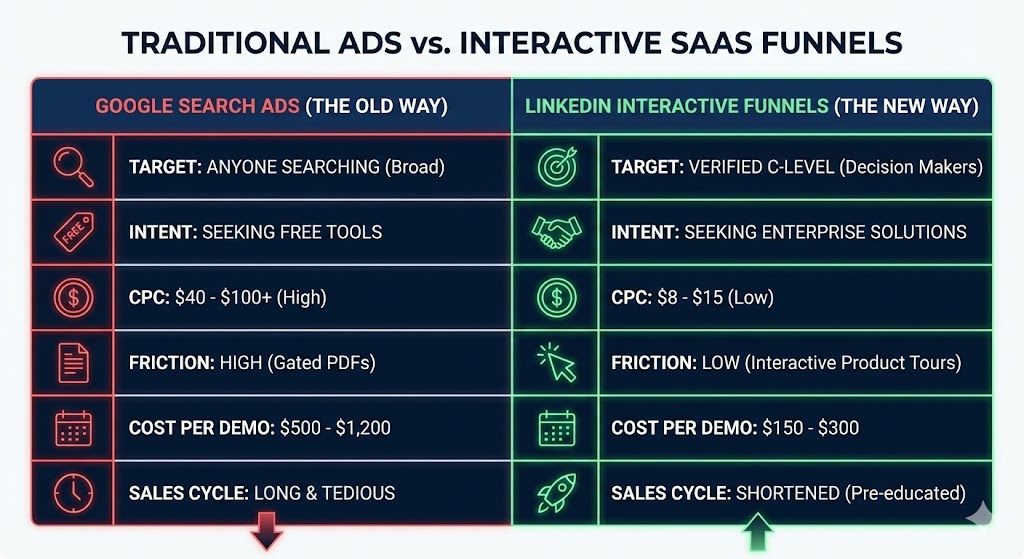
Let’s look at the actual math of traditional marketing versus an interactive funnel approach.
Data Table: Traditional Ads vs. Interactive SaaS Funnels
| Metric | Google Search Ads (The Old Way) | LinkedIn Interactive Funnels (The New Way) |
| Target Audience | Anyone searching the keyword | Verified C-Level Decision Makers |
| User Intent | Often seeking free tools | Seeking enterprise solutions |
| Cost Per Click (CPC) | $40 – $100+ | $8 – $15 |
| Friction Level | High (Forms gating boring PDFs) | Low (Interactive product tours) |
| Cost Per Demo | $500 – $1,200 | $150 – $300 |
| Sales Cycle | Long and tedious | Shortened by pre-education |
When you stop treating your buyers like numbers and start letting them experience your product, everything changes.
Top B2B SaaS Marketing Strategies for Enterprise Demos
Enterprise buyers do not want to talk to a sales rep until they actually understand what your software does.
If you want to lower your CAC, you must educate them before they book a call.
Here are the most effective B2B SaaS marketing strategies you can implement using LinkedIn and interactive funnels..
Strategy 1: The “Interactive Product Tour” Ad
Nobody wants to download another 30-page whitepaper.
Instead of gating a boring PDF, run LinkedIn ads that offer a “Clickable Product Tour.”
The Winning Creative Strategy:
The Platform: LinkedIn Ads (targeting specific job titles like VP of Operations or CTO).
The Hook: “Stop wasting 10 hours a week on manual data entry. See how [Your Software] automates the process in 3 clicks.”
The Offer: Do not ask them to book a demo. Ask them to take a 60-second interactive tour.
Using tools like Navattic or Walnut, you let the prospect click through a sandbox version of your software right from their browser.
According to recent data from Gartner on B2B Buying Behavior, modern B2B buyers spend only 17% of their journey meeting with potential suppliers. They want to self-educate first.
Step 2: The Technical Setup (DKIM, SPF, DMARC)
You cannot just buy a domain and start sending emails five minutes later. Google Workspace and Microsoft 365 will instantly reject your messages. You have to prove you are a real, authenticated sender.
This sounds incredibly nerdy, but you only have to set it up once. You need to add three specific text records to your domain’s DNS settings:
SPF (Sender Policy Framework): Tells the internet which servers are allowed to send emails on your behalf.
DKIM (DomainKeys Identified Mail): Adds a digital signature to your emails, proving they weren’t altered in transit.
DMARC (Domain-based Message Authentication): Tells receiving servers what to do if an email fails the SPF or DKIM checks.
If you do not have these three records perfectly configured, your B2B cold email lead generation campaign is over before it even begins. You will go straight to spam.
Implementing These B2B SaaS Marketing Strategies
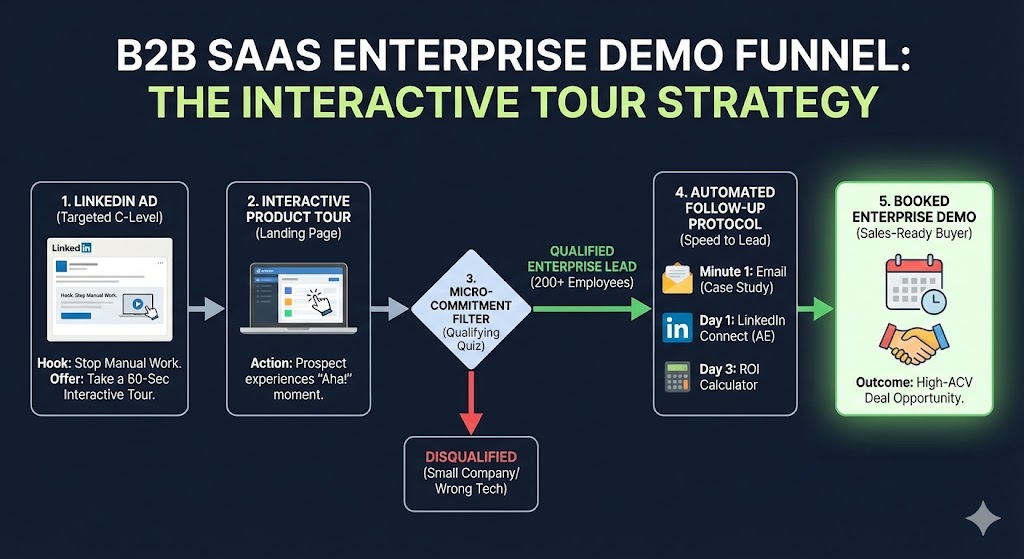
Once the prospect experiences the “Aha!” moment in your interactive tour, you need to capture them.
This is where your funnel mechanics become incredibly important.
The best B2B SaaS marketing strategies filter out the bad leads so your Account Executives (AEs) only talk to qualified buyers.
Strategy 2: The “Micro-Commitment” Qualifying Funnel
We do not want your sales team wasting time giving demos to companies with only 2 employees.
We use a simple qualifying form after the interactive tour to ensure they meet your criteria.
The Funnel Questions:
How many employees does your company currently have? (1-10, 11-50, 50-200, 200+).
What CRM are you currently using? (Salesforce, HubSpot, Other).
What is your biggest bottleneck right now?
If they select “1-10 employees” and your software is built for enterprises, the system automatically redirects them to a self-serve tier.
If they select “200+ employees,” they are tagged as a VIP Enterprise Lead and routed directly to a senior AE’s calendar.
We use this exact same qualification logic in our Wedding Venue Marketing Ideas Strategy. Whether you are filtering out low-budget weddings or small SaaS accounts, a smart funnel protects your sales team’s most valuable asset: their time.
Automating Your B2B SaaS Marketing Strategies for Speed
Generating the enterprise lead is only half the battle.
If your sales team takes 24 hours to reach out, that CTO has already moved on to a competitor.
Speed to lead is critical in the B2B tech space.
Strategy 3: The 5-Minute Follow-Up Protocol
You need an automated system that engages the prospect the moment they qualify themselves.
The 3-Step Automation Sequence:
Minute 1 (Email): “Hi [Name], great to see you exploring our interactive tour. Based on your company size, I have a specific case study showing how we helped a similar team save $50k a year. Can we chat tomorrow?”
Day 1 (LinkedIn Connection): The assigned Account Executive automatically sends a personalized connection request on LinkedIn.
Day 3 (The ROI Push): Send an automated “ROI Calculator” tool showing exactly how much money your software will save them in 6 months.
This sequence turns cold LinkedIn traffic into highly educated, eager enterprise buyers.
Conclusion: Stop Chasing Free Trials
The software companies that are dominating their niches are not outspending their rivals; they are outsmarting them.
If you continue to rely on generic search ads and boring whitepapers, you will always struggle with high churn.
By taking control of your buyer’s journey and implementing these B2B SaaS marketing strategies, you build a predictable revenue engine.
Stop begging for free trials. Start booking enterprise demos.
Ready to Scale Your SaaS MRR?
Designing interactive funnels, managing complex LinkedIn ad targeting, and setting up CRM automation is technical work.
You should be focused on building a better product, not fighting with ad pixels and lead routing.
I specialize in building demo-booking systems for high-growth SaaS and B2B tech companies.
Click the button below to book a free Strategy Call directly with my team today.
- All Posts
- Knowledge Hub
Frequently Asked Questions
1. Are LinkedIn Ads too expensive for B2B SaaS marketing strategies?
While the Cost Per Click (CPC) on LinkedIn is higher than Facebook, the lead quality is unmatched. Because you can target by exact Job Title, Company Size, and Industry, you eliminate wasted spend. A $100 lead on LinkedIn that turns into a $20,000 ACV (Annual Contract Value) client is a massive win.
2. Why shouldn't I just ask for a demo immediately?
Modern buyers are highly skeptical. Asking for a 45-minute demo from a cold ad is like asking someone to marry you on the first date. Interactive tours and calculators provide “value first,” which lowers friction and builds trust before the sales call.
3. How do I stop small companies from wasting my sales team's time?
This is where the “Micro-Commitment Funnel” comes in. By asking for company size or revenue before they can access the calendar link, you can automatically redirect unqualified leads to a recorded video demo or a self-serve checkout page, protecting your Account Executives’ time.
4. Should we still run Google Ads for our SaaS?
Yes, but only for “High-Intent” or “Competitor” keywords. For example, bidding on “Best CRM software” is too broad and expensive. Bidding on “[Competitor Name] alternative” is highly profitable because the buyer is already educated and looking to switch.
5. What is a good Cost Per Demo for B2B SaaS?
This entirely depends on your LTV (Lifetime Value). If your software costs $10,000 a year, spending $500 or even $1,000 to acquire a booked demo is a fantastic return on investment. Always measure your marketing success by pipeline generated, not just lead cost.