
Stop Selling "Discount Botox": 6 Plastic Surgery Marketing Strategies to Book $20k Procedures
By Deepak Jaiswal | Aesthetic Growth Expert Reading Time: 15 Minutes
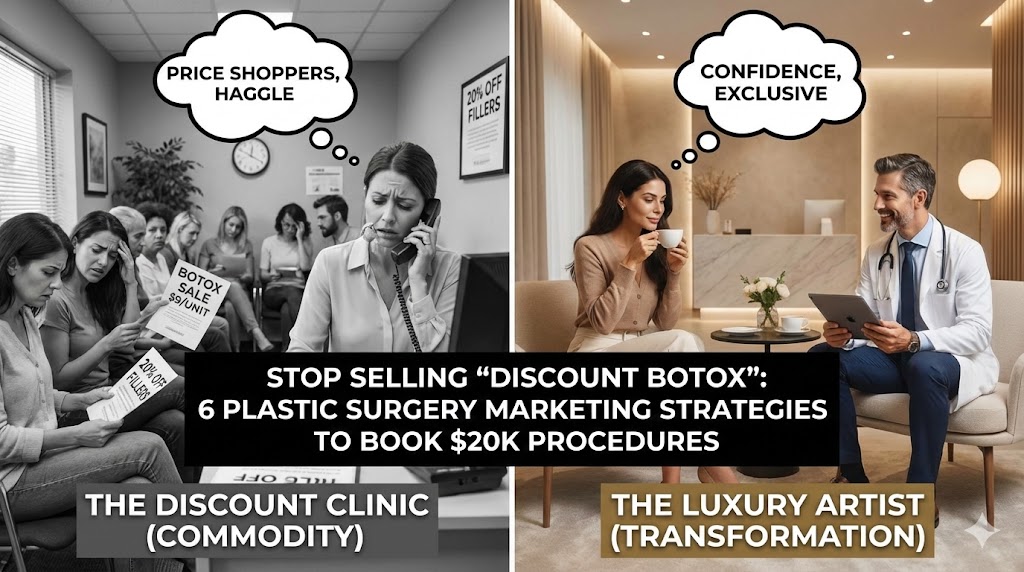
If you run a Plastic Surgery practice or a high-end MedSpa, you know the “Groupon Curse.”
You run an ad for a special offer. Your phone rings off the hook. But the people calling aren’t looking for a $15,000 Mommy Makeover. They are asking: “Do you match the price of the clinic down the street for Botox?”
You fill your waiting room with “bargain hunters.” Meanwhile, your competitor—who charges double what you charge—is fully booked with high-net-worth patients for surgeries.
Why? Because you are marketing “Commodities” (Injections, Lasers), while they are marketing “Transformation.”
In the world of aesthetics, patients do not buy “medical procedures.” They buy Confidence. They buy a new version of themselves. When you discount your services, you signal that you are a “commodity.” When you position yourself as an artist, price becomes irrelevant.
To fill your Operating Room (OR) with $20k surgeries instead of $300 injections, you need to elevate your brand. Here are 6 plastic surgery marketing strategies to stop competing on price and start dominating on prestige.
Strategy 1: The "Patient Journey" Gallery (Beyond Before & After)
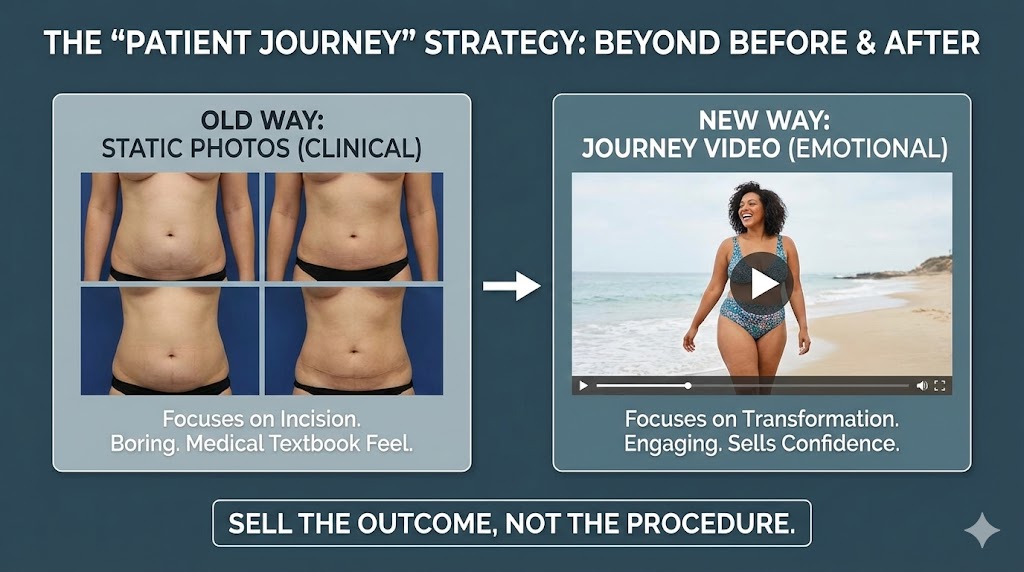
Every surgeon has a “Before & After” gallery on their website. Usually, it’s a grid of headless, clinical photos. It looks like a medical textbook. It’s necessary, but it’s boring.
The Strategy: Transform your gallery into “Patient Journeys.” Don’t just show the result. Show the person.
The Execution:
The Video: A 60-second cinematic video of the patient (fully clothed, looking glamorous) 6 months post-surgery.
The Story: “Sarah, 34. Mother of 2. Wanted to reclaim her pre-baby body. Now wears a bikini with confidence.”
The Result: Then show the clinical photos below.
The Psychology: When a potential patient sees a “headless torso,” they analyze the surgery. When they see “Sarah smiling,” they analyze the emotion. They think: “I want to feel like Sarah.” This is one of the most powerful plastic surgery marketing strategies because it sells the outcome, not the incision.
Your website needs to look like a fashion magazine, not a hospital. My Performance Marketing Services can redesign your gallery to be mobile-responsive and visually stunning.
Strategy 2: The "Price Barrier" Lead Magnet (Filtering Tires Kickers)
Surgeons are terrified of putting prices on their website. They think it will scare people away. So, they force people to call. The result? Your front desk spends 4 hours a day telling people “Rhinoplasty starts at $9,000,” only to hear “Oh, I only have $3,000.”
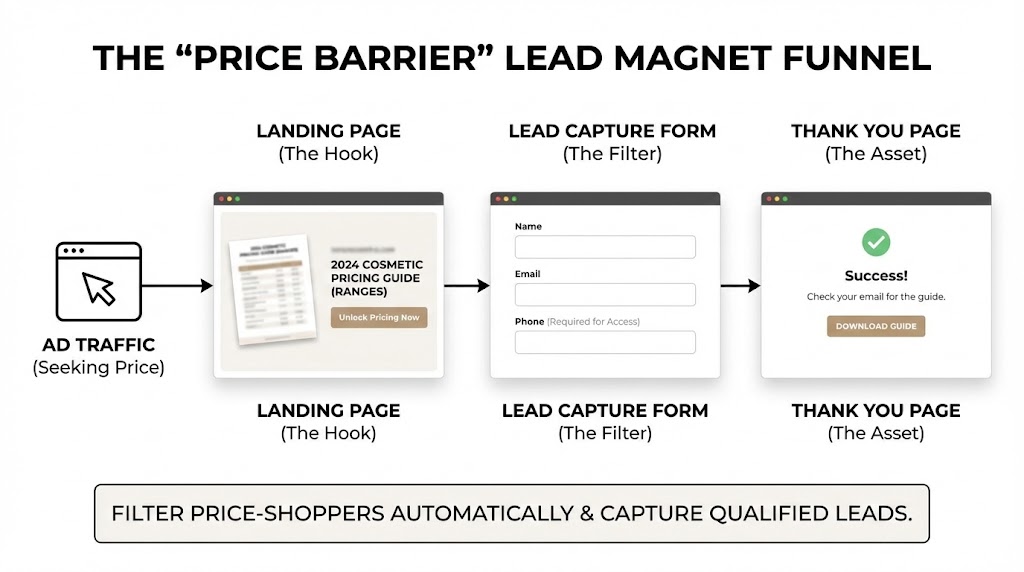
The Strategy: Use a “Procedure Pricing Guide” as a Lead Magnet.
The Funnel:
The Offer: “Download our 2024 Cosmetic Pricing Guide.”
The Content: Don’t give an exact number. Give a realistic range. “Rhinoplasty: $8,500 – $12,000.”
The Filter: To download it, they must give their Name, Email, and Phone Number.
Why this works: Anyone who downloads a pricing guide knows it’s expensive. If they call you after reading it, they are qualified. You just saved your staff hundreds of wasted hours. Effective plastic surgery marketing strategies should always filter leads before they reach your staff.
Strategy 3: The "Celebrity Lookalike" SEO (Search Intent)
Patients often don’t know medical terms. They know “Celebrity Features.” They search for “Bella Hadid nose job” or “Kim K butt lift.”
The Strategy: Build blog content and landing pages around these “Aspirational Keywords.”
The Content:
Blog Title: “How to Achieve the ‘Bella Hadid’ Look: A Guide to Refined Rhinoplasty.”
Blog Title: “The Science Behind the ‘Fox Eye’ Trend: Thread Lifts vs. Surgery.”
The SEO Benefit: You capture traffic from people who are researching the look, not just the surgery. By explaining the medical reality behind the celebrity trend, you position the surgeon as the expert who can translate “Hollywood trends” into “Medical reality.”
Ranking: Ranking for these trendy keywords requires rapid content creation.
Strategy 4: The "Surgeon as Influencer" (Social Authority)
In 2024, the surgeon is the brand. Patients want to know: “Is he scary? Is he nice? Does he have shaky hands?”
The Strategy: The surgeon must get on camera. But not just for surgery videos (which can get banned on TikTok/Instagram for gore). Do “Reaction Videos” and “Myth Busting.”
Format: The surgeon reacts to a viral “Botched” surgery video on TikTok. “Here is why that happened and how I would fix it.”
Format: “Q&A Coffee Talk.” The surgeon answers questions from comments while holding a coffee. Casual. Approachable.
The Result: You build Parasocial Relationships. When the patient finally comes in for a consult, they feel like they already know the surgeon. The trust barrier is gone. This is why “Personal Branding” is now central to all modern plastic surgery marketing strategies.
Video Production: You don’t need a film crew. You need a strategy. Our Social Media Marketing Services can plan your content calendar and edit your reels for maximum engagement.
Strategy 5: The "Recovery Diary" Email Sequence (Nurture)
The biggest fear patients have isn’t the surgery; it’s the Recovery. “Will it hurt? Will I be bruised? When can I go back to work?”
The Strategy: Create a detailed email course called “The 30-Day Recovery Roadmap.” Offer it to anyone who comes in for a consult (even if they don’t book yet).
The Content:
Day 1 Email: “What to expect immediately after waking up.”
Day 3 Email: “Why the swelling peaks today (and how to reduce it).”
Day 7 Email: “Reveal day! What your new nose really looks like.”
The Psychology: By giving them the roadmap before they buy, you remove the fear of the unknown. You are the only surgeon holding their hand before they even pay you. This level of care converts hesitant patients into booked surgeries.
Strategy 6: Google Ads for "Revision" Surgeries (High Ticket)
“Primary” surgeries are great. “Revision” surgeries (fixing someone else’s bad work) are expensive and desperate. Patients who need revisions are emotional and willing to pay anything to fix the mistake.
The Strategy: Run Google Ads targeting “Revision Keywords.”
Keywords: “Rhinoplasty revision specialist,” “Fix botched lipo,” “Breast implant removal and replacement.”
The Ad Copy:
“Not happy with your previous surgery? Dr. [Name] specializes in complex reconstructive revisions. Restore your confidence. Book a private assessment.”
The ROI: These cases are complex, so you can charge a 50% premium. You also gain a customer for life because you “saved” them. Targeting high-intent revision keywords is one of the most lucrative plastic surgery marketing strategies available.
Ad Management: These keywords are expensive. One wrong click can cost $20. My PPC Management Services ensure you only pay for clicks from serious patients, not researchers.
Conclusion: From "Clinic" to "Destination"
The aesthetic market is flooded with mediocrity. If you market like a discount clinic, you will attract discount patients.
But if you implement these plastic surgery marketing strategies—focusing on patient journeys, removing price friction, and building surgeon authority—you stop being a “choice.” You become a “Destination.”
Patients will fly across the country to see you, because you sold them the one thing they can’t get on Groupon: Trust.
Ready to Fill Your O.R. Schedule?
Stop wasting money on “Brand Awareness.” Let us build a “Patient Acquisition Engine” that books surgeries, not just consults.
- All Posts
- Knowledge Hub

Frequently Asked Questions
1. Can I show surgery videos on Facebook/Instagram Ads?
No. Meta (Facebook) has strict policies against “Graphic Content” and “Excessive Skin.” Your ads will be rejected or your account banned. Use Lifestyle Images (happy, confident women) in ads, and save the surgery videos for your organic feed or website where rules are looser.
2. How much should a plastic surgeon spend on marketing?
Established practices spend 10-15% of revenue on marketing. If you want to grow aggressively (or fill a new associate surgeon’s schedule), aim for 20%. A single $20k surgery pays for a month of ads, so the ROAS (Return on Ad Spend) is massive.
3. Is SEO better than Google Ads for surgeons?
You need both. Google Ads fills your schedule next week. SEO fills your schedule next year. SEO is vital for long-term authority, but it takes 6-12 months to rank for competitive terms like “Rhinoplasty [City].”
4. How do I handle bad reviews from unrealistic patients?
This is common in aesthetics. Use the “HIPAA Pivot.” Do not discuss their medical details in the reply.
Say: “Privacy laws prevent us from discussing specific cases publicly, but we take all feedback seriously. We strive for 5-star patient care. Please contact our practice manager directly at…” Then, bury it with 10 new positive reviews.
5. Should I use influencers?
Yes, but be careful. Don’t just pay a random influencer. Look for “Micro-Influencers” (10k-50k followers) in your local city who fit your demographic (e.g., “Fit Moms” or “Beauty Bloggers”). Offer them a treatment in exchange for a documented “Vlog” of their experience. Authentic vlogs convert better than staged photos.