
Top 7 Flaws in Your Solar EPC Marketing Strategy Costing You Megawatts
By Deepak Jaiswal | Construction Growth Expert Reading Time: 12 Minutes
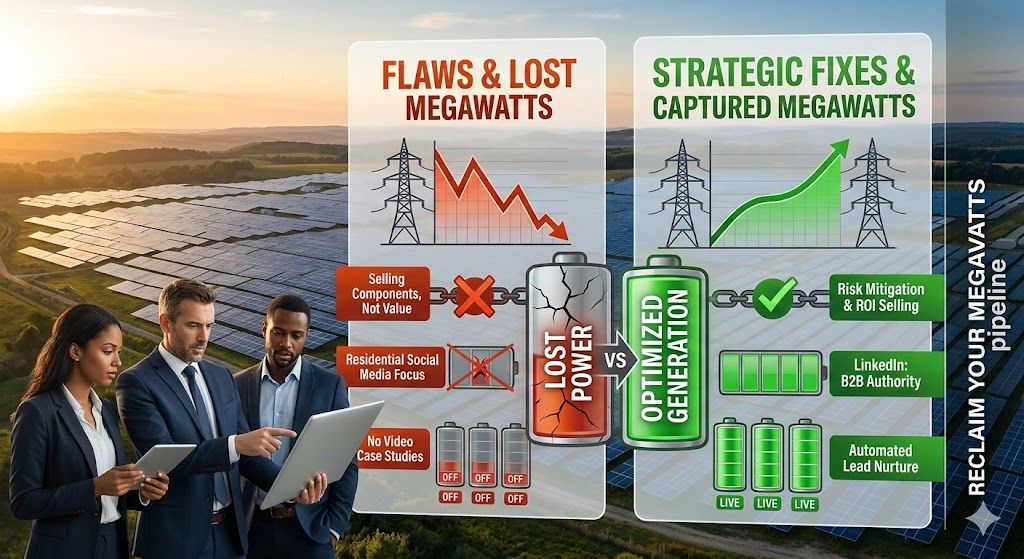
The global shift toward clean energy is an unprecedented gold rush for Solar Engineering, Procurement, and Construction (EPC) companies. Governments are setting ambitious net-zero goals, corporate mandates are demanding sustainability, and the leveled cost of solar energy continues to drop.
The demand is clearly there. So why isn’t your sales pipeline bursting with utility-scale projects and massive commercial rooftops?
The uncomfortable truth is that for many Solar EPCs, the weakness isn’t in their engineering, their supply chain, or their commissioning speed. It’s in their Solar EPC marketing.
In a high-stakes, B2B niche where a single deal can represent tens of millions of dollars and decades of commitment, “generic marketing” doesn’t work. Clients—whether they are IPPs, real estate developers, or industrial manufacturing giants—aren’t just buying panels; they are buying certainty, reliability, and long-term financial performance.
If your marketing strategy isn’t mirroring that level of sophistication, you are losing megawatts to your competitors every single day. Let’s dissect the top seven fatal flaws in modern Solar EPC marketing and how you can fix them.
Flaw #1: You Are Selling Components, Not Certainty
The Flaw: Your website, brochures, and pitches focus heavily on the wattage of your panels, the efficiency of your inverters, and the durability of your mounting structures. You are marketing like a components distributor, not a turnkey solutions provider.
Why It Costs You Megawatts: Your true clients (CFOs, Sustainability Officers, Investors) are technically literate, but they aren’t buying engineering specifications. They are buying a risk-mitigated cash flow. If your marketing highlights components, the client views you as a commodity, leading straight to price wars.
The Fix: Pivot your messaging from technical specs to risk mitigation and financial performance.
Don’t say: “We use Tier-1, 550W+ Bifacial Modules.”
Say: “Our asset management strategy ensures a guaranteed performance ratio of 98% for the first five years, mitigating your long-term operational risk.”
The Financial Impact of Optimized Marketing
| Metric | Generic Marketing (The Flaws) | Optimized B2B Strategy (The Fixes) |
| Monthly Commercial Leads | 5 – 10 | 35 – 50 |
| Lead-to-Meeting Rate | 2% | 18% |
| Sales Cycle Velocity | 12 – 18 Months | 6 – 9 Months |
| Average Project Size | 500 kW | 2 MW+ |
| Quarterly Revenue | $500,000 | $8,000,000+ |

Flaw #2: Relying on Residential-Style Social Media Tactics
The Flaw: You are spending significant time posting basic facts about “how solar works” or generic holiday greetings on Instagram and Facebook, treating your B2B enterprise like a local rooftop installer.
Why It Costs You Megawatts: Large-scale EPC deals are won on trust, complexity management, and financial modeling—not “likes.” Your ideal customer (e.g., a Facility Director at a logistics company) is not scouting for a multi-million dollar developer on their personal Facebook feed.
The Fix: Treat LinkedIn as your primary digital showroom. Share time-lapse footage of complex installations, post sustainability reports from completed projects, and create thought leadership articles on local permitting challenges.
Flaw #3: The Absence of "Extreme" Case Studies
The Flaw: Your “Portfolio” page is just a static list of project names, location, and total MW capacity. Maybe you have a two-paragraph testimonial.
Why It Costs You Megawatts: In large EPC projects, clients fear unexpected complications—land disputes, geological surprises, grid integration delays. Static text cannot convey how you handle chaotic reality. Clients need to see your problem-solving in action.
The Fix: Invest in professionally produced Video Case Studies that prioritize the challenge over the result.
The Challenge: “We had to build on a 30-degree slope with unstable soil.”
The Solution: Show drone footage of your unique mounting structure.
The Result: The client speaks on camera about your on-time delivery.
Flaw #4: Neglecting Local SEO for Regional Authority
The Flaw: You believe that because you take on utility-scale projects anywhere in the country, Local SEO doesn’t matter.
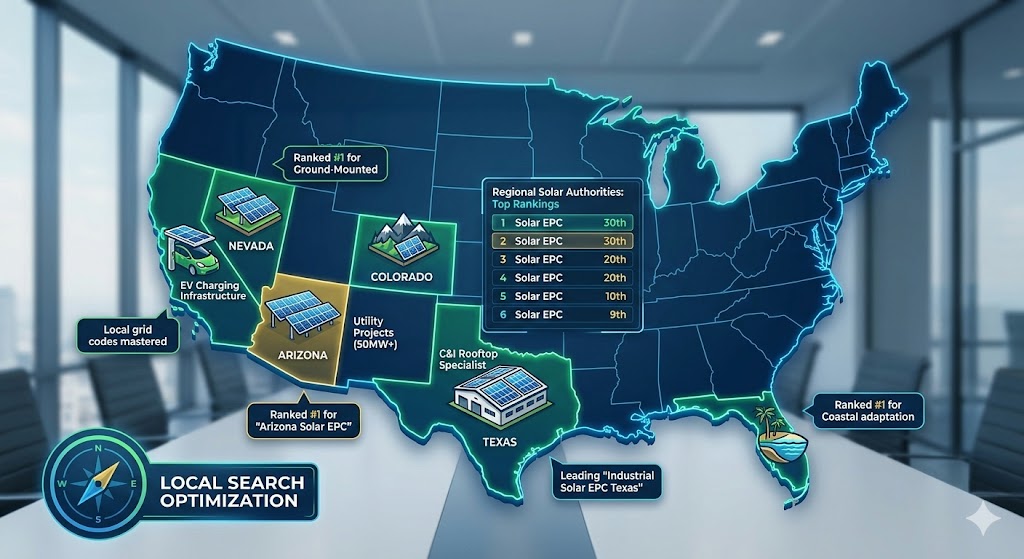
Why It Costs You Megawatts: B2B buyers often search regionally first (e.g., “Industrial Solar EPC company Texas”). They want partners who understand local grid codes, state-specific tax incentives, and local labor markets. If you don’t rank for regional high-intent keywords, you are invisible to pre-qualified traffic.
The Fix: Optimize your Google Business Profile (GBP) and website for regional cluster topics. Create region-specific service pages like “Solar EPC Solutions for Arizona Manufacturing Plants.”
Flaw #5: Weak or Inexistent "Lead Magnets" for Commercial Buyers
The Flaw: Your website’s only Call-to-Action (CTA) is “Contact Us” or “Get a Quote.”
Why It Costs You Megawatts: Large-scale buyers are at the top or middle of the funnel for months, sometimes years. “Contact Us” is too high friction. By failing to offer value early, you fail to capture their contact information and lose the chance to nurture the relationship.
The Fix: Create data-driven Lead Magnets tailored for stakeholders.
For CFOs: A whitepaper on “The Impact of Solar Depreciation on Corporate Tax Liability.”
For Developers: “Feasibility Checklist for Open-Access Ground-Mounted Projects.”
Flaw #6: No Automated Nurture Funnel After Initial Interest
The best leads are neighbors. If you are renovating a house in a wealthy zip code, every neighbor is watching.
Don’t just stick a sign in the yard. Take over the street.
The Strategy:
The “Dust Letter”: Before you start, hand-deliver a nice letter (with a Starbucks card) to the 5 closest neighbors.
Script: “Hi, we are working on the Smith’s house next door. We will be making some noise/dust. Here is my personal cell number. If our trucks block your driveway or the noise is too much, call me directly and I will fix it instantly. Lunch is on us for the trouble.”
The Result: You just proved you are conscientious and professional.
The Upsell: When the project is done, invite those same neighbors to an “Open House” (with the client’s permission) to see the transformation.
This turns one $100k job into three $100k jobs in the same neighborhood, reducing your travel time and increasing your profit.

Flaw #7: Ignoring Performance Monitoring Data in Your Marketing
The Flaw: You build the plant, commission it, and hand it over. Your marketing team never gets access to the actual generation data to use as proof.
Why It Costs You Megawatts: You are missing your most powerful marketing tool. The client’s biggest fear is that the plant won’t perform “as promised on paper.” By failing to show real-time or historical generation data, you are asking them to take your engineering modeling on faith.
The Fix: Integrate your O&M Data into your sales collateral. Show anonymized screenshots of your performance monitoring dashboard from active projects, highlighting metrics like “Actual Generation vs. Predicted Generation.”
Conclusion: Don't Let Poor Marketing Drain Your Capacity
The technical brilliance required to build a utility-scale solar plant is immense. But if your Solar EPC marketing looks generic, weak, or tailored for residential customers, you are signaling to stakeholders that you lack the sophistication to manage their high-value asset.
Correcting these seven flaws won’t happen overnight, but prioritizing them is essential to stop the bleed. Fix your messaging, prove your resilience through video, nurture your leads automatically, and use your own generation data as proof.
Don’t just engineer megawatts—market them effectively.
Ready to Scale Your Solar EPC Pipeline?
Stop losing high-ticket commercial projects to competitors with better marketing. If you want to build a data-driven, B2B marketing engine that generates qualified utility-scale leads on autopilot, we can help.
- All Posts
- Knowledge Hub

Frequently Asked Questions
1. What is the difference between standard solar marketing and Solar EPC marketing?
Standard solar marketing often targets B2C residential homeowners focusing on energy bills and basic environmental benefits. Solar EPC marketing is strictly B2B, targeting C-level executives and focusing on risk mitigation, ROI, tax benefits, and large-scale project management.
2. Which social media platform is best for Solar EPC companies?
LinkedIn is the undisputed champion for B2B Solar EPC marketing. It allows you to target specific job titles (Facility Managers, CFOs, Sustainability Directors) and share in-depth case studies and thought leadership content.
3. How long does it take to see ROI from a B2B solar marketing strategy?
Because the sales cycle for utility and commercial solar projects can range from 6 to 18 months, your marketing ROI will follow a similar timeline. However, you should see an increase in qualified lead generation and pipeline velocity within the first 3 to 6 months of implementing a targeted strategy.
4. Why is 'Certainty' more important than 'Price' in Solar EPC marketing?
At the megawatt scale, a 1% drop in performance or a month’s delay in grid connectivity can cost millions. Large-scale clients will almost always choose a developer who proves reliability and risk management over the one who just offers the lowest price.
5. How often should we update our project case studies?
Ideally, you should add a new case study for every major project milestone. For marketing purposes, aim for at least one “Deep Dive” video case study per quarter to keep your authority fresh and show active movement in the market.