Commercial roofing marketing strategy

Home Services Performance Marketing Social Media Ads Google Ads Facebook Ads Pay Per Click Ads About Me Knowledge Hub Home Services Performance Marketing Social Media Ads Google Ads Facebook Ads Pay Per Click Ads About Me Knowledge Hub Book A Discovery Call Stop Chasing “Leaks”: 5 Commercial Roofing Marketing Strategies to Land $500k Contracts By Deepak Jaiswal | Industrial Growth Strategist Reading Time: 15 Minutes If you own a Commercial Roofing company, you know the pain of the “Residential Rat Race.” You see your competitors chasing hail storms, knocking on doors, and fighting with insurance adjusters over a $15,000 shingle roof. Meanwhile, you drive past a massive Amazon distribution center or a shopping mall. You look at that 500,000 sq. ft. flat roof and think: “That one job would be worth $2 Million. That one job would change my life.” But you can’t just knock on the door of an Amazon warehouse. The Property Manager is busy. The Facility Director is behind a gatekeeper. They don’t look at “Door Hangers.” They look at Capital Expenditure (CapEx) Budgets. To win in the big leagues, you have to stop marketing like a “Repairman” and start marketing like an “Asset Manager.” A residential homeowner buys a roof because they have to (it’s leaking on their couch). A commercial owner buys a roof because it makes financial sense (Tax write-offs, energy savings, asset value). In this guide, we are ditching the “Free Inspection” flyers. We are deploying a 5-Phase Industrial Attack Plan designed to bypass the gatekeepers and land the $500k+ contracts that legitimate commercial roofers deserve. Phase 1: The “LinkedIn Sniper” Campaign (Targeting Property Managers) Residential roofers use Facebook. Commercial roofers use LinkedIn. The decision-maker (Facility Manager or Property Manager) is on LinkedIn every day. The Diagnostic: Most roofers send connection requests saying: “We do TPO roofing. Need a quote?” Block. Delete. The Blueprint Execution: You need to target the “Pain of Management.” Property Managers hate surprise leaks because their tenants scream at them. The Strategy: Search Filter: Target “Property Manager” + “Industrial” in [Your City]. The Connection Note: “Hi [Name], I’m researching industrial roof lifespans in [City]. I’m not selling anything, just building a report on how local weather impacts TPO vs. EPDM. Open to connecting?” The Content: Don’t post pictures of roofs. Post pictures of “Disasters Averted.” Caption: “This warehouse saved $100k in inventory damage because we caught a seam failure 2 weeks before the storm. Here is what a failing seam looks like…” Why this works: You position yourself as a “Risk Mitigator.” When the roof actually leaks, you are the only expert in their inbox. This is the highest-ROI tactic in commercial roofing marketing. B2B Authority: Writing LinkedIn content that sounds professional (not salesy) is an art. My Social Media Marketing Services can manage your profile to turn it into a lead-generation machine. Phase 2: The “Weather-Triggered” Geo-Fencing (Timing is Everything) Commercial roofs are tough, but they aren’t invincible. When a massive storm hits an industrial park, every Property Manager panics. The Diagnostic: You wait for them to call you. But they call the first number on Google. The Blueprint Execution: Use “Weather-Triggered” Programmatic Ads. Set up a campaign that only turns on when: Hail is detected > 1 inch. Wind speeds exceed 60 mph. Target location is an Industrial Park (Geo-Fence). The Ad Copy: “Storm Alert at [Industrial Park Name]. Your TPO roof may have sustained micro-fractures. Document the damage now for your insurance claim. Download the Commercial Inspection Checklist.” The Result: You aren’t “ambulance chasing.” You are providing a tool (The Checklist) right when they are worried. You capture the lead before the leak even starts dripping. Ad Tech: Setting up weather APIs to trigger ads requires advanced configuration. Our PPC Management Services can build this automated “Storm Response” system for you. Phase 3: The “CapEx Budget” Calculator (The Financial Sell) Commercial owners speak the language of ROI and Taxes. They love “Restoration” (Coatings) because it can be written off as “Maintenance” in 1 year, whereas a “Replacement” must be depreciated over 39 years. The Diagnostic: Your website just says “We do Silicone Coatings.” It doesn’t explain the money. The Blueprint Execution: Build a “Roof Restoration Tax Savings Calculator” on your site. How it works: Input: Roof Size (sq ft) + Estimated Replacement Cost. Output: “You save $50,000 in taxes this year by restoring instead of replacing.” The Psychology: Now you aren’t selling a bucket of white paint. You are selling a Tax Strategy. CFOs and Building Owners will love you. This shifts the conversation from “Cost” to “Savings.” Phase 4: The “Video Inspection” Trust Protocol (Transparency) The biggest fear of a Property Manager is being ripped off. They can’t climb a 40-foot ladder to check your work. They have to trust you. And they don’t trust contractors. The Diagnostic: You give them a paper quote with some blurry photos. It looks like a guess. The Blueprint Execution: Deliver a “Drone & GoPro Video Inspection.” The Drone: Fly over the entire warehouse to show the scale and drainage issues. The GoPro: Your estimator wears a camera. He walks the roof. He points at the crack. He peels back the wet insulation. “See this? This is water trapped under the membrane.” The Deliverable: Send them a 3-minute edited video link: “Inspection Report for [Building Address].” When they forward this video to the Building Owner (who lives in another state), the Owner sees the problem with their own eyes. The check gets signed immediately. Video Marketing: You don’t need a film crew. You just need a process. My Facebook Marketing Services can edit these raw clips into professional branded reports that close deals. Phase 5: The “Industrial Park” SEO Silos (Local Dominance) You don’t want to rank for “Roofer in [City].” That brings in homeowners. You want to rank for the places where the big roofs are. The Diagnostic: Your SEO is too broad. You are catching “shingle” leads. The Blueprint Execution: Create specific landing pages for the major Industrial Parks and
Luxury travel marketing strategies

Home Services Performance Marketing Social Media Ads Google Ads Facebook Ads Pay Per Click Ads About Me Knowledge Hub Home Services Performance Marketing Social Media Ads Google Ads Facebook Ads Pay Per Click Ads About Me Knowledge Hub Book A Discovery Call Stop Selling “Tickets”: The 5-Pillar Blueprint for Luxury Travel Marketing Strategies By Deepak Jaiswal | Travel Industry Growth Expert Reading Time: 15 Minutes If you run a Luxury Travel Agency or a Boutique Tour Operator business, you are fighting a war against giants. You have a potential client on the phone. You spend 3 hours crafting a custom itinerary for their honeymoon in Bali. They love it. They say, “Wow, this is amazing!” Then, they go silent. A week later, you find out they took your itinerary and booked it themselves on Booking.com to save $500. You feel used. You feel like a free “Trip Advisor.” The problem isn’t your itinerary. The problem is that you are competing on “Logistics” (Flights + Hotels). In the age of Expedia, logistics are a commodity. A billionaire can book a First Class seat on their iPhone in 30 seconds. They don’t need you for that. They need you for “Access” and “The Un-Googleable.” To survive and thrive in 2024, you must stop selling “Trips” and start selling “Transformations.” You need to market to the High-Net-Worth Individual (HNI) who values their time more than their money. In this guide, we are moving beyond generic “post pretty photos” advice. We will break down the 5-Pillar Blueprint of elite luxury travel marketing strategies that will position you as the “Gatekeeper of Dreams.” Pillar 1: The “Bucket List” SEO Strategy (Capture the Dream Phase) Most travel agents try to rank for “Travel Agent in [City].” That is a low-volume, boring keyword. Wealthy travelers don’t search for agents. They search for Experiences. The Strategy: You need to capture them when they are lying in bed at night, dreaming. Build “Destination Guides” that answer specific, high-end questions. Target Keywords: “Best private island resorts in Maldives for privacy” “Luxury African safari with private butler cost” “How to rent a private villa in Tuscany with a chef” The Content: Write a 2,000-word guide titled: “The Insider’s Guide to the Top 5 Private Islands in the Maldives (That You Can’t Find on Expedia).” The Hook: Explain that the best villas are never listed on public sites. The Gate: “To get the ‘Owner’s Rate’ and VIP amenities, download our exclusive brochure.” Why this works: You are intercepting their search before they even know they need an agent. You become the expert who knows the secrets. This is one of the most organic luxury travel marketing strategies because it attracts people with high intent and high budgets. SEO Authority: Ranking for these competitive keywords requires a robust content silo. Our Performance Marketing Services can help you build these “Dream Clusters” that dominate search results. Pillar 2: The “Influencer-Led” Group Trip (The Trust Hack) People don’t trust brands; they trust people. If you try to sell a $10,000 Yoga Retreat, it’s hard. But if a famous Yoga Instructor sells it, it sells out in minutes. The Strategy: Don’t market the trip yourself. Partner with a Micro-Influencer (10k-50k followers) who fits your niche. The Niche: A Food Blogger, a Photographer, or a Wellness Guru. The Offer: “Join [Influencer Name] for 7 Days in Tuscany: A Culinary Masterclass.” The Execution: You handle the logistics (flights, hotels, transfers). The Influencer handles the Marketing. They post to their loyal fans: “Guys, I’m hosting a trip! Who wants to come with me?” You instantly get 15-20 high-paying clients who are desperate to travel with their idol. The Math: 20 People x $5,000 Profit = $100,000 Revenue in one week. You pay the influencer a free trip + commission. This is the fastest way to generate cash flow without spending a dime on ads. Pillar 3: The “Visual Storytelling” Ad Funnel (Stopping the Scroll) Travel is 100% visual. But most agents run ads with a generic stock photo of a beach and say “Book Now.” That is lazy. It blends in. The Strategy: Use “immersive Video Ads” on Instagram and Facebook (Meta). You are selling a feeling. The Creative: Don’t Show: An empty hotel room. Do Show: A couple clinking champagne glasses in a private jacuzzi at sunset. A child’s face lighting up when they see a giraffe. The Copy: “Don’t just go on vacation. Go on an adventure your kids will talk about for 20 years. Private Safari. No crowds. Just you and the wild.” The Retargeting: This is crucial. People don’t book a $20k trip on the first click. Run a Retargeting Ad to anyone who watched 50% of the video. Ad 2: “Still dreaming of Africa? Download our Sample Itinerary to see what a 7-day luxury safari looks like.” Ad Management: Managing video funnels requires technical skill to track “Video Views” and build custom audiences. My PPC Management Services can set up this “Dream-to-Booking” pipeline for you. Pillar 4: The “Un-Googleable” Experience (The USP) If a client asks, “Can I book this myself?” and the answer is “Yes,” you are dead. Your value proposition must be Exclusivity. The Strategy: Market “Access,” not “Inventory.” Your marketing materials should highlight things money can’t buy (without connections). Examples: “Private after-hours tour of the Vatican Museum (No crowds).” “Dinner in the home of a Michelin-star chef in Paris.” “Meet-and-greet with a baby elephant rescue team in Kenya.” The Messaging: “Google can give you a flight ticket. We can give you the keys to the Vatican.” Why this works: This destroys the “Price Shopper.” You can’t price-shop an experience that isn’t listed on Expedia. It forces the HNI client to go through you. This is the cornerstone of all successful luxury travel marketing strategies. Pillar 5: The “Welcome Home” Referral Loop (Lifetime Value) The sale doesn’t end when they get on the plane. It ends when they get back home. Most agents send a “Thank You” email. That’s weak. The Strategy: Create
Plastic surgery marketing strategies

Home Services Performance Marketing Social Media Ads Google Ads Facebook Ads Pay Per Click Ads About Me Knowledge Hub Home Services Performance Marketing Social Media Ads Google Ads Facebook Ads Pay Per Click Ads About Me Knowledge Hub Book A Discovery Call Stop Selling “Discount Botox”: 6 Plastic Surgery Marketing Strategies to Book $20k Procedures By Deepak Jaiswal | Aesthetic Growth Expert Reading Time: 15 Minutes If you run a Plastic Surgery practice or a high-end MedSpa, you know the “Groupon Curse.” You run an ad for a special offer. Your phone rings off the hook. But the people calling aren’t looking for a $15,000 Mommy Makeover. They are asking: “Do you match the price of the clinic down the street for Botox?” You fill your waiting room with “bargain hunters.” Meanwhile, your competitor—who charges double what you charge—is fully booked with high-net-worth patients for surgeries. Why? Because you are marketing “Commodities” (Injections, Lasers), while they are marketing “Transformation.” In the world of aesthetics, patients do not buy “medical procedures.” They buy Confidence. They buy a new version of themselves. When you discount your services, you signal that you are a “commodity.” When you position yourself as an artist, price becomes irrelevant. To fill your Operating Room (OR) with $20k surgeries instead of $300 injections, you need to elevate your brand. Here are 6 plastic surgery marketing strategies to stop competing on price and start dominating on prestige. Strategy 1: The “Patient Journey” Gallery (Beyond Before & After) Every surgeon has a “Before & After” gallery on their website. Usually, it’s a grid of headless, clinical photos. It looks like a medical textbook. It’s necessary, but it’s boring. The Strategy: Transform your gallery into “Patient Journeys.” Don’t just show the result. Show the person. The Execution: The Video: A 60-second cinematic video of the patient (fully clothed, looking glamorous) 6 months post-surgery. The Story: “Sarah, 34. Mother of 2. Wanted to reclaim her pre-baby body. Now wears a bikini with confidence.” The Result: Then show the clinical photos below. The Psychology: When a potential patient sees a “headless torso,” they analyze the surgery. When they see “Sarah smiling,” they analyze the emotion. They think: “I want to feel like Sarah.” This is one of the most powerful plastic surgery marketing strategies because it sells the outcome, not the incision. Your website needs to look like a fashion magazine, not a hospital. My Performance Marketing Services can redesign your gallery to be mobile-responsive and visually stunning. Strategy 2: The “Price Barrier” Lead Magnet (Filtering Tires Kickers) Surgeons are terrified of putting prices on their website. They think it will scare people away. So, they force people to call. The result? Your front desk spends 4 hours a day telling people “Rhinoplasty starts at $9,000,” only to hear “Oh, I only have $3,000.” The Strategy: Use a “Procedure Pricing Guide” as a Lead Magnet. The Funnel: The Offer: “Download our 2024 Cosmetic Pricing Guide.” The Content: Don’t give an exact number. Give a realistic range. “Rhinoplasty: $8,500 – $12,000.” The Filter: To download it, they must give their Name, Email, and Phone Number. Why this works: Anyone who downloads a pricing guide knows it’s expensive. If they call you after reading it, they are qualified. You just saved your staff hundreds of wasted hours. Effective plastic surgery marketing strategies should always filter leads before they reach your staff. Strategy 3: The “Celebrity Lookalike” SEO (Search Intent) Patients often don’t know medical terms. They know “Celebrity Features.” They search for “Bella Hadid nose job” or “Kim K butt lift.” The Strategy: Build blog content and landing pages around these “Aspirational Keywords.” The Content: Blog Title: “How to Achieve the ‘Bella Hadid’ Look: A Guide to Refined Rhinoplasty.” Blog Title: “The Science Behind the ‘Fox Eye’ Trend: Thread Lifts vs. Surgery.” The SEO Benefit: You capture traffic from people who are researching the look, not just the surgery. By explaining the medical reality behind the celebrity trend, you position the surgeon as the expert who can translate “Hollywood trends” into “Medical reality.” Ranking: Ranking for these trendy keywords requires rapid content creation. Strategy 4: The “Surgeon as Influencer” (Social Authority) In 2024, the surgeon is the brand. Patients want to know: “Is he scary? Is he nice? Does he have shaky hands?” The Strategy: The surgeon must get on camera. But not just for surgery videos (which can get banned on TikTok/Instagram for gore). Do “Reaction Videos” and “Myth Busting.” Format: The surgeon reacts to a viral “Botched” surgery video on TikTok. “Here is why that happened and how I would fix it.” Format: “Q&A Coffee Talk.” The surgeon answers questions from comments while holding a coffee. Casual. Approachable. The Result: You build Parasocial Relationships. When the patient finally comes in for a consult, they feel like they already know the surgeon. The trust barrier is gone. This is why “Personal Branding” is now central to all modern plastic surgery marketing strategies. Video Production: You don’t need a film crew. You need a strategy. Our Social Media Marketing Services can plan your content calendar and edit your reels for maximum engagement. Strategy 5: The “Recovery Diary” Email Sequence (Nurture) The biggest fear patients have isn’t the surgery; it’s the Recovery. “Will it hurt? Will I be bruised? When can I go back to work?” The Strategy: Create a detailed email course called “The 30-Day Recovery Roadmap.” Offer it to anyone who comes in for a consult (even if they don’t book yet). The Content: Day 1 Email: “What to expect immediately after waking up.” Day 3 Email: “Why the swelling peaks today (and how to reduce it).” Day 7 Email: “Reveal day! What your new nose really looks like.” The Psychology: By giving them the roadmap before they buy, you remove the fear of the unknown. You are the only surgeon holding their hand before they even pay you. This level of care converts hesitant patients into booked surgeries. Strategy 6: Google Ads for “Revision”
Senior living marketing strategies
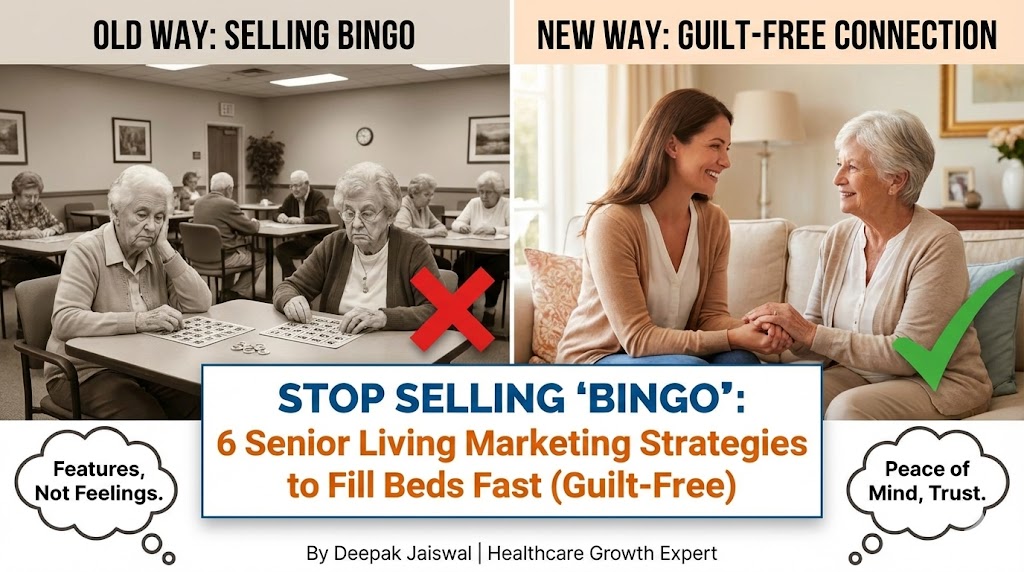
Home Services Performance Marketing Social Media Ads Google Ads Facebook Ads Pay Per Click Ads About Me Knowledge Hub Home Services Performance Marketing Social Media Ads Google Ads Facebook Ads Pay Per Click Ads About Me Knowledge Hub Book A Discovery Call Stop Selling “Bingo”: 6 Senior Living Marketing Strategies to Fill Beds Fast (Guilt-Free) By Deepak Jaiswal | Healthcare Growth Expert Reading Time: 15 Minutes If you are a Community Relations Director or Owner of a Senior Living facility, you know the “Tour Trap.” A daughter (let’s call her Sarah) walks in. She looks exhausted. She has been taking care of her mom for 2 years. She is burnt out. You show her the dining room. You show her the activity calendar (Bingo! Movie Night!). You show her the beautiful lobby. She nods, says “It’s beautiful,” and leaves. Then she ghosts you. Why? Because you were selling “Lifestyle,” but Sarah is buying “Relief.” Sarah feels terrible guilt about “putting mom in a home.” When you show her happy seniors playing Bingo, she doesn’t feel excited; she feels a disconnect. She is worried about: Will mom be safe? Will she hate me? Is the food edible? To fill your beds and increase occupancy to 100%, you need to stop marketing your facility like a Resort and start marketing it like a Support System. Here are 6 senior living marketing strategies to shift your message from “Features” to “Feelings” and close more families. Strategy 1: The “Caregiver Burnout” Funnel (Targeting the Adult Child) Your customer is rarely the senior. It is the adult daughter (age 45-65). She isn’t Googling “Fun places for mom.” She is Googling “Caregiver stress” or “Signs of dementia.” The Strategy: Create a Lead Magnet specifically for Her Pain. Don’t Offer: “Brochure of our Facility.” Do Offer: “The Caregiver’s Survival Guide: How to Tell Mom It’s Time (Without The Guilt).” The Funnel: Run Facebook Ads targeting women aged 45-60 with interests in “AARP” or “Alzheimer’s Association.” Ad Copy: “Exhausted from caring for a loved one? You can’t pour from an empty cup. Download our guide on spotting the 5 signs of Caregiver Burnout.” When she downloads this, she trusts you. You aren’t selling a room; you are validating her struggle. Pro Tip: Building an empathetic funnel requires delicate copywriting. Our Digital Marketing Services specialize in creating “Empathy-First” guides that convert distressed traffic into leads. Strategy 2: The “Cost of Care” Comparison Calculator The elephant in the room is Price. Families see “$5,000/month” and panic. They think: “I can keep mom at home for free.” But keeping mom at home isn’t free. It costs groceries, utilities, home modifications, and lost wages for the daughter. The Strategy: Build a “Home vs. Community Cost Calculator” on your website. How it works: Column A (Home): Mortgage + Utilities + Property Tax + Food + Home Health Aide ($25/hr) + Home Maintenance. Column B (Your Facility): Rent (All Inclusive). The Result: Often, the calculator shows that living at home costs $4,500/month, while your facility is $5,000. Suddenly, the gap isn’t “Expensive.” It is just a $500 difference for 24/7 safety and meals. You used logic to defeat the price objection. Strategy 3: “Staff Spotlight” Videos (Selling Trust) Families don’t care about your chandeliers or your furniture. They care about “Who is wiping Mom’s chin?” They are terrified of neglect. The Strategy: Stop posting photos of empty rooms. Start posting videos of your Caregivers (CNAs) and Nurses. Video Topic: Interview your Head Nurse about “Why I love working with dementia patients.” Video Topic: A candid clip of a caregiver singing to a resident (with permission). The Psychology: When Sarah sees a caregiver who is kind, patient, and smiling, her anxiety drops. She thinks: “Okay, these people actually care.” Trust is the currency of this industry. Distribution: These videos perform exceptionally well on Facebook and Instagram. Our Social Media Marketing Services can help you produce and target these “Trust Signals” to local families. Strategy 4: The “Speed to Lead” SMS System Senior Living is often a Crisis Purchase. Mom fell. Dad wandered off. The family needs a solution today. If they fill out a form on your site and you call them back 24 hours later, you have lost them. They have already toured your competitor. The Strategy: Implement an Instant SMS Auto-Responder. Trigger: Form filled on website. SMS (1 min later): “Hi [Name], this is [Director Name] from [Facility]. I saw your inquiry. I know this is a stressful time. I am free for a quick chat right now, or I can send you our pricing guide. What do you prefer?” Why this works: You acknowledge the stress immediately. By being the first to reply with empathy, you usually win the tour. Strategy 5: Reputation Management (The “Google Shield”) One bad review about “bad food” or “rude staff” can destroy your occupancy for months. Families read every single review. The Strategy: Don’t just wait for reviews. Orchestrate them. Who to ask: Don’t ask the residents (they might not be tech-savvy). Ask the Adult Children. When to ask: 30 days after move-in. The family is usually relieved that the transition is over. The Script: “Hi Sarah, now that Mom is settled, I wanted to check in. If you feel she is safe here, would you mind leaving a review? It helps other families who are struggling with this decision find us.” Reputation is Revenue: A 4.8-star rating allows you to charge premium rates. Our [Reputation Management Services] can automate this request process so you never miss a 5-star opportunity. Strategy 6: “Local SEO” for Specific Conditions Most facilities try to rank for “Senior Living [City].” But families often search by Condition. The Strategy: Create dedicated landing pages for specific needs: “Memory Care for Alzheimer’s in [City]” “Parkinson’s Care Facility in [City]” “Short-Term Respite Care for Seniors in [City]” The SEO Benefit: These are lower volume keywords, but Extremely High Intent. If someone searches “Respite care for post-surgery,” they need a bed now. By answering that specific
Franchise marketing strategies
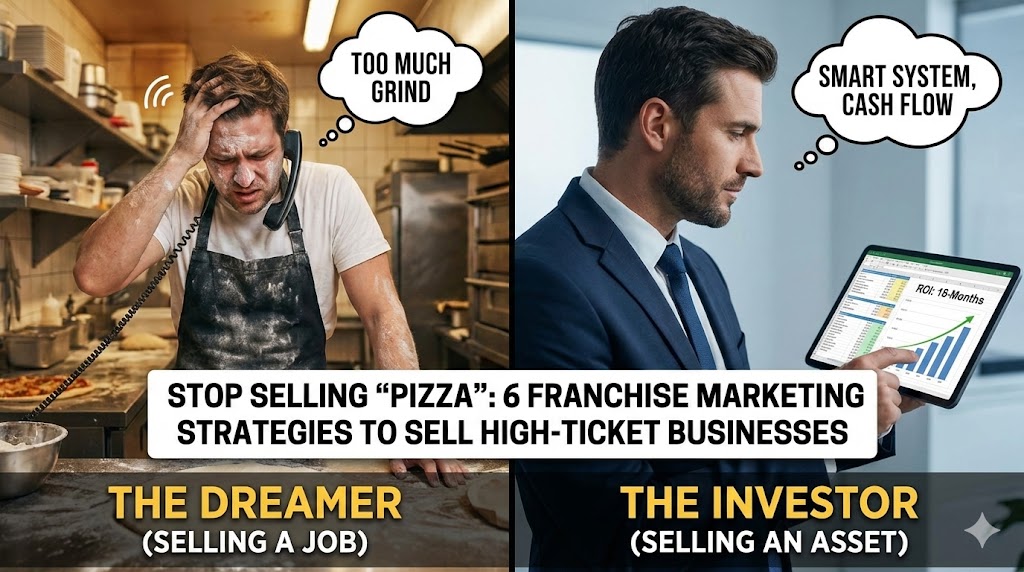
Home Services Performance Marketing Social Media Ads Google Ads Facebook Ads Pay Per Click Ads About Me Knowledge Hub Home Services Performance Marketing Social Media Ads Google Ads Facebook Ads Pay Per Click Ads About Me Knowledge Hub Book A Discovery Call Stop Giving “Free Estimates”: 5 Remodeling Marketing Strategies to Book $100k Renovations (Without Tire Kickers) By Deepak Jaiswal | Business Growth Strategist Reading Time: 15 Minutes If you are a Franchisor or a Franchise Development Manager, your daily reality likely involves a painful routine. Your sales team receives a list of 100 leads at 10 AM. They start dialing. “Hello sir, you expressed interest in our Coffee Franchise?” The voice on the other end replies: “Yes, but I don’t have the funds right now. I am looking for a loan.” Or worse: “I was just checking the price, I’m not ready yet.” You spend thousands on Facebook or Google Ads, and in return, you get “Wantrepreneurs.” These are people who want to do business but lack the capital to execute it. Selling a franchise is not easy. It is a High-Stakes Sale. You are not selling a product off a shelf; you are asking someone to invest their life savings (ranging from $50,000 to $200,000+) into your brand. So, where is the disconnect? The mistake lies in your marketing. You are selling the “Product” (The Pizza, The Gym, The Salon). But the person who writes a $100,000 check does not buy the Product. They buy the “ROI” (Return on Investment). If you want to attract serious investors, you must shift your approach. In this guide, I will share 6 proven franchise marketing strategies designed to filter out the “Window Shoppers” and bring only “Ready-to-Buy” investors to your negotiation table. Why Traditional Franchise Marketing Strategies Fail Most brands rely on the old playbook: Post a picture of a burger on social media with a caption like “Own Your Own Business.” This strategy might generate clicks, but it generates the wrong clicks. It attracts consumers, not investors. To acquire high-net-worth partners, you need to stop thinking like a B2C brand and start thinking like an Investment Firm. Below are the strategies to pivot your funnel from “Volume” to “Value.” Strategy 1: The “Liquid Capital” Filter (The Brutal Gatekeeper) The biggest drain on your sales team’s efficiency is “Unqualified Leads.” 80% of their time is wasted talking to people who simply cannot afford your franchise fee. The Strategy: You must inject “Fear” and “Reality” into your Lead Generation Form. Do not just ask for a Name and Phone Number. Add a mandatory dropdown field: “Minimum Liquid Capital Available to Invest:” Option A: Under $15,000 (Auto-Reject / Nurture List) Option B: $30,000 – $75,000 (Potential) Option C: $100,000+ (VIP Priority) Why this works: When a user sees that the minimum entry barrier is $30,000, the “tire kickers” will abandon the form immediately. Your lead volume will drop by 50%, but your lead quality will increase by 500%. Your sales team will thank you. Pro Tip: Designing forms that filter without killing conversion rates is an art. If you need help optimizing your landing pages, check our Conversion Rate Optimization Services to build high-filtering funnels. Strategy 2: The “Unit Economics” Webinar (Selling the Spreadsheet) Sophisticated investors do not care about how “tasty” your food is. They care about the Math. They aren’t thinking, “Will people like this burger?” They are thinking, “If I invest $100k, when do I get it back?” The Strategy: Instead of sending a generic PDF brochure, host a “Unit Economics Masterclass.” In this webinar, do not tell the “Brand Story.” Open an Excel Sheet. Average Monthly Revenue: $25,000 Cost of Goods Sold (COGS): 30% Labor & Rent: 25% Net Profit: 20% ($5,000/Month) Break-Even Point: 18 Months The Pitch: “We are not teaching you how to make pizza. We are handing you an asset that generates $5,000 in monthly cash flow.” When you transparently showcase the numbers, you shift from being a “Salesman” to a “Financial Advisor.” Strategy 3: Compare with Real Estate (The “Active Asset” Angle) Your competition is not another burger brand. Your competition is Real Estate. Anyone with $100,000 in cash is thinking: “Should I buy a rental property, or should I open a franchise?” The Strategy: Create ads and landing pages that draw a direct comparison. Real Estate Investment: $200k Investment -> $1,500 Monthly Rent (3-4% Yield). Your Franchise Investment: $200k Investment -> $5,000 Monthly Profit (15-20% Yield). Content Hook: Write a detailed blog post titled: “Why Investing in a [Your Brand] Franchise Beats Buying a Second Apartment in 2024.” This speaks directly to the “Investor Logic” in their brain, positioning your business as a superior high-yield asset. Strategy 4: Competitor Conquesting (Stealing Frustrated Leads) There is always a segment of the market that wanted to buy a major franchise (like McDonald’s, Domino’s, or Subway) but got rejected due to lack of territory or insufficient net worth. These are High-Intent Leads. The Strategy: Use Google Ads (PPC) to bid on your competitors’ keywords. Keywords: “Domino’s franchise cost,” “Subway franchise enquiry,” “KFC franchise requirements.” The Ad Copy: “Domino’s Franchise Too Expensive? Discover the Fastest Growing Pizza Brand with 50% Lower CapEx & Higher Profit Margins. Download ROI Sheet.” This strategy is aggressive, but it delivers pre-qualified investors who are actively looking to spend money in your specific industry. Need Help? Setting up these conquesting campaigns requires precision to avoid wasted spend. Our [PPC Management Services] can manage this bidding strategy for you. Strategy 5: The “Discovery Day” Video Series (Show, Don’t Tell) Investors have one major fear: “Can I actually run this? I don’t know anything about operations.” Text brochures are boring. Video builds trust and removes anxiety. The Strategy: Create a “Day in the Life of a Franchisee” video series. Video 1: Opening the store and managing the morning staff briefing. Video 2: How the inventory management software works (Demo the simplicity). Video 3: Managing the evening rush and checking daily sales reports on a mobile app.
Financial advisor marketing strategies
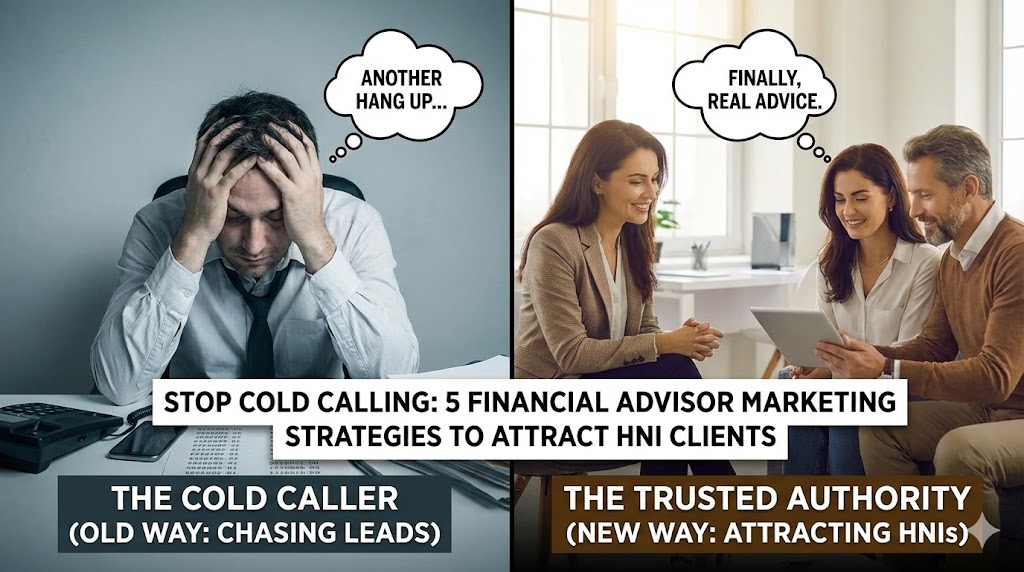
Home Services Performance Marketing Social Media Ads Google Ads Facebook Ads Pay Per Click Ads About Me Knowledge Hub Home Services Performance Marketing Social Media Ads Google Ads Facebook Ads Pay Per Click Ads About Me Knowledge Hub Book A Discovery Call Stop Cold Calling: 5 Financial Advisor Marketing Strategies to Attract HNI Clients (Without Free Dinners) By Deepak Jaiswal | Fintech Growth Expert Reading Time: 15 Minutes If you are a Financial Advisor or Wealth Manager, your morning probably starts with a pit in your stomach. You look at your “Lead List.” It’s a spreadsheet of 100 random people. You pick up the phone. You dial. “Hello, I’m calling from…” Click. They hang up. Or worse, you spend $5,000 renting a hotel ballroom, buying steak dinners for 50 people, hoping to sell them a retirement plan. 40 people eat the free food and leave. 10 people give you fake numbers. This is the “Salesman Trap.” In 2024, High-Net-Worth Individuals (HNIs) do not buy from cold callers. They do not buy from people who interrupt their dinner. They buy from Experts they trust. When an HNI has ₹10 Crores ($1M+) to invest, they don’t look for a “Salesman.” They look for a “Financial Doctor.” If you are struggling to grow your Assets Under Management (AUM), it’s not because you are bad at finance. It’s because your marketing makes you look needy. To attract the whales (HNIs) instead of the minnows (small retail investors), you need to stop chasing and start attracting. Here are 5 financial advisor marketing strategies to shift your business from “Outbound Noise” to “Inbound Authority.” Strategy 1: The “Niche Specialist” Content (Kill the Generalist) The biggest mistake advisors make is saying: “I help everyone with financial planning.” If you help everyone, you help no one. An HNI doesn’t have “General Problems.” They have “Specific Problems.” The Strategy: Pick a Micro-Niche and create content ONLY for them. Bad: “I help you save tax.” Good: “I help Tech Startup Founders with ESOP Taxation and Exits.” Good: “I help Doctors structure their clinic assets to protect against malpractice lawsuits.” Why this works: When a Tech Founder sees your LinkedIn post about “ESOP Mistakes,” they don’t compare you to other advisors. They think: “This person understands MY world.” You instantly become a Premium Specialist, and specialists get paid 10x more than generalists. Here is a visual comparison of why niches win: Strategy 2: The “Retirement Shock” Calculator (The Lead Magnet) HNIs are smart, but they are terrified of one thing: Running out of money. They don’t want a “Free Consultation” (that sounds like a sales pitch). They want answers. The Strategy: Build a “Lifestyle Longevity Calculator” on your website. Most calculators just ask “How much do you save?” Your calculator should ask emotional questions: What kind of car do you want to drive in retirement? How many international trips per year? Do you want to leave an inheritance? The Output: “Based on your current path, you will run out of money at age 78. To maintain your lifestyle until 90, you need to adjust your portfolio by X%.” The Funnel: This result creates “Urgency.” They need to talk to you now, not because you sold them, but because the math scared them. Here is the lead generation funnel in action: Strategy 3: The “Client Interview” Podcast (Social Proof) HNIs run in packs. Doctors know doctors. Business owners know business owners. They trust their peers more than they trust you. The Strategy: Start a simple podcast or video series. But don’t just talk about “Market Trends” (boring). Interview your Success Stories (anonymously if needed). Title: “How Dr. Sharma Retired 5 Years Early Without Selling His Clinic.” The Content: Discuss the strategy you used for him. Let him talk about his peace of mind. The Viral Effect: Dr. Sharma will share this video with his other Doctor friends. “Look, I was featured here.” Suddenly, you are being referred to 10 other HNIs without asking for a referral. Strategy 4: LinkedIn “Thought Leadership” (The Trust Engine) Instagram is for small retail investors. LinkedIn is where the money is. But stop posting “Stock Market Updates.” CNBC already does that. The Strategy: Post about “Behavioral Finance” and “Mistakes.” Rich people are scared of losing wealth. Post Idea 1: “The 3 biggest estate planning mistakes I saw families make in 2023.” Post Idea 2: “Why buying a second home might be a terrible investment right now.” The CTA (Call to Action): Don’t say “Call me.” Say: “I wrote a 5-page PDF on Estate Planning for Business Owners. DM me ‘ESTATE’ and I’ll send it over.” This starts a conversation in the DMs, where high-ticket deals are closed. Strategy 5: The “Seminar 2.0” (Webinar Funnel) Seminars work, but hotel dinners are expensive and attract “Free Food Seekers.” Move it online, but keep it Exclusive. The Strategy: Host a “Closed-Door Virtual Round Table.” Limit: Only 10 seats. Topic: Highly specific. “Tax-Efficient Wealth Transfer for Family Business Owners.” Gatekeeping: They must apply to attend. The Psychology: When you make it “Exclusive” and “Application Only,” HNIs want in. It triggers FOMO (Fear Of Missing Out). Since it’s on Zoom, your cost is $0. You can do this every week. Even if only 5 people show up, they are 5 qualified, high-net-worth leads. Conclusion: Be the lighthouse, Not the Tugboat A tugboat goes out into the ocean, chasing ships, wasting fuel, trying to pull them in. A lighthouse stands still, shines a bright light, and the ships come to it. Most financial advisors are tugboats. They are exhausted from cold calling. You need to be the lighthouse. By picking a niche, creating valuable tools, and demonstrating expertise on LinkedIn, you stop chasing. The HNIs will find you, and they will ask, “Will you manage my money?” instead of you begging, “Please hire me.” Ready to Automate Your Client Acquisition? Stop buying bad leads. Click below to download our “Financial Advisor Marketing Funnel” blueprint. Book A Discovery Call All Posts Knowledge Hub
Remodeling marketing strategies
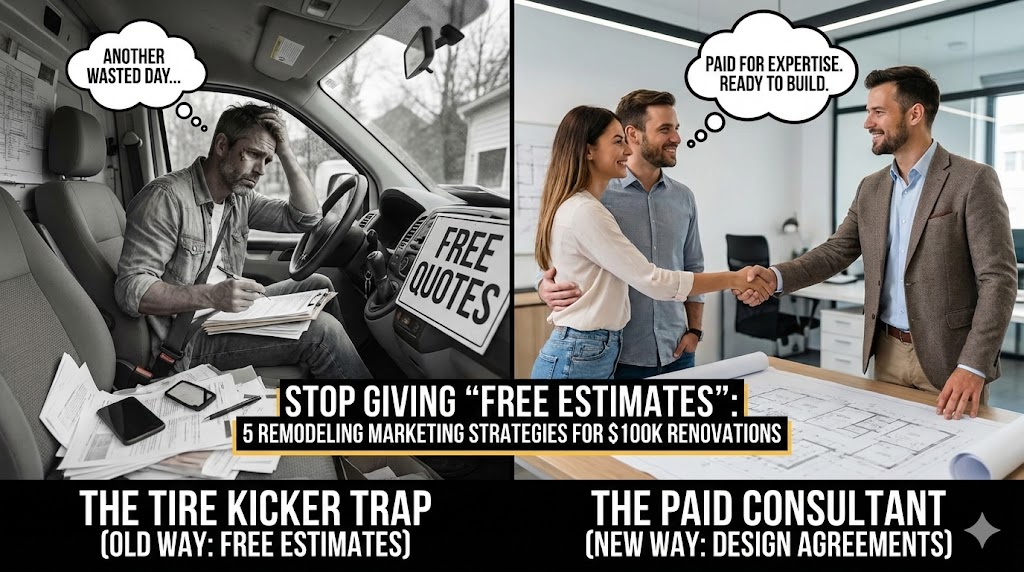
Home Services Performance Marketing Social Media Ads Google Ads Facebook Ads Pay Per Click Ads About Me Knowledge Hub Home Services Performance Marketing Social Media Ads Google Ads Facebook Ads Pay Per Click Ads About Me Knowledge Hub Book A Discovery Call Stop Giving “Free Estimates”: 5 Remodeling Marketing Strategies to Book $100k Renovations (Without Tire Kickers) By Deepak Jaiswal | Construction Growth Expert Reading Time: 16 Minutes If you run a Design-Build or Home Remodeling business, your week probably looks like this: You get a lead from a referral or a generic lead site. They want a “New Kitchen.” You drive 45 minutes to their house. You spend an hour listening to their dreams, measuring their cabinets, and taking notes. You drive back to the office. You spend 4 hours crunching numbers and calling suppliers to create a detailed estimate. You send the estimate: $85,000. Then… silence. You call them. They say, “Oh, we were hoping to spend $20,000. We’ll get back to you.” You just wasted 6 hours of your life and $100 in gas/overhead for zero dollars. This is the “Free Estimate Trap.” In the global construction industry, contractors have been trained to act like beggars. You are expected to work for free just for the chance to win a job. Doctors don’t give free surgeries to prove they are good. Lawyers don’t give free trials. Why are you giving away your expertise? The homeowners aren’t the problem; your positioning is. When you offer a “Free Estimate,” you attract “Price Shoppers.” These people are looking for the cheapest number at the bottom of the page. To book $100,000+ renovations with high margins, you need to stop selling “Bids” and start selling “Vision.” You need to shift from being a “Commodity Contractor” to a “Trusted Advisor.” In this comprehensive guide, I will share 5 remodeling marketing strategies that will help you stop driving around for free and start getting paid for your knowledge before you even swing a hammer. The Paradigm Shift: From “Bidder” to “Builder” Before we dive into the strategies, you must understand the psychology of a High-Ticket Homeowner. A client planning a $150,000 extension is terrified. They have heard the horror stories: contractors running away with money, projects taking 3 years instead of 3 months, budgets doubling overnight. They don’t want the cheapest contractor. They want the safest contractor. When you compete on price (Free Estimates), you signal that you are “Cheap.” When you compete on process (Paid Consultations), you signal that you are “Professional.” Here is how to make that shift happen, starting with understanding your client type: Strategy 1: The “Paid Design” Funnel (Flipping the Script) This is the single most important strategy to kill the “Tire Kickers.” The Old Way: Visit House -> Free Estimate -> Ghosted. The New Way: Phone Call -> Budget Check -> Paid Design Agreement (PDA). The Strategy: Stop giving line-item quotes for free. Instead, sell a “Project Discovery Package” for a flat fee (e.g., $500 – $1,500). The Pitch: “Mr. Client, a $100k renovation is complex. I can’t give you an accurate price by just guessing. If I guess, I’ll have to inflate the number to protect myself, or cut corners later. Instead, we start with a Feasibility Study. For $500, our architect visits your home, we check the zoning laws, we create a 3D Concept Design, and we give you a Guaranteed Fixed Price range. You own these plans. If you hire us, we credit the $500 back. If not, you keep the plans. Does that sound fair?” Why this works: Commitment: If they won’t pay $500, they definitely won’t pay $100,000. You filter out the time-wasters instantly. Cash Flow: You get paid for your estimating time. Authority: You are now a Consultant, not a beggar. Here is a visual of this new, profitable process: Strategy 2: The “Ugly Truth” Content Marketing Most contractors post photos of finished kitchens. That’s nice, but it’s generic. Pinterest is full of pretty kitchens. To attract high-ticket clients, you need to answer the question they are secretly Googling: “How much does it actually cost?” The Strategy: Create a detailed, honest blog post or video titled: “The True Cost of a Luxury Kitchen Remodel in 2024.” The Content: Break it down fearlessly. “Economy Kitchen (IKEA/DIY): $15k – $30k” “Mid-Range (Custom Cabinets/Quartz): $50k – $80k” “Luxury (Sub-Zero/Wolf/Marble): $100k+” The Result: When a homeowner reads this before calling you, they self-qualify. If they have a $20k budget, they realize you are out of their league and don’t call (saving your time). If they have a $100k budget, they respect your honesty and call you because you gave them real data, not sales fluff. Use local data. Mention your specific city/region to dominate Local SEO. Strategy 3: The “Site Visit” Reality Series (Video Trust) High-end clients are visual, but they are also skeptical about the process. They fear the mess, the dust, and the strangers in their house. The Strategy: Don’t just post the “After” photo. Post the “During” video. Use Instagram Reels or YouTube Shorts to document a live project. The “Protection” Video: Show how you seal off the rest of the house with plastic zip-walls to keep dust out. Show how you cover their expensive floors. The “Problem Solving” Video: “We opened this wall and found a leaking pipe. Here is exactly how we fixed it and updated the client.” The Psychology: This shows Competence and Cleanliness. A luxury client watching this thinks: “Wow, they respect the home. They are clean. I can trust them with my house keys.” Strategy 4: The “Budget Calculator” Tool (The Automated Filter) If you hate talking about money on the first phone call, let your website do it for you. The Strategy: Install a “Renovation Budget Calculator” on your website. How it works: The user selects: Room Type: Kitchen / Bathroom / Basement. Finish Level: Standard / Premium / Ultra-Luxury. Size: Small / Medium / Large. The Output: The tool gives them an instant estimated
Cosmetic dentistry marketing strategies
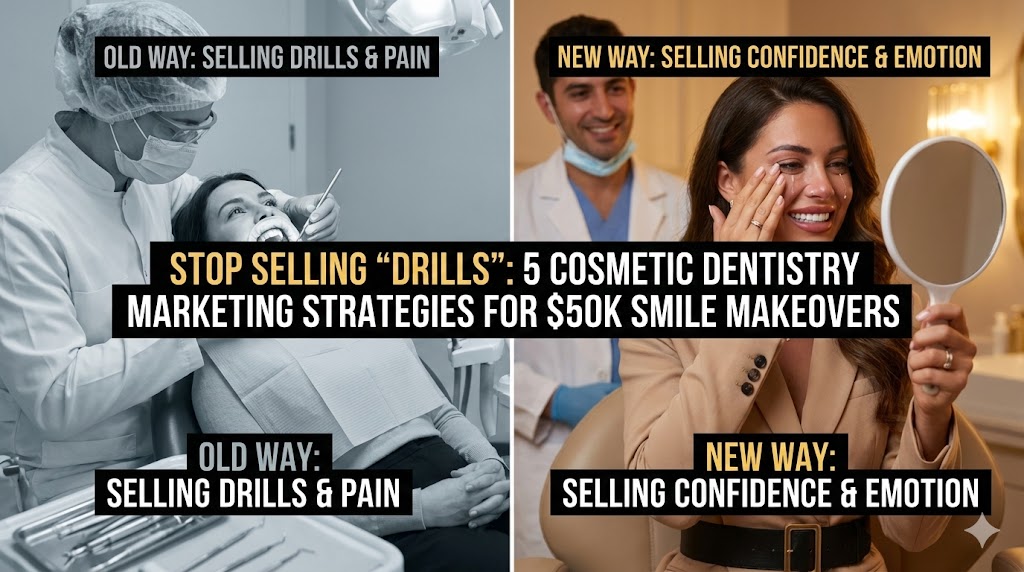
Home Services Performance Marketing Social Media Ads Google Ads Facebook Ads Pay Per Click Ads About Me Knowledge Hub Home Services Performance Marketing Social Media Ads Google Ads Facebook Ads Pay Per Click Ads About Me Knowledge Hub Book A Discovery Call Stop Selling “Drills”: 5 Cosmetic Dentistry Marketing Strategies to Book $50k Smile Makeovers By Deepak Jaiswal | Healthcare Growth Expert Reading Time: 10 Minutes If you are a Cosmetic Dentist, you are likely suffering from the “Insurance Trap.” You spend your day doing fillings, cleaning plaque, and fighting with insurance companies for a $150 reimbursement. You are overworked and underpaid. Meanwhile, you see patients flying to Turkey or Dubai to spend $30,000 on a “Hollywood Smile.” Why aren’t they coming to you? Because your marketing looks like a Medical Clinic, not a Beauty Studio. You are posting photos of bloody gums, metal tools, and dental chairs. This scares people. Patients who buy Veneers or Implants aren’t buying “Health.” They are buying Confidence. They are buying Status. They are buying a New Life. To attract the $50k cases, you need to stop thinking like a Dentist and start thinking like a Plastic Surgeon or a Luxury Fashion Brand. Here are 5 cosmetic dentistry marketing strategies to shift your practice from “Needs-Based” (Pain) to “Wants-Based” (Beauty). Strategy 1: The “Virtual Smile” Funnel (The Hook) Stop putting your phone number on Instagram ads. You will get 1,000 calls from students with 40% marks asking for scholarships. The Strategy: Run ads to a “University Eligibility Quiz.” Question 1: What is your GPA/Percentage? Question 2: What is your budget? (A. Under ₹10L | B. ₹20L+ | C. Loan Required) Question 3: Do you have an IELTS score? The Magic: If they select “Under ₹10L” and “No IELTS,” send them an automated email guide. Do not call. If they select “₹20L+” and “7.0 Bands,” your sales team calls them immediately. This ensures your counselors spend time only on “Commission-Ready” leads. Here is how this filtration process works visually: Strategy 2: The “Influencer Barter” (Local Celebrity Status) You don’t need Kim Kardashian. You need the local Real Estate Agent with 10k followers or the local News Anchor. The Strategy: Offer a “Smile Partnership.” The Deal: You give them veneers at Cost Price (e.g., $5k instead of $20k). The Requirement: They must document the entire journey on Instagram Stories. Not just the result, but the consultation, the temporaries, and the “Reveal Day.” Why this works: Their followers trust them. When they see the influencer crying tears of joy on Reveal Day, you get 10-20 inquiries from people who want that same feeling. Strategy 4: The “Price Anchoring” Menu (The Psychology) Most dentists hide their prices. This makes people assume it’s “too expensive” or “scary.” The Strategy: Create a “Smile Menu” on your website. Option A: Teeth Whitening ($500) – The Teaser. Option B: Composite Bonding ($5,000) – The Upgrade. Option C: Porcelain Veneers ($25,000) – The Luxury. The Anchor: When you show the $25,000 option next to the $500 option, the $5,000 option looks “cheap.” Many patients will come in for Option B and eventually upgrade to Option C once they trust you. Strategy 5: Video Testimonials > Written Reviews A written review on Google saying “Dr. Smith is nice” is useless for high-ticket sales. The Strategy: Film the “Mirror Moment.” The exact second you hand the patient the mirror after cementing the veneers. Capture their gasp, their tears, their shock. The Content: Post this raw emotion on TikTok and Reels. Caption: “She waited 20 years to smile without covering her mouth. Today, she is free.” This sells the Transformation, not the teeth. Here is a comparison of the old vs. new way of marketing your practice: Conclusion: You Are a Smile Architect The market for cosmetic dentistry is exploding globally. People are obsessed with self-image (thanks to Zoom and Instagram). The dentists who are struggling are the ones waiting for sick patients. The dentists who are making millions are the ones creating beautiful patients. Shift your cosmetic dentistry marketing strategies from “Clinical” to “Emotional.” When you do that, you stop competing with the cheap clinic down the street and start competing with Louis Vuitton. Ready to Attract $50k Cases? Stop drilling for pennies. Click below to download our “High-Ticket Smile Funnel” guide. Book A Discovery Call All Posts Knowledge Hub Exclusive Real Estate Leads Read More Exclusive Solar Leads Read More Get high ticket clients without cold dm Read More Exclusive Kitchen Remodeling Leads Read More Commercial solar leads Read More Off Market Real Estate Leads Read More High ticket B2B leads Read More Exclusive home service leads Read More Facebook ads for solar leads Read More Load More End of Content. Frequently Asked Questions 1. Is TikTok good for dentists? Don’t compete on price. Compete on Safety and Maintenance. Market the risks of “Turkey Teeth” (aggressive filing, nerve damage). Position yourself as the “Safe, Long-Term Investment” vs. the “Risky Quick Fix.” 2. How do I stop patients from going to Turkey for cheap teeth? Don’t compete on price. Compete on Safety and Maintenance. Market the risks of “Turkey Teeth” (aggressive filing, nerve damage). Position yourself as the “Safe, Long-Term Investment” vs. the “Risky Quick Fix.” 3. Should I advertise “Free Consultations”? For cosmetic cases? Yes. But call it a “Smile Assessment.” Charge a deposit ($50) that is refundable if they show up. This filters out the complete time-wasters while keeping the barrier low. 4. What keywords should I target? Stop targeting “Dentist near me.” Target “Veneers [City Name],” “Invisalign Cost,” and “Smile Makeover.” These keywords imply high intent to buy, not just a toothache. 5. How do I get more high-ticket patients from Google? Build a dedicated landing page for “Cosmetic Dentistry” that looks like a luxury spa, not a clinic. Show patient video testimonials first. Have a clear call-to-action for a “Virtual Consultation.” Focus on Local SEO by getting reviews that mention specific high-ticket procedures. Don’t compete on price. Compete on Safety
Private jet charter marketing
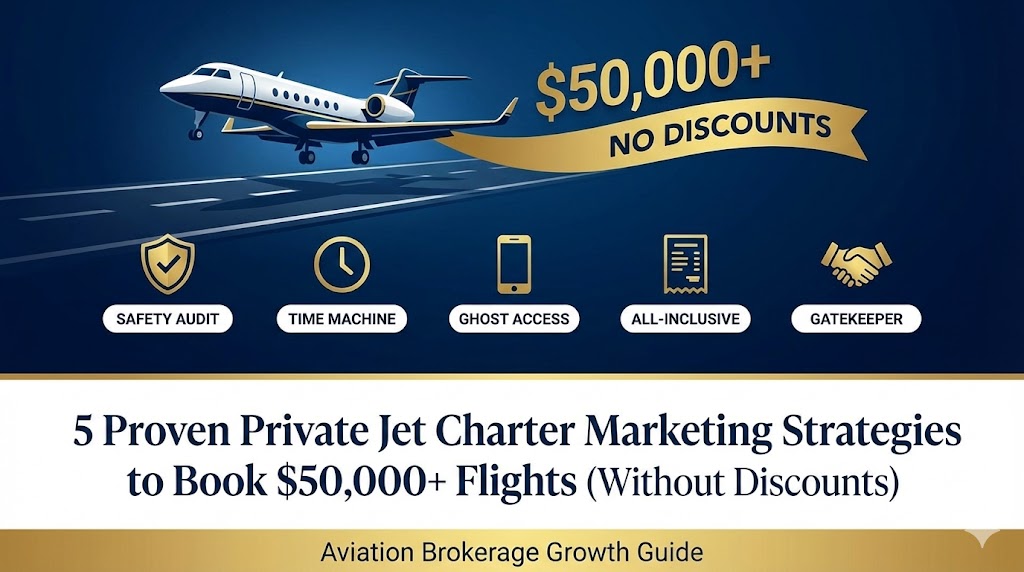
Home Services Performance Marketing Social Media Ads Google Ads Facebook Ads Pay Per Click Ads About Me Knowledge Hub Home Services Performance Marketing Social Media Ads Google Ads Facebook Ads Pay Per Click Ads About Me Knowledge Hub Book A Discovery Call 5 Proven Private Jet Charter Marketing Strategies to Book $50,000+ Flights (Without Discounts) By Deepak Jaiswal | Luxury Aviation Growth Expert Reading Time: 12 Minutes If you are a Private Aviation Broker, you are likely making a critical mistake on social media. You are posting photos of champagne, caviar, and models sitting in a Gulfstream G650. You think this sells “Luxury.” But the people who actually book jets—the Fortune 500 CEOs, the Tech Founders, the Family Offices—don’t care about the champagne. They can buy their own champagne. They care about two things: Time and Safety. The “Instagram Flex” marketing attracts influencers who want a photo but ask for a discount. It does not attract the Billionaire who needs to be in London for a meeting at 9 AM and back in New York for dinner. To dominate this niche and book $50,000+ flights without discounting, you need to stop selling “Lifestyle” and start selling “Logistics.” In this guide, I will share 5 proven private jet charter marketing strategies that shift your positioning from a “Booking App” to an “Invisible Concierge.” Strategy 1: The “Safety Audit” (Selling Certainty) Ultra-HNWIs (High Net Worth Individuals) are paranoid. They fear accidents. They fear bad pilots. They fear negative press. Most brokers hide the technical details to make the sale look “easy.” You will do the opposite. You will market Safety Transparency. The Strategy: Don’t just send a quote with a price. Send a “Safety Profile” of the operator. Content Marketing: Write articles titled “Why I won’t put you on a Part 135 operator without a WYVERN Wingman rating.” The Pitch: “Mr. Client, I have a cheaper option ($40k) and a safer option ($50k). The safer jet is a 2022 model with 5,000+ pilot hours. Which one do you prefer?” The Result: When a client sees you prioritizing their life over the sale, they stop negotiating. They trust you as a Safety Auditor, not just a salesperson. Strategy 2: The “Time Machine” Framing (ROI Selling) Stop calling them “Planes.” In your marketing copy, call them “Time Machines.” A commercial flight forces a CEO to waste 3 hours in security, delays, and baggage claim. A private jet buys those 3 hours back. The Strategy: Create a marketing tool or a blog post that calculates the value of the client’s time. If a CEO earns $5,000/hour: Commercial Flight Friction (4 hours wasted) = $20,000 loss. Private Flight Friction (15 mins) = Efficiency gained. Message: “We don’t sell luxury. We sell 4 extra hours of productivity per trip. How much is your time worth?” This speaks the language of a CFO or Executive Assistant who is booking the flight. It justifies the $50,000 invoice as a business expense, not a luxury splurge. Strategy 3: The “Ghost” Access (Deep Personalization) The highest level of private jet charter marketing is Hyper-Personalization. Don’t blast “Empty Leg Deals” to your entire email list. It looks desperate and cheapens your brand. Use a “Route-Based” Notification System. The Strategy: Survey: Ask clients: “What are your top 3 frequent routes?” (e.g., London to Dubai, NY to LA). Monitor: When a specific jet is available on that route, do not post it on Instagram. Direct Message: Send a personal WhatsApp. Script: “Mr. Smith, a Global 6000 is repositioning from London to Dubai on Tuesday. I can secure it for you at a 30% efficiency rate. Should I hold it?” Why this works: It feels like an “Inside Tip,” not an advertisement. You become their “Guy on the inside,” giving them ghost access to inventory nobody else sees. Strategy 4: The “All-Inclusive” Pricing Guarantee One of the biggest complaints from HNWIs is “Surprise Billing.” They book a flight for $45,000, and two weeks later, they get a bill for $5,000 covering de-icing, catering, or hangar fees. The Strategy: Market your “No-Surprise Invoice” Policy. Quote slightly higher than your competitors, but state clearly: “This price includes de-icing, premium catering, and Wi-Fi. No hidden bills later.” The Ad Hook: “Tired of getting billed for de-icing weeks after your flight? Switch to [Your Brokerage]. One Price. Zero Surprises.” This builds massive trust with Family Offices who manage the finances. Strategy 5: Marketing to the “Gatekeeper” (The EA) Here is a secret: The Billionaire rarely books the jet. Their Executive Assistant (EA) or Chief of Staff does. If you make the EA’s life hard, you lose the client. If you make the EA look like a hero, you keep the client for life. The Strategy: Create content specifically for EAs on LinkedIn. Guide: “The Executive Assistant’s Checklist for Private Aviation.” Service: Send the EA a pre-flight PDF with the tail number, pilot names, and catering menu that they can simply forward to their boss. When you market to the Gatekeeper, you bypass the competition entirely. Conclusion: Be the Fixer, Not the Booker In the world of $50,000 transactions, trust is the only currency. The market is full of brokers who post pictures of leather seats. The market is starving for brokers who understand safety ratings, pilot hours, and tarmac logistics. Shift your private jet charter marketing from “Glamour” to “Competence.” When you do that, you stop attracting the people who want to look rich, and you start attracting the people who are rich. Ready to Upgrade Your Client List? Stop fighting for low-margin empty legs. Click below to book a strategy call for your Aviation Brokerage. Book A Discovery Call All Posts Knowledge Hub Exclusive Real Estate Leads Read More Exclusive Solar Leads Read More Get high ticket clients without cold dm Read More Exclusive Kitchen Remodeling Leads Read More Commercial solar leads Read More Off Market Real Estate Leads Read More High ticket B2B leads Read More Exclusive home service leads Read More Facebook ads for solar
Real estate marketing strategies
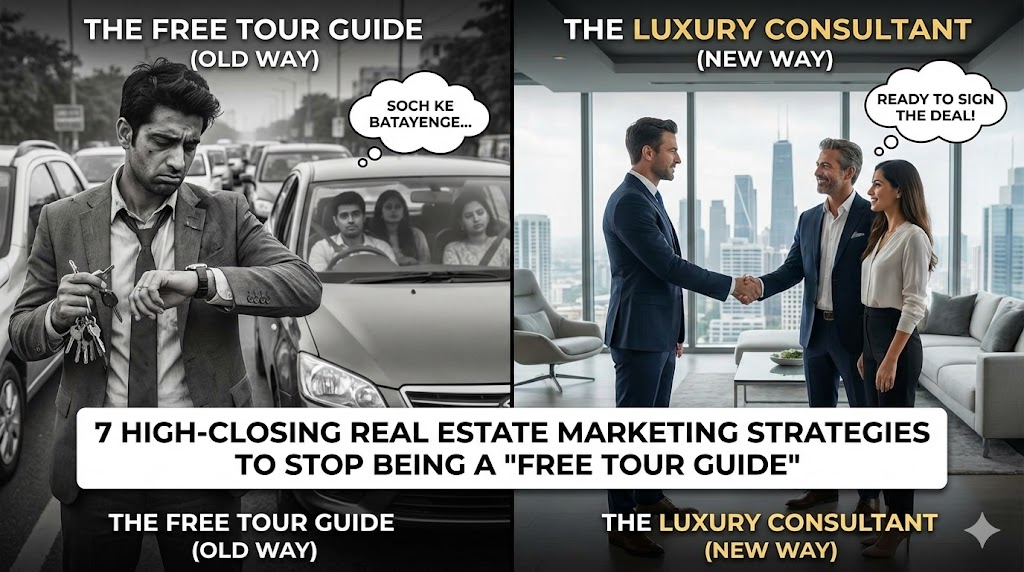
Home Services Performance Marketing Social Media Ads Google Ads Facebook Ads Pay Per Click Ads About Me Knowledge Hub Home Services Performance Marketing Social Media Ads Google Ads Facebook Ads Pay Per Click Ads About Me Knowledge Hub Book A Discovery Call 7 High-Closing Real Estate Marketing Strategies to Stop Being a “Free Tour Guide” By Deepak Jaiswal | Real Estate Growth Expert Reading Time: 14 Minutes Let’s be honest about the life of a Real Estate Agent in 2024. You spend your weekends driving across the city, dodging traffic, and waiting in lobbies. You show 10 different properties to a client. You answer their 100 questions. You buy them coffee. And after all that effort, they give you the dreaded line: “Hum soch ke batayenge” (We will think and let you know). A week later, you find out they bought a property through another agent who offered a 0.5% discount. It is heartbreaking. But more than that, it is a waste of your most valuable asset: Time. If you feel like a “Glorified Uber Driver” or a “Free Tour Guide” rather than a Real Estate Consultant, the problem isn’t the market. The problem isn’t the property prices. The problem is your real estate marketing strategies. Most agents rely on “Hope Marketing”—listing a property on a portal (like 99acres or MagicBricks) and hoping a good lead calls. But those leads are sold to 10 other agents. You are fighting a war you cannot win. To close high-ticket deals (3 Cr+), you need to stop chasing leads and start attracting High-Net-Worth Individuals (HNIs) who respect your time. In this guide, I will share 7 proven real estate marketing strategies that will help you filter out the window shoppers and fill your calendar with serious buyers. Why Portal Leads Are Killing Your Business Before we get to the strategies, you need to understand why relying on property portals is dangerous. When a user enquires on a portal, they are not looking for you. They are looking for a house. They don’t know who you are. To them, you are just a commodity—a person with the keys. The Shift: You need to build a Personal Brand. People trust people, not logos. When a client consumes your content before they meet you, they treat you like an expert, not a salesperson. Here is a comparison of the old way vs. the new way of doing business: Strategy 1: Video Walkthroughs (Sell the “Lifestyle”) Photos can be deceptive. Text is boring. Video is the truth. But stop making slideshows of static images with elevator music. That is lazy. The Strategy: Be the host. Stand in front of the camera. Don’t sell the brick: Don’t just say “This is a 3BHK, 2000 sq ft.” Sell the life: Say “Imagine drinking your morning chai on this balcony while watching the sunrise over the city skyline.” Upload these to YouTube (for search) and Instagram Reels (for discovery). When a client calls you after watching your video, they are already 50% sold. They aren’t coming to see the house; they are coming to confirm what they felt in the video. Check our Google Ads Marketing Services Strategy 2: Google My Business (The Local King) Real Estate is a hyper-local business. If someone wants a flat in “South Delhi,” they search on Google. If you don’t have a Google Business Profile with at least 50 reviews, you are invisible. The Strategy: Keywords: Rename your profile to “Your Name – Luxury Real Estate Consultant in [City]”. Reviews: Don’t just ask for a review. Ask for a story. “Deepak helped us find our dream home in 3 days when we were struggling for 3 months.” Updates: Post photos of your “Sold” properties every week. This proves you are active and closing deals. Strategy 3: The “Dream Home” Quiz Funnel Stop giving your phone number to everyone. Protect your time. Instead of a “Call Now” button, use a “Find Your Dream Home” Quiz. The Questions: Are you looking to buy in 1 month, 3 months, or 6 months? What is your budget range? Do you have a pre-approved loan? The Magic: If someone answers “Under ₹50 Lakhs” and “Looking in 1 year,” send them an automated email guide. Do not call them. If someone answers “Above ₹3 Crores” and “Ready to buy now,” your phone should ring immediately. This is one of the most efficient real estate marketing strategies to filter out window shoppers. Strategy 4: LinkedIn for HNIs (Where the Money Is) Instagram is for visibility. LinkedIn is for Net Worth. If you want to sell luxury penthouses or commercial office spaces, your clients are on LinkedIn. They are CEOs, Founders, and VPs. The Strategy: Don’t post property listings. Post Market Insights. “Why South Mumbai real estate is outperforming the stock market this year.” “5 things NRIs must check before investing in Indian real estate.” Position yourself as an Investment Advisor, not a property dealer. HNIs want to work with someone who understands ROI, rental yields, and capital appreciation. Strategy 5: The “Coming Soon” (FOMO Marketing) The most powerful trigger in real estate is Scarcity. Most agents list a property after it is ready. Smart agents market it before it hits the market. The Strategy: Post a “Sneak Peek” on your social media. “I have a verified 4BHK coming up in [Premium Area]. It hits the market next week, but my private list gets first access. DM ‘VIP’ to get the photos now.” This makes the buyer feel special and creates urgency. You might sell the property before you even have to list it publicly. Strategy 6: Client Interview Testimonials Written reviews are good. Video interviews are gold. After the closing (when the client is happiest, holding the keys), record a short interview. Agent: “What was your biggest fear before buying?” Client: “We were scared of hidden paperwork issues.” Agent: “How did I help?” Client: “You verified everything and made it stress-free.” This video destroys the trust deficit that new clients