Facebook ads for B2B SaaS
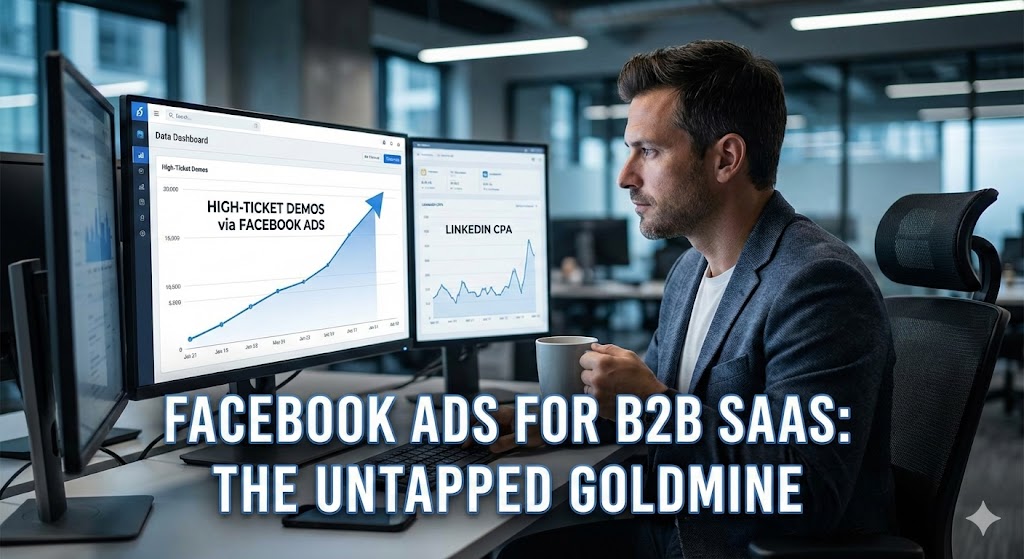
Home Services Performance Marketing Social Media Ads Google Ads Facebook Ads Pay Per Click Ads About Me Knowledge Hub Home Services Performance Marketing Social Media Ads Google Ads Facebook Ads Pay Per Click Ads About Me Knowledge Hub Book A Discovery Call Facebook Ads for B2B SaaS: Why I Stopped Selling the “Free Trial” and Started Booking More Demos By Deepak Jaiswal | Performance Marketing & Automation Expert Reading Time: 13 Minutes If you are running a B2B SaaS company, you are likely trapped in the “Free Trial” delusion. You’ve been told that the only way to grow is to get people into your app as quickly as possible. So, you run Facebook ads for B2B SaaS that scream: “Start your 14-day free trial today!” You spend thousands of dollars, you get a decent number of sign-ups, and you feel great—until you look at your churn rate. You realize that 90% of those “Free Trial” users never even complete their profile, let alone become paying customers. They are “tire-kickers” who wanted a free tool but have zero intention of integrating your software into their actual business workflow. In the B2B world, a free trial is a massive commitment of time, not just money. Busy executives don’t want to learn a new piece of software on a Saturday afternoon. I’ve flipped the script for my SaaS clients. I’ve stopped leading with the trial and started leading with Educational Authority. By changing the funnel design and using advanced automation, I’m helping founders book high-ticket demos for $150 instead of chasing $20 trial users who never convert. Here is exactly how I do it. The Death of the “Frictionless” Sign-Up The biggest mistake I see in B2B performance marketing is the obsession with “reducing friction.” Common wisdom says: “The fewer clicks, the better.” In B2C e-commerce, that’s true. In high-ticket B2B SaaS, it’s a disaster. If your lead generation is too easy, you attract low-quality people. I want intentional friction. I want to make sure that the person clicking my Facebook ad is a serious decision-maker with a serious problem. Data Table: Trial-First vs. Education-First Strategy Metric The “Free Trial” Push My “Education-First” Funnel Initial Ad Hook “Try our tool for free” “Solve [Specific Problem] with this Data” Cost Per Lead (CPL) $10 – $25 (Low quality) $40 – $70 (High quality) Lead Intent Passive curiosity Active problem-solving Demo Show-up Rate 20% – 30% 65% – 80%+ Long-Term CAC High (Due to churn) Low (Higher LTV customers) Step 1: Crafting the “High-Value” Lead Magnet Instead of asking a stranger to “sign up” for my software, I ask them to download a specific tool that solves a micro-problem related to my software. Examples of what I build for my clients: The ROI Calculator: If you sell a logistics SaaS, I build a “Fuel Waste Calculator” where they enter their fleet size to see how much money they are losing. The Competitor Audit: A checklist or template that helps a VP of Marketing see where their current strategy is failing. The proprietary Data Report: “How 500+ SaaS Companies Scaled to $10M ARR in 2025.” When someone downloads one of these, they are telling me exactly what their pain point is. They aren’t just looking for a “tool”; they are looking for a result. My Facebook ads for B2B SaaS focus 100% on the value of this lead magnet. Step 2: The “Bridge” Funnel & Automated Demo Booking Once the lead is captured via the lead magnet, I don’t just send them a PDF and hope they call me. I use a “Bridge Funnel” to move them toward a demo immediately. The Page Flow I Design: Landing Page: 100% focus on the Lead Magnet. No distracting links. Thank You / Bridge Page: Instead of just saying “Thanks,” I embed a 5-minute video of me (or the founder) saying: “Your report is in your inbox. But usually, people who download this are struggling with [Problem X]. I’ve carved out some time this week to show you how our software automates this entire process. Want to see a 10-minute walkthrough?” The Booking Widget: Right below that video is a calendar. By the time they book that demo, they have already consumed my content and watched my video. They are “pre-sold.” Generating volume is easy, but closing $50k+ contracts requires a completely different level of precision. If you are tired of small fish and want to learn my exact system for filtering and closing high ticket b2b leads using automated VSL funnels and elite Meta targeting, you need to check out my advanced lead-gen blueprint. Step 3: Ruthless Automation & CRM Nurture The demo booking is just the start. If you don’t have a backend automation system, 50% of those people will “no-show” their appointment. I build “The Indoctrination Sequence” inside the CRM: Immediately: SMS & Email confirmation with a link to a case study. 24 Hours Before: A “Reminder” email that adds more value. “Hey, before our call tomorrow, check out how [Competitor Name] used our tool to save 20 hours a week.” 1 Hour Before: A final SMS reminder. If they don’t book a demo after downloading the lead magnet, my automation puts them into a 30-day “Value Drip.” Every 3 days, they get a helpful tip or a success story. My goal is to stay top-of-mind so that when their problem becomes unbearable, I am the only person they think of. Conclusion: Quality Always Wins in B2B In the B2B SaaS world, more leads does not mean more money. It often just means more work for your sales team. By shifting your Facebook ads for B2B SaaS strategy away from the “Free Trial” trap and toward an education-first funnel, you are filtering for quality. You are building a system that doesn’t just collect emails, but builds a pipeline of educated, high-intent buyers who understand your value before they ever jump on a Zoom call. I don’t just build ads; I build acquisition machines that turn cold
Real estate funnel design
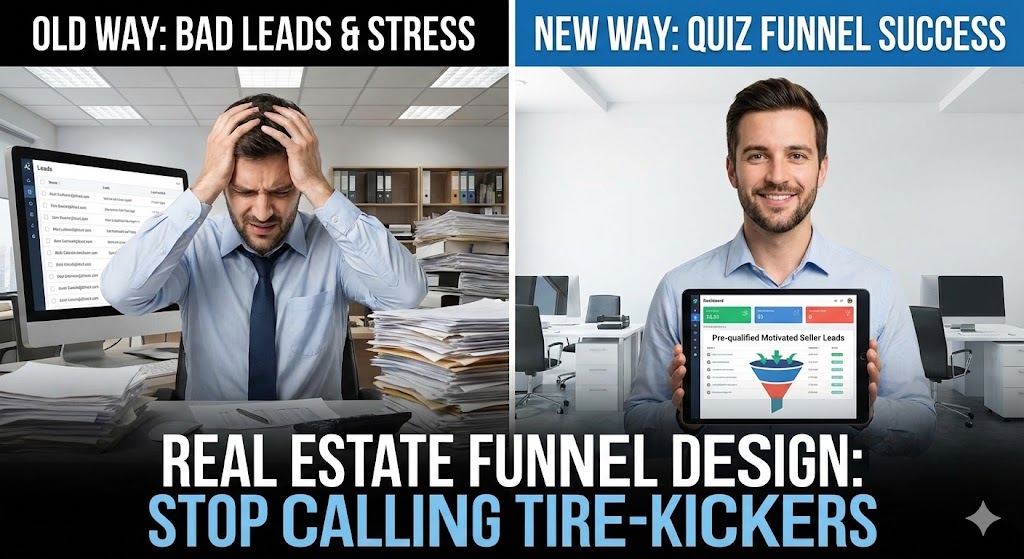
Home Services Performance Marketing Social Media Ads Google Ads Facebook Ads Pay Per Click Ads About Me Knowledge Hub Home Services Performance Marketing Social Media Ads Google Ads Facebook Ads Pay Per Click Ads About Me Knowledge Hub Book A Discovery Call Real Estate Funnel Design: How I Use “Quiz Funnels” to Pre-Qualify Motivated Sellers and Block Tire-Kickers By Deepak Jaiswal | Performance Marketing & Funnel Expert Reading Time: 12 Minutes Every week, a frustrated real estate wholesaler reaches out to me with the exact same complaint: “Deepak, I ran Meta Ads for my investing business. I got 50 leads for $15 each. But when I call them, they either don’t answer, curse me out, or demand full retail Zillow value for their completely trashed house. Facebook leads are garbage.” I always give them the same blunt answer: The platform is not broken. Your funnel is broken. If you are running a generic “We Buy Houses” Facebook ad and sending traffic to a basic form that just asks for Name, Email, and Phone Number, you are begging for low-quality leads. You have made it too easy for bored, curious tire-kickers to submit their information without any real intent to sell at a discount. If you want to stop wasting your time on the phone with people who aren’t motivated, you need to completely change your real estate funnel design. You have to stop using basic forms and start using what I call the “Micro-Commitment Quiz Funnel.” In this breakdown, I am going to show you exactly how I build performance marketing funnels that automatically filter out retail sellers, pre-qualify distress, and trigger instant automations so you only talk to highly motivated homeowners. The Psychology of the “Micro-Commitment” Human psychology is simple. If you walk up to a stranger and immediately ask for their phone number, their defense mechanism goes up. But if you ask them a few simple, non-threatening questions first, they become engaged. By the time you ask for the phone number, they have already invested time into the process, so they gladly hand it over. This is called the “Sunk Cost Fallacy,” and it is the secret weapon of my highest-converting funnels. Instead of a terrifying contact form, my funnels look like an interactive quiz. It feels like a personalized assessment rather than a harsh sales pitch. Data Table: Standard Form vs. The Quiz Funnel Metric Basic Web Form (Name/Email/Phone) The Micro-Commitment Quiz Funnel Lead Intent Low (Too easy to fill out) Extremely High (They answered 7 questions) Data Captured Contact info only Motivation, Timeline, Property Condition Retail Sellers Slips through easily Filtered out automatically Conversion Rate 2% – 5% 12% – 20%+ Your Time Wasted High (Calling bad leads) Zero (Only calling qualified deals) Step 1: The Interactive Question Sequence (Filtering the Garbage) When I design a funnel for a real estate campaign, the homeowner never sees an input box for their phone number on the first page. That is a conversion killer. Instead, when they click the Meta Ad, they land on a clean, authoritative page with a simple headline: “See What We Can Pay For Your [City] Home in As-Is Condition.” Below it, there is a large, clickable button that says: “Start My Cash Offer Assessment.” Once they click it, the quiz begins. Here is the exact sequence I build to extract the data you need to make an offer: Question 1 (The Easy Yes): “What type of property are you looking to sell?” (Single Family, Townhouse, Multi-Family, Land). Question 2 (The Timeline): “How quickly are you looking to close?” (ASAP, 1-3 Months, Just curious). If they select “Just curious,” my automation tags them as low-priority. Question 3 (The Condition): “Does the property need any major repairs?” (Needs full gut, Minor updates, Move-in ready). Question 4 (The Motivation): “Why are you considering selling?” (Relocation, Inherited, Financial Distress, Too many repairs). Question 5 (The Hook): “Great! We are calculating your local cash offer range. Where should we send the details?” -> This is where I finally ask for the Name, Email, and Phone Number. Because they just spent 45 seconds answering questions about their specific property, their brain tells them they need to finish the process to get the result. The quality of the leads I generate with this structure is night and day compared to standard forms. Step 2: The “Disqualification” Page Here is a radical concept that most marketing “gurus” will never tell you: You should actively try to reject people in your funnel. If a homeowner clicks through the quiz and states that their house is “Move-in ready” and they are “Looking for full market value,” I do not want that lead entering your CRM. I don’t want you wasting 15 minutes trying to negotiate with someone who should just hire a traditional real estate agent. I use conditional logic in my real estate funnel design. If a seller’s answers indicate they are a retail seller, the funnel automatically redirects them to a “Disqualification Page.” The Page Says: “Based on your answers, it looks like your home is in pristine condition! Since we are cash buyers looking for properties that need repairs, we might not be your best option. We highly recommend reaching out to a local realtor to list your house on the MLS for top dollar.” By actively pushing bad leads away, the only notifications you get on your phone are from people who actually have a distressed problem that you can solve. A high-converting quiz funnel is useless if you don’t have the right people landing on it. While Meta ads are incredible for generating local awareness, you also need to capture the homeowners who are actively panicking and searching for an immediate cash buyer. To pump the absolute highest-intent traffic into this funnel, you must deploy my exact search strategy for Google ads for motivated sellers and dominate your local market. Step 3: “Abandoned Cart” Automation for Real Estate This is where my background in direct-response e-commerce translates
Facebook ads for home service
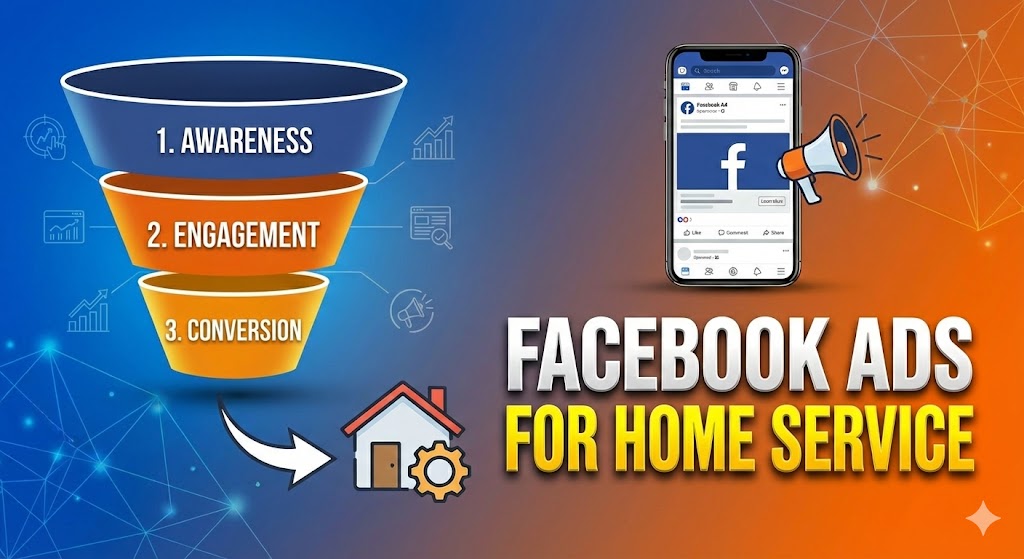
Home Services Performance Marketing Social Media Ads Google Ads Facebook Ads Pay Per Click Ads About Me Knowledge Hub Home Services Performance Marketing Social Media Ads Google Ads Facebook Ads Pay Per Click Ads About Me Knowledge Hub Book A Discovery Call Facebook Ads for Home Service: The 3-Step Funnel to Stop Buying Shared Leads and Dominate Your Market By Deepak Jaiswal | Performance Marketing & Funnel Expert Reading Time: 13 Minutes If you run a roofing, HVAC, or plumbing company, you already know the extreme pain of the “shared lead” hustle. A homeowner has a leaking roof. They go to a massive directory site like Angi, HomeAdvisor, or Thumbtack, and fill out a quick form. Instantly, that single lead is sold to you and four of your fiercest local competitors for $80 a pop. Within ten seconds, five different contractors are blowing up the homeowner’s phone. The homeowner gets annoyed, and the job goes to the guy willing to slash his prices the absolute lowest. You are forced into a race to the bottom, sacrificing your profit margins just to keep your crews busy. This is not a business model; it is a hamster wheel of stress. If you want to command premium pricing ($15,000+ for a roof replacement, $10,000+ for a new HVAC system) without begging for attention, you must build your own proprietary lead generation engine. You need to stop renting access to customers and start generating 100% exclusive jobs. The fastest, most scalable way to do this is by combining Facebook ads for home service with high-converting Funnel Design and backend CRM Automation. When you do this correctly, you stop competing on price and start competing on value. Here is the exact performance marketing blueprint to build your exclusive lead machine. Why “Boosting Posts” is Burning Your Money Before we build the funnel, we need to address the biggest mistake contractors make on the platform: The “Boost Post” button. Facebook intentionally makes this button bright blue and incredibly easy to click. A contractor finishes a nice patio installation, uploads a picture, and clicks “Boost” for $50. They get 100 “Likes,” three comments from their relatives, and absolutely zero phone calls. Boosting a post is not performance marketing; it is a vanity metric. The algorithm optimizes boosted posts for “Engagement” (likes and shares), not for “Conversions” (name, email, phone number, and physical address). To generate actual revenue, you must use the Facebook Ads Manager to run direct-response conversion campaigns. But running a good ad is only 20% of the equation. If you send that paid traffic to your generic company homepage, you will lose 95% of your potential leads. You must have a dedicated sales funnel. Data Table: The “Boosted Post” vs. The Performance Funnel Metric Boosting Facebook Posts Facebook Ads + Funnel & Automation Optimization Goal Vanity metrics (Likes/Comments) Lead Generation (Name, Phone, Email) Traffic Destination Generic company homepage Dedicated, single-offer Landing Page Lead Exclusivity N/A (Rarely generates leads) 100% Exclusive to your business Follow-Up Manual (If you remember to check) Instant SMS/Email CRM Automation ROI Tracking Impossible to track revenue Exact Cost Per Acquisition (CPA) tracked Facebook Ads are incredible for generating exclusive demand and building your local brand. However, if you need the phone to ring with high-intent emergency jobs right this second—like a burst pipe at 2 AM—you should pair your Facebook funnels with our strategy for Google Local Services Ads for contractors to capture people actively searching on Google.) Step 1: The “Before & After” Ad Creative (Show, Don’t Tell) When homeowners scroll through Facebook, they are looking for entertainment, stories, or updates from friends. They are not actively looking for a plumber. Your ad must visually disrupt their scrolling and instantly communicate the massive transformation you provide. Do not use stock photos of models wearing clean hard hats and pointing at blueprints. Homeowners see right through corporate stock photography. It looks fake, and they will scroll past it in half a second. The Highest Converting Facebook Ad Formats for Contractors: The Time-Lapse Video: Set up an iPhone on a tripod and record your crew tearing off an old roof and installing a new one in a 30-second sped-up video. It is visually satisfying and proves you actually do real, hard work in the community. The “Before & After” Carousel: Show the disgusting, moldy HVAC unit on the first slide, swipe right, and show the pristine, high-efficiency system you just installed on the second slide. The Founder “Selfie” Video: Stand in front of a recognizable local landmark or a recently completed job site. Say: “Hey [City] homeowners, we just finished this complete roof replacement over in the Oakbrook neighborhood. If your roof is over 15 years old and you’re worried about the next storm season, click below to get a free, no-obligation drone inspection.” Step 2: Funnel Design (Never Send Paid Traffic to a Homepage) This is the exact point where most generic marketing agencies fail their contractor clients. They write a great ad, get a cheap $3 click, and then send the homeowner to www.joesplumbing.com. The homeowner lands on the homepage, gets confused by the “About Us” tab, reads a blog post from four years ago, and leaves without ever calling. You must use a Dedicated Landing Page Funnel. A funnel is a single web page with one highly specific goal: Convert the click into a lead. There are no menus at the top. There are no external links to your social media. There is only a compelling offer and a form. Anatomy of a High-Converting Home Service Funnel: The Headline: Matches the ad perfectly. “Get Your Free, No-Obligation Roof Inspection in [City].” The Trust Proof (Above the Fold): Badges showing you are Licensed, Bonded, Insured, and have a 4.9 Star Rating on Google. If they don’t see trust signals immediately, they bounce. The Irresistible Offer: Give them a financial reason to act now. “Get $500 off a full HVAC replacement if you book your estimate this week.” The Form: Keep
YouTube ads for solar leads
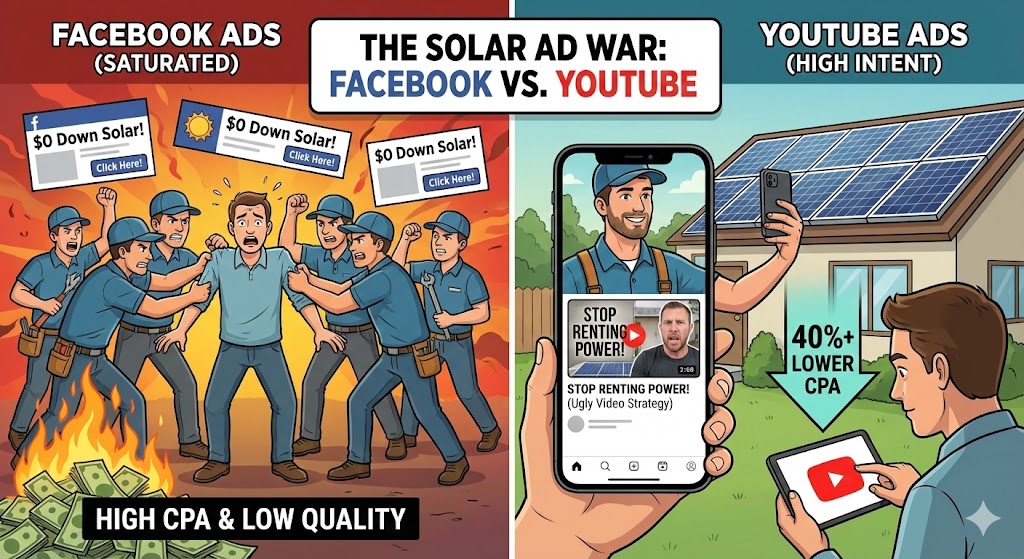
Home Services Performance Marketing Social Media Ads Google Ads Facebook Ads Pay Per Click Ads About Me Knowledge Hub Home Services Performance Marketing Social Media Ads Google Ads Facebook Ads Pay Per Click Ads About Me Knowledge Hub Book A Discovery Call YouTube Ads for Solar Leads: The “Ugly Video” Strategy Generating 40%+ Lower CPAs While Competitors Fight on Facebook By Deepak Jaiswal | Solar Marketing Strategy Expert Reading Time: 13 Minutes The solar industry has a massive “herd mentality” problem. Five years ago, everyone rushed to buy shared leads from Angi. Then, they all rushed to run generic Facebook image ads. Now, your newsfeed is suffocated with identical ads screaming “Does your zip code qualify for $0 down solar??” The result? Facebook ad costs are skyrocketing, homeowners have developed “banner blindness” to these ads, and lead quality is tanking fast. You are fighting in a red ocean, competing with 50 other installers in your city for the same distracted homeowner scrolling through cat memes. If you want to generate high-intent YouTube ads for solar leads and drop your Cost Per Acquisition (CPA) by 40% or more, you need to go where homeowners are actively looking for answers, not just scrolling out of boredom. You need to be on YouTube. YouTube is the second largest search engine in the world, owned by Google. When a homeowner gets a massive $500 electric bill during a heatwave, they don’t go to Instagram to research solutions. They go to Google and YouTube and type in: “Why is my electric bill so high?” or “Are solar panels worth it?” If your video ad appears right at that moment of high intent, you are not interrupting them; you are answering their prayers. Why YouTube Beats Facebook for High-Ticket Solar The fundamental difference between Facebook and YouTube is intent. Facebook is “interruption marketing.” You are trying to stop someone from looking at photos of their cousin’s wedding. Their attention span is less than 3 seconds. YouTube is “search-intent marketing.” The user is already in a learning mindset. They are sitting at their desktop or watching on their TV, ready to consume content. They have the patience to understand the complex financial value proposition of solar. Data Table: The Solar Ad Platform Comparison Let’s look at the raw data on why smart money is moving to YouTube. Metric Facebook / Instagram Ads YouTube Ads (Google) User Mindset Distracted, Scrolling, Bored Focused, Learning, Searching Average Watch Time 3-5 seconds 30-60+ seconds Targeting Power Interests & Demographics Real-Time Search Intent (What they just typed into Google) Competition Level Extremely High (Saturated) Low (Most installers are scared of video) Lead Quality Mixed (Lots of tire kickers) Very High (Educated homeowners) Step 1: The “Ugly Video” Ad Strategy (Stop Being Polished) The number one reason solar companies don’t run YouTube ads is fear. They think they need a $20,000 camera crew, drones, actors, and a professional studio script. This is completely false. In fact, overly polished “TV commercials” perform terribly on YouTube. They look like ads, so people skip them immediately. Authenticity wins. We call this the “Ugly Video” strategy. Some of the highest-converting solar ads running right now are shot on an iPhone, often in selfie mode, by a real person standing in front of a meter or a roof. The winning 4-part script framework: YouTube Ads for Solar Leads. Don’t try to be a movie director. Just follow this psychological framework used by top direct-response marketers: The Hook (0-5 seconds): Call out the pain immediately. Do not show your logo. Example: “Stop paying your utility company $300 a month for power you are just renting. It’s ridiculous.” (Shot selfie-style in front of an electric meter). The Problem Agitation (5-20 seconds): Twist the knife. Example: “Did you see the rate hike notice? Rates are going up again this summer. That $300 bill is about to be $450. And once you pay it, that money is gone forever.” The “New Opportunity” Solution (20-45 seconds): Introduce the current incentives without being boring. Example: “But homeowners in [Your State] with a credit score over 650 are using the current federal programs to swap that rising utility bill for a fixed solar payment that is usually lower than what they pay now. It costs $0 out of pocket to switch.” The Call to Action (45-60 seconds): Tell them exactly what to do next. Example: “I recorded a short video explaining exactly how the math works for homes in our area. Click the link below, answer three questions about your roof, and you can watch it instantly.” It’s raw. It’s real. It feels like a friend giving advice, not a corporation trying to sell something. That is why it converts. Step 2: Targeting Homeowners Who Are Actively Searching This is where YouTube’s connection to Google becomes your unfair advantage. You cannot do this on Facebook. We use something called “Custom Intent Audiences.” You can tell YouTube: “Show my video ad ONLY to people who have gone to https://www.google.com/search?q=Google.com in the last 7 days and searched for these exact keywords:” “cost of solar panels in [My State]” “best solar companies near me” “how does the solar tax credit work” “why is my electric bill so high” Think about the power of that. You are putting your “Ugly Video” right in front of someone who literally just asked Google for help with high energy costs. The intent is off the charts. This isn’t cold traffic; it’s pre-heated traffic. Step 3: The VSL Landing Page (Don’t Use a Basic Form) Just like we discussed with other platforms, never send high-quality YouTube traffic to a generic “Contact Us” page. They just watched a 60-second video; they want more information, not less. Send them to a Video Sales Letter (VSL) page or an interactive savings calculator. Give them the educational content you promised in the ad. YouTube users are in “watch mode.” Let them watch. The VSL does the heavy lifting of educating the homeowner on net metering, tax
Google ads for motivated sellers
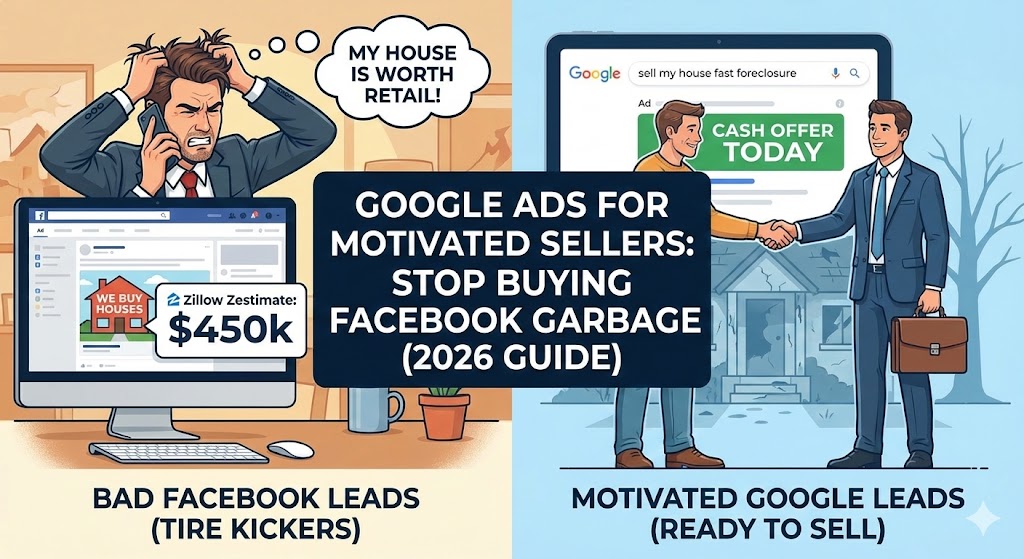
Home Services Performance Marketing Social Media Ads Google Ads Facebook Ads Pay Per Click Ads About Me Knowledge Hub Home Services Performance Marketing Social Media Ads Google Ads Facebook Ads Pay Per Click Ads About Me Knowledge Hub Book A Discovery Call Google Ads for Motivated Sellers: Stop Buying Facebook Garbage and Target Real Intent (2026 Guide) By Deepak Jaiswal | Real Estate Growth Specialist Reading Time: 10 Minutes Every week, I talk to a real estate wholesaler or flipper who tells me the exact same sad story. “Deepak, I’m getting Facebook leads for $15 a piece! But when I call them, they tell me their house is worth $450k because that’s what Zillow says. The house needs a new roof, the foundation is cracked, and they won’t take a penny under retail.” I always give them the same answer: You are marketing to the wrong mindset. Facebook is a platform of interruption. When you run a “We Buy Houses” ad on Facebook, you are interrupting someone who is looking at photos of their nephew’s birthday party. They click your ad out of pure curiosity. They are not desperate. They are not motivated. They are just tire-kickers. If you want to buy deep-discounted, off-market real estate in 2026, you need to stop begging people for their attention and start standing in front of the people who are actively begging for your help. You need to master Google Ads for motivated sellers. When someone is facing foreclosure on Friday, getting a divorce, or dealing with a house completely destroyed by terrible tenants, they don’t scroll Instagram. They go to Google and type: “How to sell my house fast for cash in [City].” That is not curiosity. That is a cry for help. And if your ad is the first thing they see, you win the deal. Here is how to build a high-converting PPC machine that actually works. The Intent Hierarchy: Why Google Leads Cost More (And Why You Should Gladly Pay It) Let’s address the elephant in the room: Google Ads are expensive. A single click can cost you $20 to $50 depending on your market. A single generated lead might cost you $150 to $300. Amateur investors see that $200 Cost Per Lead (CPL) and run back to Facebook to buy $15 garbage leads. Professional investors look at the Cost Per Acquisition (CPA) and realize Google is a goldmine. Would you rather call 100 Facebook leads (spending $1,500) to get zero deals and 99 people yelling at you? Or would you rather pay $300 for one Google lead where the seller says, “The bank is taking the house in two weeks, please just make me an offer today.” Data Table: Interruption vs. Search Intent in Real Estate Metric Facebook “We Buy Houses” Ads Google Search Ads (PPC) Seller Mindset Curious, Passive, Window Shopping Urgent, Stressed, Ready to Sell Price Expectation Wants full retail value (Zillow) Willing to take a massive discount Cost Per Lead (CPL) $10 – $30 (Cheap) $100 – $300 (Expensive) Lead-to-Deal Ratio 1 deal per 80-100 leads 1 deal per 10-15 leads Time Wasted High (Endless follow-up required) Low (They want to close immediately) Step 1: The Long-Tail Keyword Strategy If you go into Google Ads right now and bid on the keyword “sell my house,” you will go bankrupt in three days. You will be competing against Zillow, OpenDoor, and massive national hedge funds with bottomless budgets. You cannot outspend the giants. You have to outsmart them using “Long-Tail Keywords.” Long-tail keywords are specific, multi-word phrases that indicate massive distress and urgency. Hedge funds don’t bid on these because the search volume is too low for their algorithms. But for a local investor, these keywords are pure cash. Stop bidding on: “Sell my house” “Real estate agent near me” “What is my house worth” Start bidding on: “Sell my house fast with fire damage [Your City]” “How to stop foreclosure auction tomorrow” “Sell inherited house with stuff left inside” “Cash home buyers who pay closing costs” When you bid on hyper-specific pain points, your clicks are cheaper, and the conversion rate skyrockets because your ad copy can speak directly to their exact problem. While Google PPC captures general distress, some of the highest-equity deals come from specific life events. Pairing your PPC campaigns with a targeted inbound funnel specifically designed for probate real estate leads is how you build a truly dominant, multi-channel acquisition system Step 2: The “Anti-Corporate” Landing Page Here is where 90% of local investors mess up their Google Ads for motivated sellers. They pay $40 for a click, and send the seller to a website that looks like a Wall Street banking firm. Distressed sellers are usually intimidated. They are embarrassed about the condition of their house. They don’t want to deal with a guy in a $2,000 suit who is going to judge them. They want a local, blue-collar problem solver. Your landing page needs to scream: “I am local, I am real, and I make this easy.” The Hero Image: Do not use stock photos of smiling families handing over keys. Use a real photo of you standing in front of an ugly house in your city. The Headline: Address the speed and condition. “We Buy Houses in [City] Completely As-Is. Get a Cash Offer in 24 Hours.” The Proof: Put up local video testimonials of people saying, “I thought I was going to lose my house to the bank, but John bought it in 7 days and let me leave all the trash behind.” The Form: Keep it dead simple. Address, Phone Number, Email. That’s it. Step 3: Speed to Lead is Life or Death Once your technical records are set, you still can’t send your pitch. New domains have a “neutral” reputation. If a 1-day-old domain suddenly sends 100 emails, it triggers massive red flags. You have to “warm up” your inboxes. You connect your new email accounts to a warm-up tool. This software automatically sends emails
Google Local Services Ads for contractors
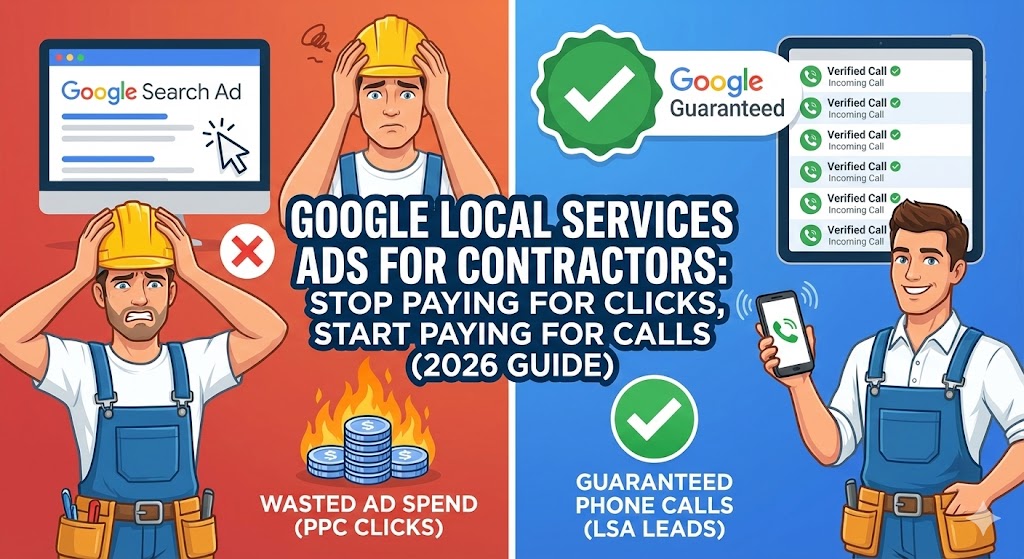
Home Services Performance Marketing Social Media Ads Google Ads Facebook Ads Pay Per Click Ads About Me Knowledge Hub Home Services Performance Marketing Social Media Ads Google Ads Facebook Ads Pay Per Click Ads About Me Knowledge Hub Book A Discovery Call Google Local Services Ads for Contractors: Stop Paying for Useless Clicks and Start Paying for Calls (2026 Guide) By Deepak Jaiswal | Local Business Growth Specialist Reading Time: 11 Minutes Let me ask you a painful question. How much money did your home service business waste on Google Ads last month? If you are running a standard Pay-Per-Click (PPC) campaign for your plumbing, HVAC, or roofing business without knowing exactly what you are doing, you are probably bleeding cash. You bid on a keyword like “plumber near me.” You pay Google $40 for a single click. The homeowner lands on your website, gets distracted by their dog, and closes the tab. Boom. You just lost $40, and your phone never rang. In the home services industry, paying for “website visitors” is a scam. You don’t need traffic. You need phone calls. You need a frantic homeowner with a broken AC unit in the middle of July screaming into the receiver, “How fast can you get here?” This is exactly why Google Local Services Ads for contractors (LSAs) completely changed the game. If you are not running LSAs right now, your competitors are literally stealing the best jobs in your city right out from under your nose. In this guide, I am going to tear down the old way of running Google Ads and show you how to dominate the very top of the search results using the “Google Guaranteed” program. The Math: Why LSAs Destroy Traditional PPC Look at any Google search result for a home service today. What is at the absolute top? It is not the organic SEO results. It is not even the traditional text ads. It is a row of three boxes featuring a green checkmark that says “Google Guaranteed.” These are Local Services Ads. The biggest difference between standard PPC and LSAs is the billing model. With traditional ads, you pay every time someone clicks your link. With LSAs, you only pay when a qualified customer actually calls your business and speaks to you. If they click your ad but don’t call, Google charges you $0. Data Table: Standard Google Ads vs. Google LSAs Feature Standard Google Search Ads (PPC) Google Local Services Ads (LSA) Placement Below LSAs Absolute Top of Page (Above everything) Billing Model Pay Per Click (PPC) Pay Per Lead (Valid Phone Calls Only) Trust Factor Just another text ad “Google Guaranteed” Badge (High Trust) Management Requires heavy keyword tweaking Automated (Based on job types/zip codes) Refunds for Bad Leads Extremely difficult to get Easy (Just dispute the call in the dashboard) Running LSAs is the absolute fastest way to stop relying on terrible platforms like HomeAdvisor. If you haven’t already made the decision to ditch shared leads, you need to read my complete breakdown on why building a system for exclusive home service leads is the only way to scale past 7-figures. Step 1: Surviving the “Google Guaranteed” Background Check Google does not just let anyone run these ads. Because they are putting their own brand on the line with the “Google Guaranteed” badge (which covers the customer up to $2,000 if you mess up the job), they heavily vet your business. This barrier to entry is actually a massive advantage for you. It keeps the cheap, unlicensed “chuck-in-a-truck” contractors out of the ad space. To get approved, you must pass: Background Checks: You, and often your field workers, must pass a third-party criminal background check. License Verification: You must upload your active state and local contracting licenses. Insurance Proof: You must provide proof of general liability insurance. Do not drag your feet on this. The approval process can take 2 to 4 weeks. Get your paperwork organized, submit it through the LSA dashboard, and get it done. Step 2: The Art of the Dispute (Never Pay for Junk) One of the greatest features of Google Local Services Ads for contractors is the dispute button. Sometimes, people call the LSA tracking number for the wrong reason. A competitor might call to spy on your pricing. A solicitor might call to sell you SEO services. Someone might call looking for a job. With standard Google Ads, you still pay for that click. With LSAs, you can simply log into your dashboard, click on that specific call recording, and hit “Dispute.” You tell Google, “This was a solicitor, not a customer.” Google reviews the call recording, agrees with you, and refunds the cost of the lead back to your account. You are literally only paying for legitimate homeowners who need your specific services. It is the highest ROI marketing spend in the home services industry. Step 3: Hacking the LSA Ranking Algorithm Once you are approved, you will notice you aren’t the only one with a green checkmark. You are competing against other approved contractors in your city. So, how does Google decide who gets the #1 spot? It is not just about who pays the most. The LSA algorithm is heavily based on three operational metrics: 1. Review Velocity and Rating Having 500 reviews from three years ago is okay, but Google wants to see recent activity. They prioritize contractors who consistently get 5-star reviews every single week. You must build an automated review request system into your dispatch software (like ServiceTitan or Housecall Pro) so every satisfied customer gets a text message asking for a review the second you leave their driveway. 2. Your “Speed to Lead” (Answer the Phone!) Google tracks how fast you answer LSA calls. If you miss calls, let them go to voicemail, or put people on hold for five minutes, Google will heavily penalize your ranking. They want to send their users to businesses that provide a great experience. If you cannot answer the
B2B cold email lead generation
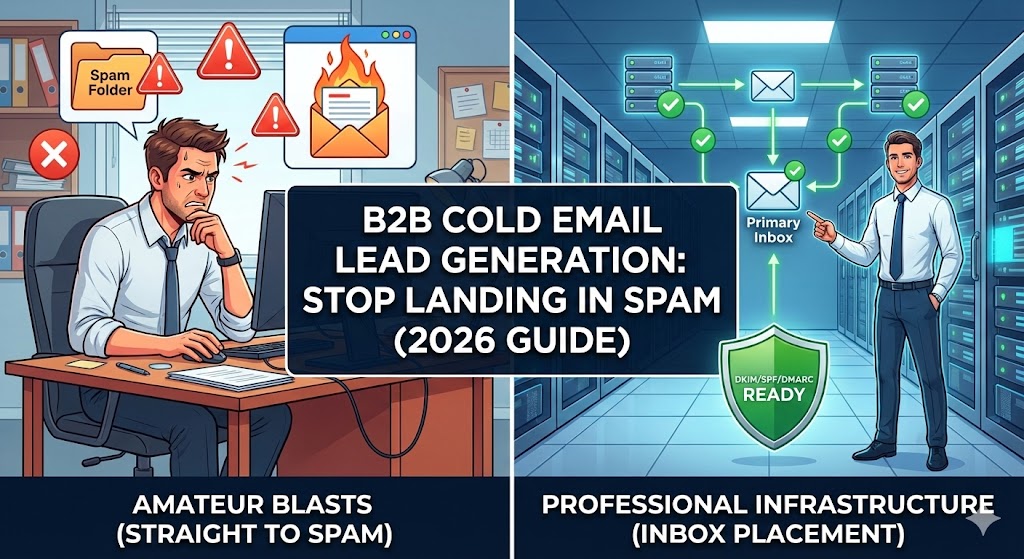
Home Services Performance Marketing Social Media Ads Google Ads Facebook Ads Pay Per Click Ads About Me Knowledge Hub Home Services Performance Marketing Social Media Ads Google Ads Facebook Ads Pay Per Click Ads About Me Knowledge Hub Book A Discovery Call B2B Cold Email Lead Generation: Why You Are Landing in Spam and How to Build a Real Infrastructure (2026 Guide) By Deepak Jaiswal | B2B Growth Strategy Expert Reading Time: 12 Minutes “Cold email is dead.” If I had a dollar for every time a struggling agency owner or SaaS founder told me that, I would retire tomorrow. Cold email is not dead. What is dead is the lazy, amateur way people have been doing it for the last five years. Here is what the average founder does: They buy a list of 5,000 emails from a cheap data provider. They load that list into Mailchimp or HubSpot using their company’s main email address (founder@mycompany.com). They write a terrible, five-paragraph pitch starting with “Hope this finds you well,” and hit send. Within 48 hours, Google and Microsoft flag their domain as spam. Not only do their cold emails go straight to the junk folder, but now their actual clients are not receiving their regular emails or invoices. They literally burn their own digital house down. If you want to master B2B cold email lead generation in 2026, you have to treat it like a serious IT infrastructure project, not a weekend marketing hack. You are fighting against billion-dollar spam filters. To win, you need burner domains, technical authentication, and hyper-relevant copy. In this guide, I will show you exactly how to build a cold email machine that bypasses the spam folder, lands in the primary inbox, and books highly qualified sales calls on autopilot. The Amateur Blast vs. The Professional Infrastructure Spam filters analyze everything. They look at how old your domain is, how many emails you send per day, what words you use, and whether people actually reply to you. If you act like a spammer, you get treated like one. Data Table: How the Amateurs Fail vs. How the Pros Scale Strategy The Amateur Approach The Professional 2026 Infrastructure Domain Used Main company domain (Huge Risk) Secondary “Burner” Domains (Zero Risk) Volume per Inbox 500+ emails per day Max 30-40 emails per day Email Accounts 1 account sending 1,000 emails 20 accounts sending 30 emails each Deliverability 10% (Straight to Spam) 95%+ (Primary Inbox) The Copy “We are the best, buy our service.” “I noticed X problem at your company. Open to a fix?” List Quality Scraped, unverified junk data Hand-picked, manually verified contacts Step 1: The “Burner Domain” Shield This is the most non-negotiable rule of cold email: Never send cold outreach from your main company domain. If your main website is acmesoftware.com, you must buy secondary domains that look similar but act as a shield. We call these “burner domains” or “lookalike domains.” Buy domains like: tryacmesoftware.com, getacmesoftware.com, or acmesoftware.co. Set up redirects: Forward all these secondary domains so that if a prospect types them into their browser, they instantly redirect to your main website. Why do we do this? Because if one of these secondary domains gets blacklisted by Google for sending too many cold emails, your actual business operations remain completely safe. You just throw that burned domain away, buy a new $10 domain, and keep your campaigns running. Step 2: The Technical Setup (DKIM, SPF, DMARC) You cannot just buy a domain and start sending emails five minutes later. Google Workspace and Microsoft 365 will instantly reject your messages. You have to prove you are a real, authenticated sender. This sounds incredibly nerdy, but you only have to set it up once. You need to add three specific text records to your domain’s DNS settings: SPF (Sender Policy Framework): Tells the internet which servers are allowed to send emails on your behalf. DKIM (DomainKeys Identified Mail): Adds a digital signature to your emails, proving they weren’t altered in transit. DMARC (Domain-based Message Authentication): Tells receiving servers what to do if an email fails the SPF or DKIM checks. If you do not have these three records perfectly configured, your B2B cold email lead generation campaign is over before it even begins. You will go straight to spam. Step 3: Domain Warm-Up (Patience is Profitable) Once your technical records are set, you still can’t send your pitch. New domains have a “neutral” reputation. If a 1-day-old domain suddenly sends 100 emails, it triggers massive red flags. You have to “warm up” your inboxes. You connect your new email accounts to a warm-up tool. This software automatically sends emails back and forth between thousands of other real people in the network. It opens the emails, replies to them, and marks them as “not spam.” You must let your domains warm up for a minimum of 14 to 21 days before you send a single real sales email. This builds a pristine sender reputation with Google and Microsoft. Step 4: Writing Human Copy and Selling the “Click” Now that your infrastructure guarantees you will land in the primary inbox, you have to get the prospect to actually reply. CEOs and Founders delete bad cold emails in 1.5 seconds. If your email is longer than 5 sentences, they won’t read it. If it contains bullet points of your services, they will delete it. The Anatomy of a High-Converting Cold Email: The Subject Line: Keep it boring and casual. “Quick question regarding [Company Name]” or just “Your outbound process.” Do not use capitalization or exclamation marks. The Hook: Prove you actually researched them. “Hey John, saw you just hired three new SDRs in Chicago.” The Problem/Offer: State the pain point simply. “Usually, when companies scale their sales team that fast, ramp-up time eats their margins. We built a system that cuts SDR ramp-up from 3 months to 3 weeks.” The Call to Action (CTA): Do not ask for a 30-minute call. That is too big
Facebook ads for solar leads
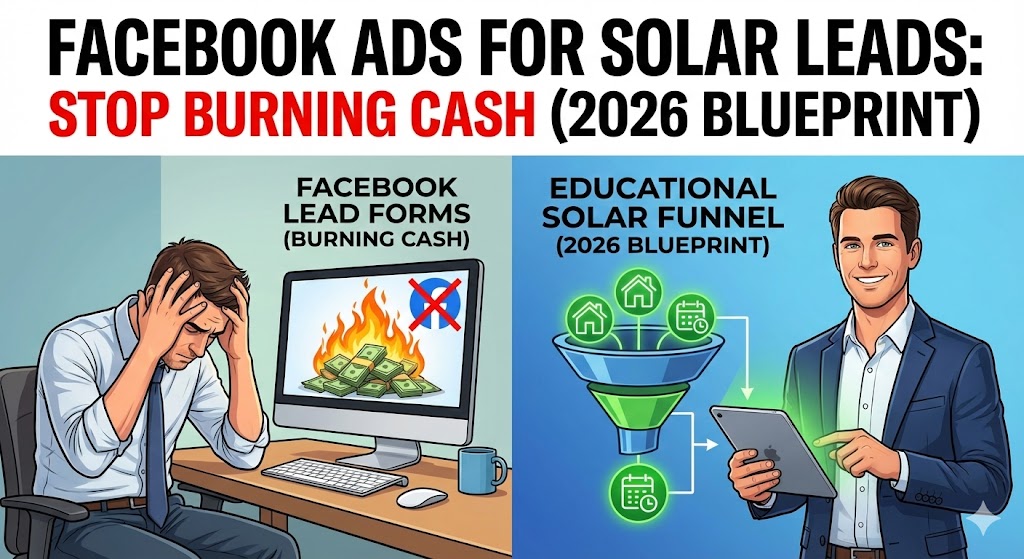
Home Services Performance Marketing Social Media Ads Google Ads Facebook Ads Pay Per Click Ads About Me Knowledge Hub Home Services Performance Marketing Social Media Ads Google Ads Facebook Ads Pay Per Click Ads About Me Knowledge Hub Book A Discovery Call Facebook Ads for Solar Leads: How to Stop Burning Cash and Build a Predictable Appointment Machine (2026 Guide) By Deepak Jaiswal | Solar Marketing Strategy Expert Reading Time: 12 Minutes If you own a solar company or sell solar door-to-door, you have probably heard the same rumor circulating in the industry: “Facebook ads don’t work for solar anymore. The leads are garbage, the cost is too high, and homeowners just want free stuff.” This is a dangerous myth. Facebook ads for solar leads still work flawlessly in 2026. The problem is not the platform; the problem is your strategy. If you are running generic ads that say, “Stop paying high electric bills! Get zero down solar today!” and sending that traffic to a basic form that asks for their name and phone number, you are marketing like it is 2018. Homeowners are completely blind to these offers. They have seen them a thousand times. To win on Facebook and Instagram today, you have to stop selling “panels” and start selling “education.” You have to shift from a high-pressure sales tactic to a consultative, value-driven funnel. In this comprehensive guide, I am going to show you the exact 2026 blueprint to generate high-intent, exclusive solar leads on Meta (Facebook/Instagram) that actually convert into signed contracts. The Death of the “Lead Gen Form” Strategy The biggest mistake solar marketers make is using Facebook’s native “Lead Generation” objective. Why? Because Facebook makes it too easy for the user. With two taps, Facebook auto-fills the user’s name, email, and phone number, and the lead is sent to your CRM. The homeowner barely remembers filling it out. When your sales rep calls them 5 minutes later, the homeowner says, “Solar? I didn’t sign up for solar. I just clicked a picture of a house.” You get a high volume of leads, but the intent is virtually zero. Your sales team gets frustrated, your close rate drops to 2%, and you conclude that Facebook ads are dead. Data Table: Native Lead Forms vs. Custom Educational Funnels Let’s look at the math comparing the “old way” of running Facebook ads for solar leads versus the “new way.” Metric Facebook Native Lead Forms Custom Educational Funnel Cost Per Lead (CPL) $15 – $30 (Very Cheap) $60 – $120 (Higher) Lead Quality / Intent Very Low (Accidental clicks) Extremely High (Educated) Contact Rate 10% – 20% 60% – 80% Appointment Show Rate 20% – 30% 70% – 85% Sales Close Rate 2% – 5% 15% – 25% Customer Acquisition Cost $4,000+ (Wasted sales time) $1,500 – $2,500 (Highly Profitable) As you can see, a cheap lead is actually the most expensive lead you can buy if it doesn’t close. We want fewer, higher-quality leads. Step 1: Writing Ad Copy That Educates, Not Sells To capture high-quality Facebook ads for solar leads, your ad creative must stop looking like an advertisement and start looking like a valuable piece of local news or financial education. The “State Policy” Angle Homeowners don’t care about the wattage of your panels. They care about government incentives, rising utility rates, and saving money. Bad Ad Copy: “Get solar installed for $0 down! Call us today for the best prices in Texas!” Good Ad Copy (The 2026 Approach): “Attention Texas Homeowners: Did you know that the recent utility rate hikes from [Local Utility Company] are expected to increase average winter bills by 18%? Many homeowners in [City] are using the new 2026 Federal ITC program to lock in their energy rates and build equity instead of renting their power. Click below to use our free calculator and see if your zip code qualifies.” The Creative (Images & Videos) Stop using stock photos of smiling families pointing at the sun. Use real, authentic content: A raw, unedited selfie video of a local homeowner explaining how much their bill dropped. A picture of your installation crew on a roof with a recognizable local landmark in the background. A screenshot of a local news article talking about rising energy costs. Step 2: The Solar Savings Calculator Funnel (The Filter) When the homeowner clicks your ad, they must NOT go to a page asking for their phone number. They need to go to an interactive “Solar Savings Calculator.” This is the secret weapon for generating the best Facebook ads for solar leads. It gamifies the experience and acts as a strict qualification filter. The Quiz Flow: “Do you own your home?” (If they select “Rent,” redirect them to a disqualification page. Stop wasting time on renters). “What is your average monthly utility bill?” (Under $100 / $100-$200 / $200+). This helps you identify the whales. “What type of roof do you have?” (Shingle, Tile, Flat, Metal). “How much shade covers your roof during the day?” (None, Some, A lot). “Where should we send your custom energy savings report?” (Name, Email, Phone Number, Address). Because the homeowner just spent 45 seconds answering specific questions about their property, their psychological commitment is high. When you call them, they know exactly who you are and why you are calling. Step 3: The Omnipresent Retargeting Machine Only about 5% of people who click your ad will fill out the calculator on the first try. The other 95% get distracted—their kid cries, the dog barks, or their boss walks in. If you do not have a retargeting strategy, you are leaving hundreds of thousands of dollars on the table. The 3-Tier Retargeting Strategy You must install the Meta Pixel on your landing page. Once a homeowner visits your page but doesn’t become a lead, you put them into a 14-day retargeting sequence. Days 1-3 (The Logical Push): Show them ads featuring the financial breakdown. Explain the ROI, the tax credits, and the
Exclusive home service leads
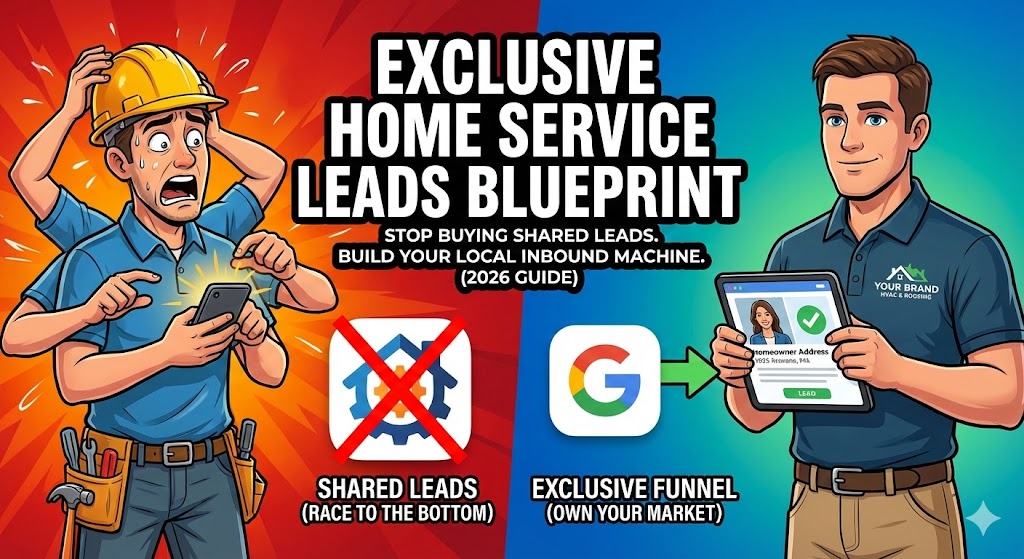
Home Services Performance Marketing Social Media Ads Google Ads Facebook Ads Pay Per Click Ads About Me Knowledge Hub Home Services Performance Marketing Social Media Ads Google Ads Facebook Ads Pay Per Click Ads About Me Knowledge Hub Book A Discovery Call Exclusive Home Service Leads: How to Stop Buying Shared Leads and Build Your Own Local Funnel (2026 Guide) By Deepak Jaiswal | Local Business Growth Specialist Reading Time: 13 Minutes If you run a home service business—whether it’s HVAC, roofing, plumbing, or electrical—you have probably experienced this exact scenario: Your phone dings. You just bought a $75 lead from Angi (formerly HomeAdvisor) or Thumbtack. You stop what you are doing and call the number within 60 seconds. The homeowner picks up and says: “Oh, I already have three guys coming over today to give me a quote. Can you beat their price?” You just paid $75 for the privilege of entering a bidding war. You are racing to the bottom, discounting your labor, and sacrificing your profit margins just to keep your crews busy. This business model is broken. In 2026, the home service companies that are scaling to 8-figures and dominating their local markets do not buy shared leads. They generate their own Exclusive Home Service Leads. They own their traffic, they control the customer journey, and they dictate their own pricing because they are the only contractor the homeowner is speaking to. In this comprehensive guide, I will show you exactly how to break free from the shared-lead trap and build your own local inbound acquisition machine. The “Shared Lead” Trap: Why You Are Losing Money Platforms like Angi, Thumbtack, and Yelp are marketing companies. Their entire business model is based on arbitrage: they buy traffic cheaply on Google, capture the homeowner’s information, and sell that exact same information to you and four of your competitors simultaneously. Why is this bad for your business? The Price War: When a homeowner gets 5 calls in 5 minutes, they stop caring about quality. They only care about the lowest price. Low Intent: Many people on these platforms are “just browsing” or looking for free advice. They are not ready to buy a $15,000 roof replacement today. Zero Brand Loyalty: The homeowner doesn’t know your brand. To them, you are just “the guy Angi sent.” To scale, you need Exclusive Home Service Leads—homeowners who searched specifically for your services, landed on your website, and booked an appointment only with you. Data Table: Shared Leads vs. Owned Inbound Funnel Let’s look at the brutal math of shared platforms versus owning your own digital real estate. Metric Shared Leads (Angi/Thumbtack) Owned Inbound Funnel (Google/SEO) Exclusivity Shared with 3-5 competitors 100% Exclusive to your business Pricing Power Extremely Low (Race to the bottom) High (You dictate the value) Brand Awareness Zero (They remember Angi, not you) High (They trust your specific brand) Average Close Rate 10% – 15% 35% – 50%+ Lead Intent Often window-shopping High Emergency/Immediate Need Long-Term Asset You own nothing You build a scalable digital asset Step 1: Capturing High-Intent Emergency Traffic (Google is King) Step 2: The “Instant Quote” Qualification Funnel When a homeowner’s AC unit breaks down in the middle of a 100-degree July afternoon, they do not go to Facebook or Instagram to look for a contractor. Social media is for interruption marketing. Emergency home services require intent-based marketing. They go to Google, and they want someone at their house within two hours. To capture these high-ticket Exclusive Home Service Leads, you must dominate the top of Google using two specific strategies: 1. Google Local Services Ads (LSAs) LSAs are the “Google Guaranteed” ads that appear at the very, very top of the search results—even above the traditional text ads. Why they work: You only pay per call, not per click. If someone clicks but doesn’t call, you pay nothing. Furthermore, the “Google Guaranteed” badge instantly builds massive trust. If you are an HVAC or Roofing contractor, maxing out your LSA budget should be your number one priority. 2. High-Intent Search Ads (PPC) Below the LSAs are traditional Google Search Ads. You must bid aggressively on “emergency” and “high-ticket” keywords. Bad Keyword: “Air conditioning” (Too broad, could be someone looking to buy a window unit). Good Keyword: “Emergency AC repair [City]” or “Ductless mini-split installation near me.” Bad Keyword: “Roofing” (Too broad). Good Keyword: “Leaking roof repair [City]” or “Full roof replacement financing.” If you only bid on high-intent, bottom-of-the-funnel keywords, your Cost Per Acquisition (CPA) will drop significantly while your ticket size increases. Getting the click from Google is only 20% of the battle. The other 80% is converting that click into a qualified appointment. Most contractors send Google Ad traffic to their generic homepage. The homeowner sees a wall of text, a tiny “Contact Us” form, and a phone number. If it’s past 5 PM and no one answers the phone, they click the “Back” button and call your competitor. You need a Conversion Funnel. Specifically, you need an interactive “Instant Estimate” or “Diagnosis” quiz. How the Funnel Works: Instead of a boring contact form, you offer a fast, interactive experience. Question 1 (Urgency): “Is this an emergency?” (Yes – Need someone today / No – Just looking for a quote). Question 2 (The Problem): “What do you need help with?” (E.g., for HVAC: AC blowing warm air, Strange noises, System won’t turn on, Need new system). Question 3 (Property Details): “What is the approximate age of your home?” or “Is this a residential or commercial property?” Question 4 (Contact): “Where should we send your priority repair estimate?” (Collect Name, Phone, Email, and Address). Why this works: It uses micro-commitments. A homeowner is much more likely to click a button that says “AC blowing warm air” than they are to immediately type out all their personal information. By the time they reach the end of the quiz, they are psychologically committed to finishing it. Step 3: The 5-Minute “Speed to Lead” Automation In
High ticket B2B leads
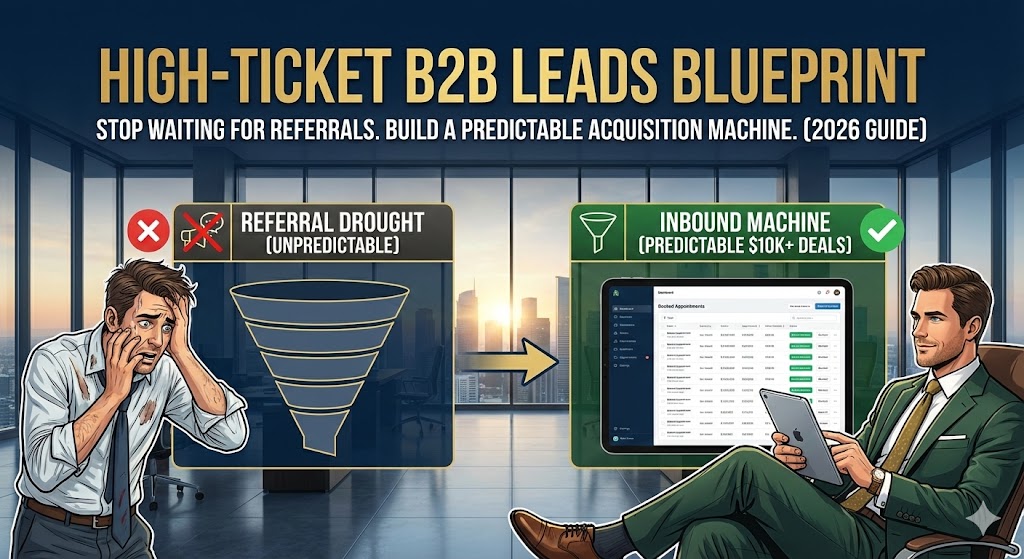
Home Services Performance Marketing Social Media Ads Google Ads Facebook Ads Pay Per Click Ads About Me Knowledge Hub Home Services Performance Marketing Social Media Ads Google Ads Facebook Ads Pay Per Click Ads About Me Knowledge Hub Book A Discovery Call High-Ticket B2B Leads: How to Stop Relying on Referrals and Build a Predictable Acquisition Machine (2026 Guide) By Deepak Jaiswal | B2B Growth Strategy Expert Reading Time: 12 Minutes High-ticket B2B leads are the foundation of any scalable agency, consultancy, or enterprise SaaS company. Yet, if you ask 100 B2B founders where their next $10,000 client is coming from, 90 of them will give you the exact same answer: “Word of mouth, mostly.” If your business relies entirely on referrals, you do not have a business—you have a very stressful, unpredictable network. In the “Feast or Famine” cycle, one month you close three massive deals because a past client recommended you. You hire staff, you expand your software stack, and you feel like a genius. The next month, the phone stops ringing. The referrals dry up. You spend the next 60 days desperately sending connection requests on LinkedIn and dropping prices on Upwork just to make payroll. In 2026, the B2B landscape has evolved. Decision-makers (CEOs, CMOs, and Founders) are not blindly trusting their network anymore. They are actively searching online for specialized experts who can solve their exact bottlenecks. If you want to generate predictable High-Ticket B2B Leads, you must transition from a passive “wait and hope” referral model to an active, automated inbound acquisition machine. In this comprehensive guide, I will show you exactly how to build a system that attracts, educates, and closes five-figure B2B clients on autopilot. The Danger of the “Generalist” Agency Trap Before we build your lead generation funnel, we have to fix your offer. The number one reason B2B companies fail to generate cold leads is that they look exactly like everyone else. If you are a “Full-Service Digital Marketing Agency” that does SEO, web design, social media, and PR for “small to medium-sized businesses,” you are going to drown. You are competing on price because you have no unique differentiator. High-ticket buyers do not hire generalists. If a CEO has a brain tumor, they don’t go to a general practitioner; they pay $100,000 to a top neurosurgeon. To generate High-Ticket B2B Leads, you must become the neurosurgeon of your industry. You need a highly specific “Micro-Niche” offer. Examples of the Pivot: Bad (Generalist): “We build websites for businesses.” (Value: $2,000) Good (Specialist): “We build high-converting Shopify funnels for 7-figure D2C skincare brands.” (Value: $15,000) Bad (Generalist): “We do accounting and bookkeeping.” (Value: $500/month) Good (Specialist): “We provide fractional CFO services to post-Series A SaaS startups to extend runway.” (Value: $5,000/month) Once your offer is dialed in, marketing becomes incredibly easy because you know exactly who to target. The Math: Referrals vs. Paid Inbound Systems Let’s look at why building an automated inbound funnel is mathematically superior to waiting for referrals or doing manual cold outreach. Data Table: The B2B Acquisition Comparison Metric Word-of-Mouth (Referrals) Cold Email / Outreach Paid Inbound Funnel (My System) Predictability Zero (Completely random) Low (Dependent on spam filters) High (Dictated by ad spend) Scalability None (Cannot force referrals) Medium (Requires massive volume) Infinite (Turn the dial up) Lead Intent Warm, but rare Extremely Cold (Annoyed) Very Hot (They sought you out) Time to Close Fast 2-4 Months 2-4 Weeks (Educated in funnel) Positioning High Authority Low Authority (Begging) High Authority (Expert Status) Step 1: The “Trojan Horse” Educational Asset (VSL) High-ticket B2B buyers do not fill out a “Contact Us” form just because they saw a nice ad. They are busy, skeptical, and highly protective of their time. You need to earn the right to speak with them. We do this using a Video Sales Letter (VSL) or an Executive Briefing. Instead of running an ad that says “Hire our agency today,” you run an ad that solves a micro-problem. The VSL Funnel Structure: The Hook: Target their specific pain point. (e.g., “Why 80% of B2B SaaS companies churn out in their first year.”) The Opt-In: They trade their Name, Business Email, and Company Size to watch your exclusive 15-minute training. The Video (The Value): You spend 12 minutes giving them pure, actionable value. You show them exactly how to fix their problem using your unique methodology. You hold nothing back. The Pitch (The Call to Action): In the last 3 minutes, you say: “You can take this framework and apply it yourself, OR you can click the button below to book a discovery call, and my team will build this system for you in 30 days.” By the time they book a call, they have spent 15 minutes watching you demonstrate your expertise. They already trust you. Step 2: Traffic Generation (LinkedIn Ads & Retargeting) To feed your VSL funnel, you need eyeballs. But you don’t need millions of eyeballs; you only need the right eyeballs. For generating High-Ticket B2B Leads, LinkedIn Ads are the most powerful tool on the planet. Why? Because LinkedIn allows you to target people based on their exact professional identity. The Sniper Targeting Strategy On Facebook, you target interests. On LinkedIn, you target facts. We can build an audience consisting exclusively of: Job Titles: CEO, Founder, VP of Sales, Chief Marketing Officer. Company Size: 11-50 employees, 51-200 employees. (Filters out broke solopreneurs). Industry: B2B Software, IT Services, Management Consulting. Company Growth: Companies that have recently hired or received funding. The Omnipresence Retargeting Cloud Most B2B buyers won’t convert on the first click. That is why retargeting is essential. Once a CEO visits your VSL page, you pixel them. For the next 90 days, they will see your face everywhere. They will see your case studies on LinkedIn, your client testimonials on Facebook, and your educational videos on YouTube. You create an illusion of “Omnipresence.” They will think your agency is massive, even if you are a lean team of