
Stop Chasing "Leaks": 5 Commercial Roofing Marketing Strategies to Land $500k Contracts
By Deepak Jaiswal | Industrial Growth Strategist Reading Time: 15 Minutes
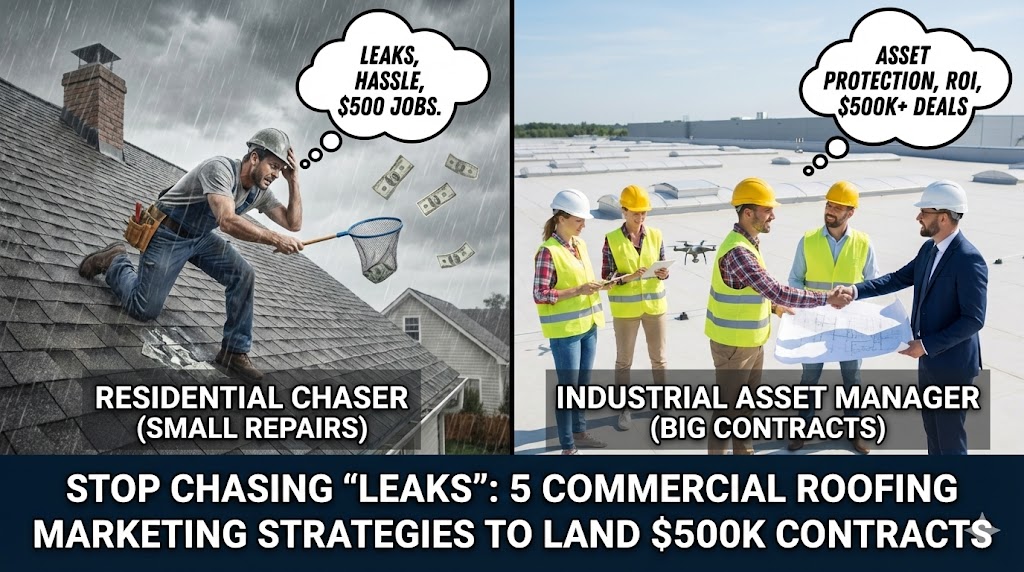
If you own a Commercial Roofing company, you know the pain of the “Residential Rat Race.”
You see your competitors chasing hail storms, knocking on doors, and fighting with insurance adjusters over a $15,000 shingle roof. Meanwhile, you drive past a massive Amazon distribution center or a shopping mall. You look at that 500,000 sq. ft. flat roof and think: “That one job would be worth $2 Million. That one job would change my life.”
But you can’t just knock on the door of an Amazon warehouse. The Property Manager is busy. The Facility Director is behind a gatekeeper. They don’t look at “Door Hangers.” They look at Capital Expenditure (CapEx) Budgets.
To win in the big leagues, you have to stop marketing like a “Repairman” and start marketing like an “Asset Manager.”
A residential homeowner buys a roof because they have to (it’s leaking on their couch). A commercial owner buys a roof because it makes financial sense (Tax write-offs, energy savings, asset value).
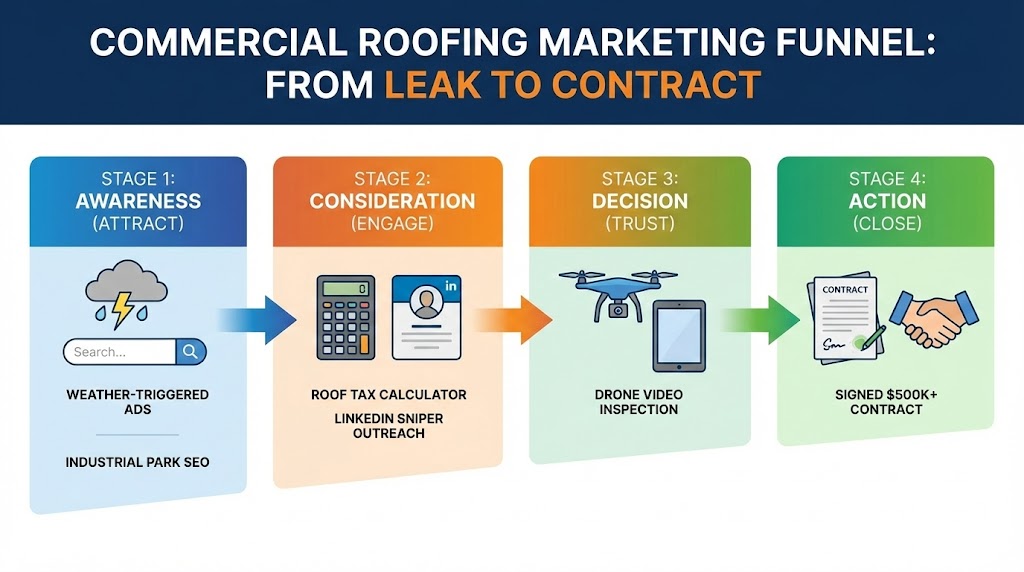
In this guide, we are ditching the “Free Inspection” flyers. We are deploying a 5-Phase Industrial Attack Plan designed to bypass the gatekeepers and land the $500k+ contracts that legitimate commercial roofers deserve.
Phase 1: The "LinkedIn Sniper" Campaign (Targeting Property Managers)
Residential roofers use Facebook. Commercial roofers use LinkedIn. The decision-maker (Facility Manager or Property Manager) is on LinkedIn every day.
The Diagnostic: Most roofers send connection requests saying: “We do TPO roofing. Need a quote?” Block. Delete.
The Blueprint Execution: You need to target the “Pain of Management.” Property Managers hate surprise leaks because their tenants scream at them.
The Strategy:
Search Filter: Target “Property Manager” + “Industrial” in [Your City].
The Connection Note: “Hi [Name], I’m researching industrial roof lifespans in [City]. I’m not selling anything, just building a report on how local weather impacts TPO vs. EPDM. Open to connecting?”
The Content: Don’t post pictures of roofs. Post pictures of “Disasters Averted.”
Caption: “This warehouse saved $100k in inventory damage because we caught a seam failure 2 weeks before the storm. Here is what a failing seam looks like…”
Why this works: You position yourself as a “Risk Mitigator.” When the roof actually leaks, you are the only expert in their inbox. This is the highest-ROI tactic in commercial roofing marketing.
B2B Authority: Writing LinkedIn content that sounds professional (not salesy) is an art. My Social Media Marketing Services can manage your profile to turn it into a lead-generation machine.
Phase 2: The "Weather-Triggered" Geo-Fencing (Timing is Everything)
Commercial roofs are tough, but they aren’t invincible. When a massive storm hits an industrial park, every Property Manager panics.
The Diagnostic: You wait for them to call you. But they call the first number on Google.
The Blueprint Execution: Use “Weather-Triggered” Programmatic Ads. Set up a campaign that only turns on when:
Hail is detected > 1 inch.
Wind speeds exceed 60 mph.
Target location is an Industrial Park (Geo-Fence).
The Ad Copy:
“Storm Alert at [Industrial Park Name]. Your TPO roof may have sustained micro-fractures. Document the damage now for your insurance claim. Download the Commercial Inspection Checklist.”
The Result: You aren’t “ambulance chasing.” You are providing a tool (The Checklist) right when they are worried. You capture the lead before the leak even starts dripping.
Ad Tech: Setting up weather APIs to trigger ads requires advanced configuration. Our PPC Management Services can build this automated “Storm Response” system for you.
Phase 3: The "CapEx Budget" Calculator (The Financial Sell)
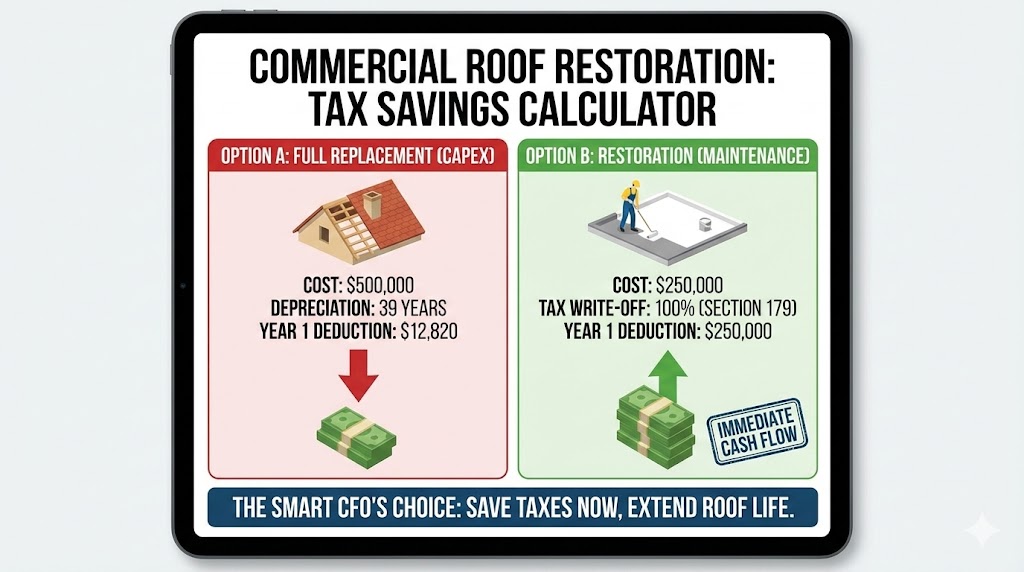
Commercial owners speak the language of ROI and Taxes. They love “Restoration” (Coatings) because it can be written off as “Maintenance” in 1 year, whereas a “Replacement” must be depreciated over 39 years.
The Diagnostic: Your website just says “We do Silicone Coatings.” It doesn’t explain the money.
The Blueprint Execution: Build a “Roof Restoration Tax Savings Calculator” on your site.
How it works:
Input: Roof Size (sq ft) + Estimated Replacement Cost.
Output: “You save $50,000 in taxes this year by restoring instead of replacing.”
The Psychology: Now you aren’t selling a bucket of white paint. You are selling a Tax Strategy. CFOs and Building Owners will love you. This shifts the conversation from “Cost” to “Savings.”
Phase 4: The "Video Inspection" Trust Protocol (Transparency)
The biggest fear of a Property Manager is being ripped off. They can’t climb a 40-foot ladder to check your work. They have to trust you. And they don’t trust contractors.
The Diagnostic: You give them a paper quote with some blurry photos. It looks like a guess.
The Blueprint Execution: Deliver a “Drone & GoPro Video Inspection.”
The Drone: Fly over the entire warehouse to show the scale and drainage issues.
The GoPro: Your estimator wears a camera. He walks the roof. He points at the crack. He peels back the wet insulation. “See this? This is water trapped under the membrane.”
The Deliverable: Send them a 3-minute edited video link: “Inspection Report for [Building Address].” When they forward this video to the Building Owner (who lives in another state), the Owner sees the problem with their own eyes. The check gets signed immediately.
Video Marketing: You don’t need a film crew. You just need a process. My Facebook Marketing Services can edit these raw clips into professional branded reports that close deals.

Phase 5: The "Industrial Park" SEO Silos (Local Dominance)
You don’t want to rank for “Roofer in [City].” That brings in homeowners. You want to rank for the places where the big roofs are.
The Diagnostic: Your SEO is too broad. You are catching “shingle” leads.
The Blueprint Execution: Create specific landing pages for the major Industrial Parks and Commercial Districts in your state.
Page Title: “Flat Roof Repair Services for [Name of Industrial Park].”
Page Title: “Commercial Roofing Contractors near [Local Airport/Logistic Hub].”
The Content: Mention the specific building types in that park (e.g., “Tilt-wall construction,” “Built-up roofs”). When a Facility Manager in that park Googles “Roof repair near me,” Google sees your page is hyper-relevant to their exact location.
The ROI: These keywords have low volume (maybe 10 searches a month), but if you close one deal, it’s $500,000. It is the ultimate “Quality over Quantity” strategy in commercial roofing marketing.
SEO Strategy: Structuring your site for these “Micro-Locations” requires a solid architecture.
Conclusion: Become the "Roof Asset" Partner
The commercial roofing industry is not about hammers and nails. It is about Finance and Trust.
If you continue to market like a residential roofer—chasing storms and knocking on doors—you will stay small. But if you implement this 5-Phase Blueprint, you change the game.
You stop “begging” for repairs. You start “consulting” on assets.
When you show a Property Manager a video of their roof failing, calculate their tax savings, and protect them before the storm hits, you don’t just get a contract. You get the keys to the building.
Ready to Bid on the Big Roofs?
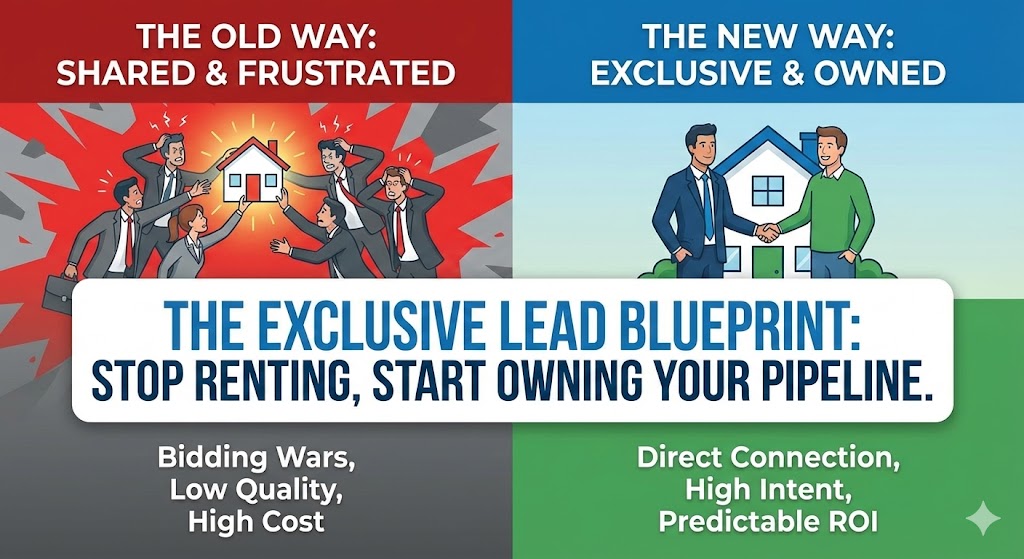
Stop wasting time on $500 repairs. Let us build your “Commercial Lead Engine” today.
- All Posts
- Knowledge Hub
Frequently Asked Questions
1. Is Google Ads expensive for commercial roofing?
Yes, keywords like “Commercial Roofing” can cost $50 – $100 per click. That is why Negative Keywords are critical. You must exclude words like “Home,” “Residential,” “Shingle,” “House.” If you don’t, you will burn your budget on homeowners looking for cheap repairs.
2. Should I join BNI or Chambers of Commerce?
BNI is usually full of residential trades. For Commercial, join BOMA (Building Owners and Managers Association) or IFMA (International Facility Management Association). That is where the big decision-makers hang out.
3. How long is the sales cycle for a commercial roof?
It is long. 3 to 12 months. Budgets have to be approved by boards or owners. That is why Email Nurturing (Phase 1) is so important. You need to stay top-of-mind until the budget is approved.
4. What is the best way to get past the "Gatekeeper" (Receptionist)?
Don’t sell. Ask for help.
Script: “Hi, I’m sending over a drone inspection report for the facility’s roof assets. Who is the best person to email that link to so it doesn’t get lost?” The promise of a “Report” sounds valuable, not salesy.
5. Can I use solar to sell roofing?
Absolutely. “Solar-Ready Roofing” is a huge trend. Many companies want solar, but their roof is too old. Pitch a “Roof + Solar Prep” package. It increases the contract value and positions you as a forward-thinking partner.