
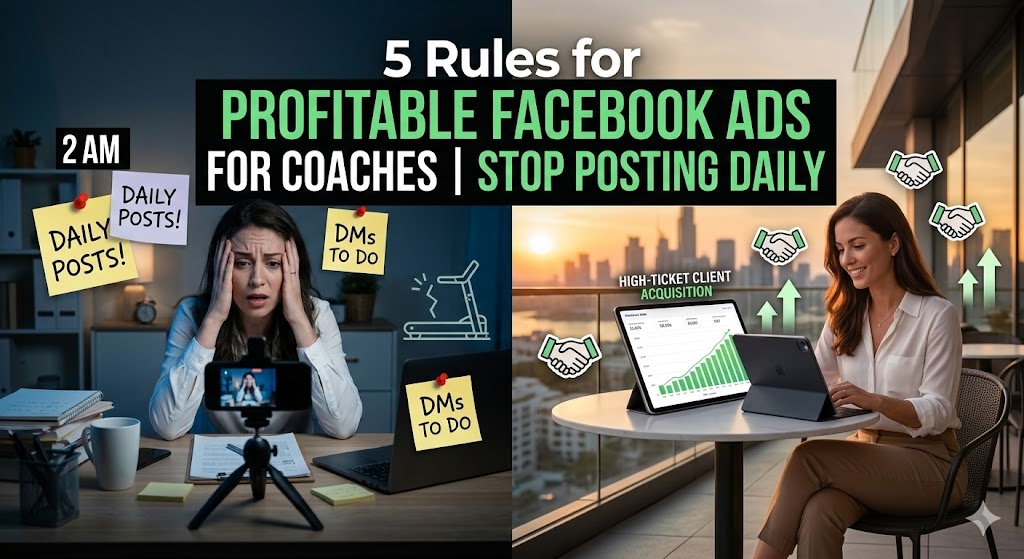
5 Rules for Profitable Facebook Ads for Coaches | Stop Posting Daily.
By Deepak Jaiswal | Consultant Growth Expert Reading Time: 12 Minutes
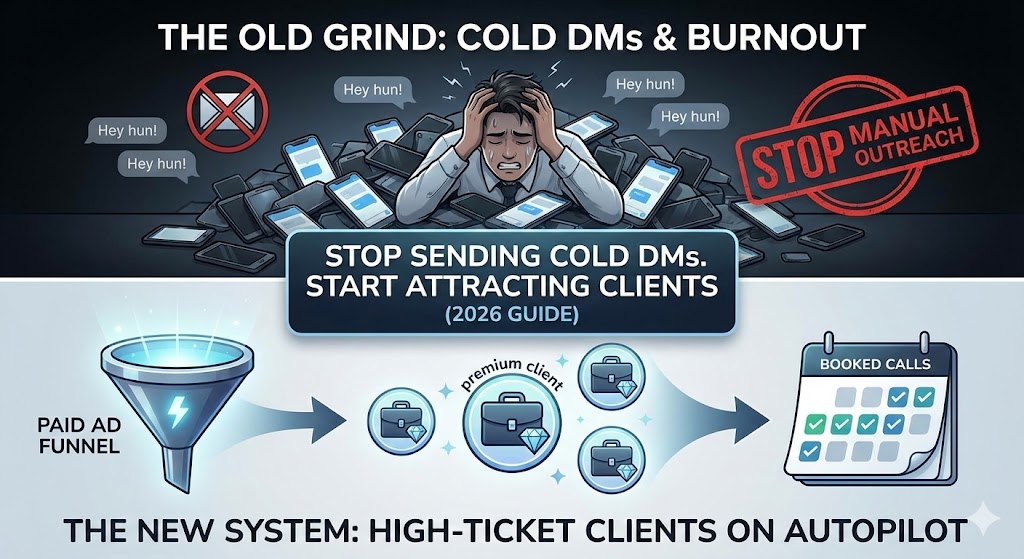
Let’s be brutally honest: the modern coaching industry is pushing a toxic marketing lie. The lie is that to get high-paying clients, you need to post three Reels a day, dance to trending audio, send 50 cold DMs every morning, and be a slave to the Instagram algorithm.
You became a coach to change lives and build financial freedom, not to become a full-time content creator.
If you are a business coach, fitness consultant, mindset mentor, or life coach charging $1,500 to $10,000+ for your programs, relying purely on organic reach is a dangerous game. Organic reach is unpredictable. It doesn’t scale on command.
The most successful coaches in the industry have stepped off the organic content treadmill. Instead, they use Facebook Ads for Coaches to buy back their time and build a predictable, automated pipeline of high-intent leads.
But running ads for a high-ticket coaching offer isn’t the same as selling e-commerce products. You are selling trust, authority, and transformation. If your ads feel like a cheap infomercial, you will burn through your budget in days.
Here are the 5 non-negotiable rules to run profitable Facebook Ads for your coaching business and finally stop posting daily.
Rule #1: Stop Selling "Coaching" – Sell a Unique Mechanism
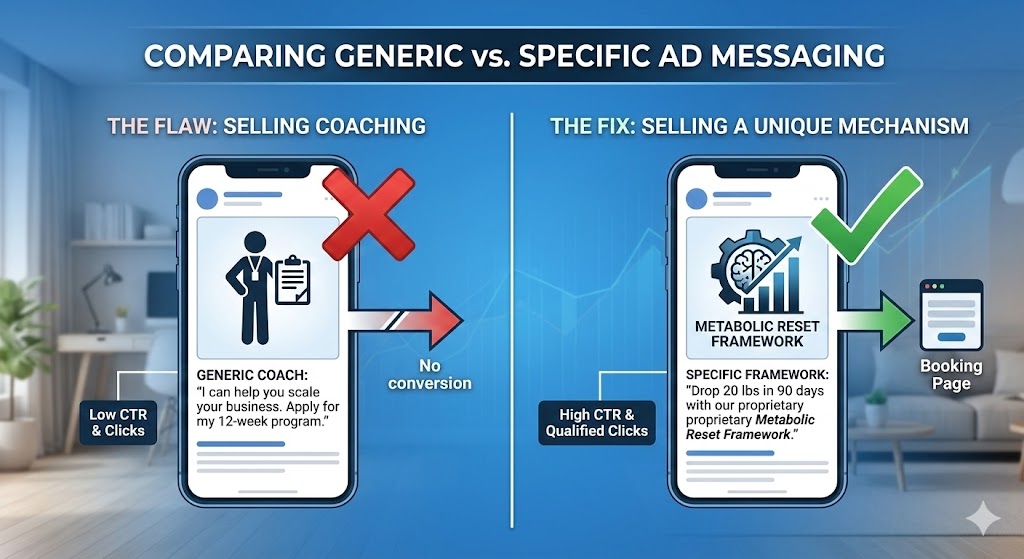
The fastest way to fail with Facebook Ads is to call yourself a “Life Coach” or a “Business Coach” in your ad copy. The market is entirely saturated with generic coaches. When a prospect sees an ad for “I will help you scale your business,” their brain immediately tunes it out.
The Fix: Introduce a Unique Mechanism. Your Unique Mechanism is the proprietary system, framework, or methodology you use to get clients their results. People don’t want to buy “coaching sessions”; they want to buy a proven vehicle to get from their current pain to their desired reality. Just as we discussed the importance of specific messaging in High-Ticket Roofing Google Ads, precision is what separates premium services from commodities.
By giving your process a name, you position yourself in a category of one.
This clear diagram contrasts the performance of generic coaching ads (left, red ‘X’) with ads selling a specific, named framework or unique mechanism (right, green checkmark). It visually proves why specific messaging wins on high-ticket platforms.
Rule #2: The "Give Before You Ask" Video Funnel
A cold prospect scrolling through Facebook is not going to hand over $5,000 to a stranger just because they saw a nice graphic. Asking them to “Book a Discovery Call” on the very first ad is like proposing marriage on a first date.
The Fix: The 2-Step Video View Funnel. Instead of driving cold traffic straight to a calendar link, you need to build a digital relationship first.
Top of Funnel (The Hook): Run a 3 to 5-minute educational video ad. This video should solve one specific micro-problem for your ideal client. Do not ask them to buy anything. Your only goal is to provide immense value.
Middle of Funnel (The Retargeting): Use Meta’s Custom Audiences to create an audience of people who watched at least 50% or 75% of that first video. These are your warm leads. Now, show this specific group a secondary ad inviting them to download your training or book a call.
By gating your calendar behind a value-first approach, you lower your Cost Per Lead (CPL) and ensure you are only speaking with highly qualified prospects.
Rule #3: Lead Magnets That Filter (Not Just Capture)
The traditional advice is to create a 1-page PDF checklist to get cheap email subscribers. While that works for building a massive newsletter, it is terrible for booking high-ticket coaching clients. Cheap leads usually equal cheap intent.
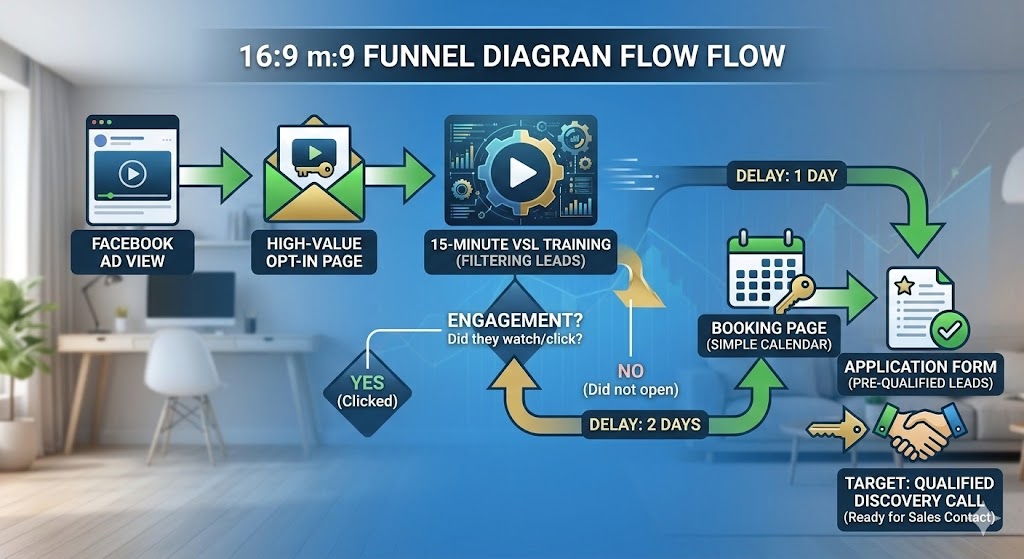
The Fix: Use a Video Sales Letter (VSL) or In-Depth Training. Your lead magnet shouldn’t just capture an email; it should educate, indoctrinate, and filter out the freebie-seekers.
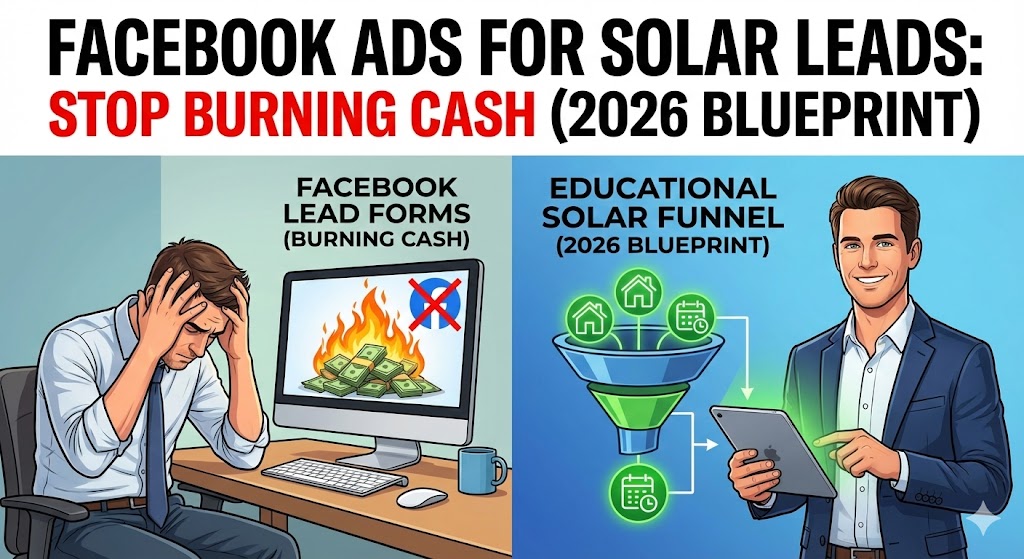
This modern funnel diagram visualizes the critical education-first path. Arrows connect stylized icons from “Ad View” to “Booking,” demonstrating how a 15-minute VSL filters leads before they ever reach your calendar, ensuring you only spend time on high-intent calls.
Rule #4: Broad Targeting + Highly Specific Copy
Two years ago, media buyers spent hours finding hidden “interests” on Facebook. They would target fans of Tony Robbins, specific business magazines, or niche software tools.
Thanks to Meta’s AI and Advantage+ Campaign settings, those days are over. The algorithm is now smarter than any human media buyer.
The Fix: Let the Copy Do the Targeting. Today, the best strategy is to leave your audience targeting relatively broad (e.g., Men and Women, ages 30-55, in the US/UK/Canada) and let your ad copy find your exact client. If your copy starts with, “Attention 7-figure agency owners who are struggling with client churn…” the algorithm will quickly learn to show your ad only to that specific demographic based on who stops to read it.
Your headline is your targeting. Your first three lines of text are the ultimate filter. Speak directly to your exact avatar’s pain points, and Meta’s machine learning will optimize delivery to find them.
Rule #5: Know Your High-Ticket Math (LTV vs. CAC)
The reason most coaches panic and turn off their ads is that they don’t understand the math behind high-ticket client acquisition. If you are used to selling $50 courses, spending $200 on ads without a sale feels terrifying.
The Fix: Understand Customer Acquisition Cost (CAC) and Lifetime Value (LTV). If your coaching program costs $3,000, and it takes 10 discovery calls to close one client (a 10% close rate), you need to know what you can afford to pay for a call. Just as we map out predictable revenue in B2B Marketing Strategies, you must track your numbers objectively. Stop looking at daily ad spend and start looking at the 30-day return on investment. Once the math makes sense, you can scale indefinitely.
The Financial Impact: Organic Hustle vs. Paid Predictability
To truly understand why ads are the ultimate leverage for a coaching business, let’s look at a side-by-side comparison of a typical month using organic content versus a dialed-in paid ads funnel.
The Real Cost of ‘Hustling’ vs. Investing
| Metric | Organic Hustle (The Treadmill) | Facebook Ads (The Predictable Pipeline) |
| Time Spent Marketing | 15-20 Hours / Week (Filming, Editing, DMs) | 2-3 Hours / Week (Managing Ads) |
| Reach / Impressions | Unpredictable (Algorithm Dependent) | Predictable (Budget Dependent) |
| Lead Quality | Mixed (Fans & Freebie Seekers) | High (Filtered via VSL & Application) |
| Monthly Booked Calls | 5 – 10 | 30 – 50+ |
| Close Rate | 10% – 15% | 20% – 25% (High Authority Positioning) |
| Monthly New Clients | 1 – 2 | 6 – 10+ |
| Focus | Being an “Influencer” | Being a CEO & Coach |
Conclusion: Reclaim Your Time and Scale Your Impact
You have a gift, a methodology, and the ability to profoundly change your clients’ lives or businesses. But you cannot help people if they don’t know you exist, and you cannot scale your impact if you are chained to your phone making daily content just to survive.
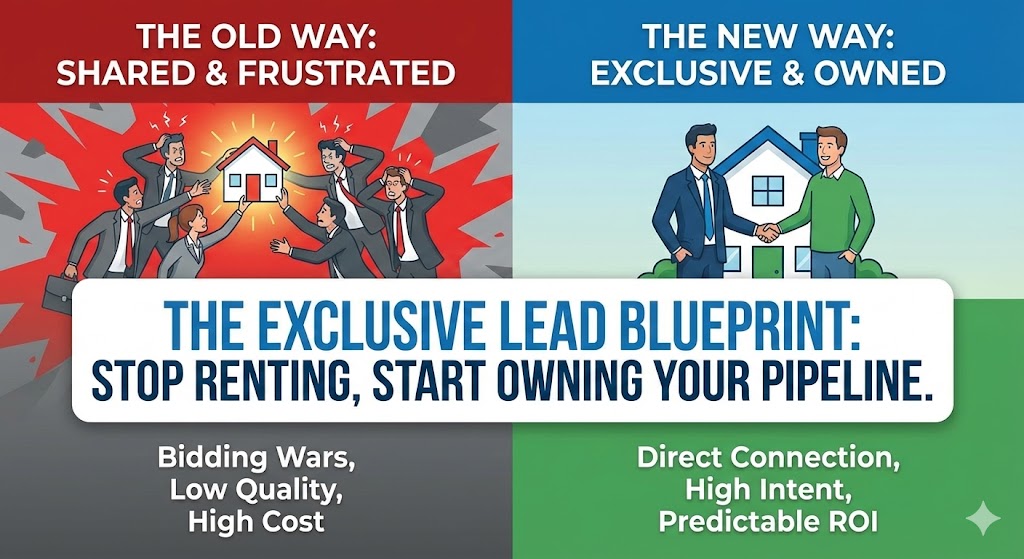
Mastering Facebook Ads for Coaches is the bridge between being a stressed-out freelancer and a confident business owner. By selling a Unique Mechanism, filtering through video funnels, writing specific copy, and trusting the math, you build a machine that works for you 24/7. Reclaiming your time allows you to focus on leading your clients, just as the relaxed coach in our final image does.
Ready to step off the organic content treadmill?
If you are tired of guessing where your next high-paying client is coming from, it’s time to build a predictable system.
- All Posts
- Knowledge Hub

Frequently Asked Questions
1. How much should I spend on Facebook Ads for Coaches to get started?
For high-ticket coaching, a good starting budget is $30 to $50 per day ($1,000 to $1,500 per month). This gives the Meta algorithm enough data to test your messaging and start generating qualified calls.
2. Do Facebook Ads still work for coaches in 2026?
Absolutely. While the platform has evolved, it remains the most robust targeting engine in the world. The difference now is that success requires better funnels and stronger messaging, rather than just “clever targeting hacks.”
3. What if I don't have a large social media following?
That is the beauty of paid ads! You do not need a following. A high-converting video ad and a strong VSL funnel build instant authority. Your ads reach cold audiences who don’t care about your follower count; they only care if you can solve their problem.
4. Should I run ads to a webinar or a VSL?
For coaches starting their paid ad journey, a 15-minute evergreen VSL (Video Sales Letter) is generally more effective and easier to manage than a live 90-minute webinar. It provides instant gratification for the lead and requires less technical setup.
5. What is a good Cost Per Booked Call (CPB)?
This depends entirely on your niche (B2B business coaching will cost more than B2C fitness coaching) and your offer price. Generally, seeing a CPB anywhere from $75 to $250 is standard and highly profitable if your coaching package is priced at $3,000+.