Personal injury lawyer marketing: How to Get Signed Cases for $250 (Stop Paying $300/Click)
By Deepak Jaiswal | Performance Marketing Specialist Reading Time: 13 Minutes
Let’s have a brutally honest conversation about Legal Marketing.
If you are a Personal Injury (PI) attorney, you are fighting in the most expensive advertising arena on earth.
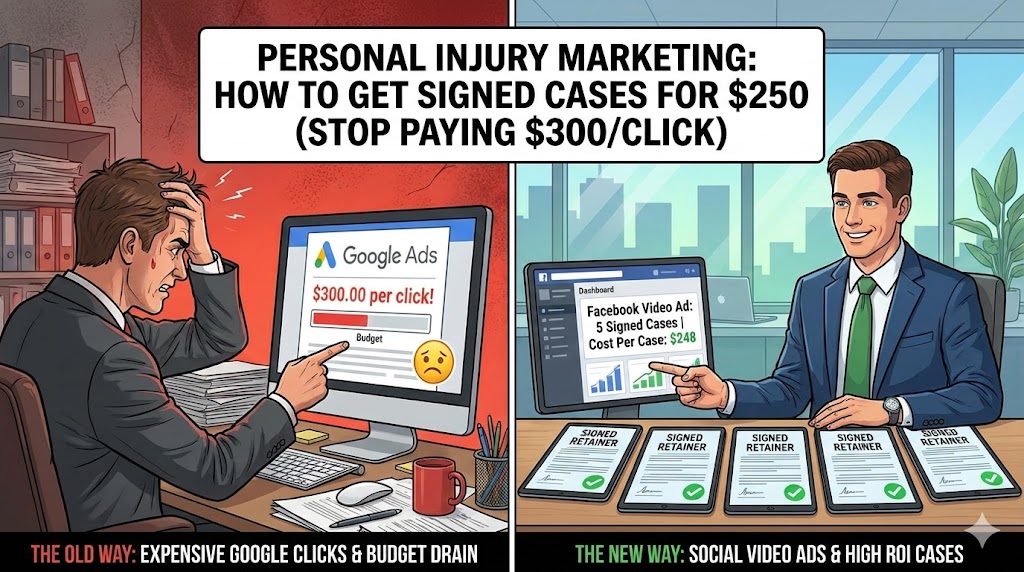
You are bidding on keywords like “Car accident lawyer near me” or “Truck accident attorney.” In cities like New York or Los Angeles, the Cost Per Click (CPC) for these terms can hit $200 to $500.
That is $500 just for someone to visit your website. Not a call. Not a case. Just a click.
If you are a massive firm with a $10 Million monthly budget, maybe you can afford to bully your way to the top of Google. But for solo practitioners and small firms, this is financial suicide.
You are competing with “Morgan & Morgan” money. You will lose.
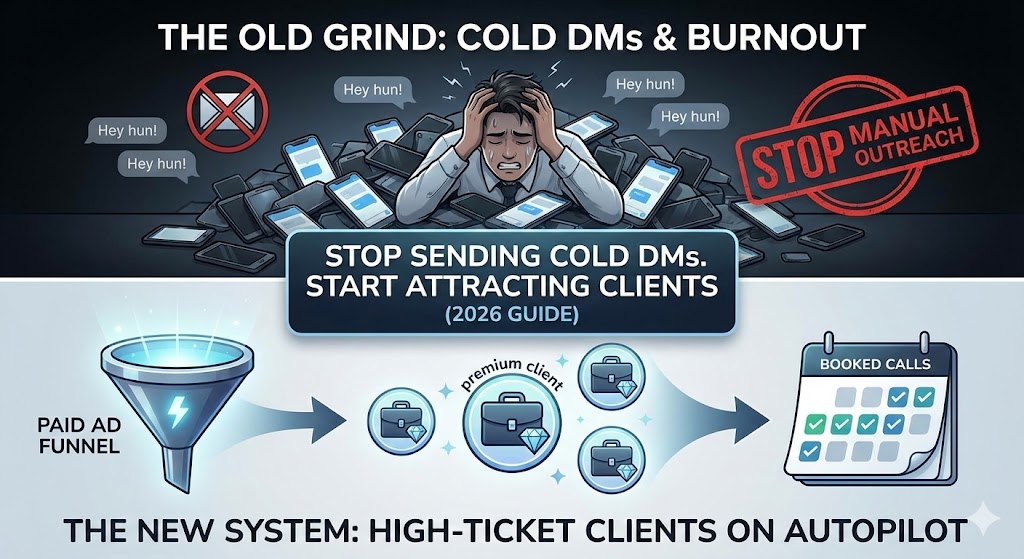
But there is a backdoor. While every other lawyer is fighting over the 3% of people searching on Google, the other 97% are scrolling on social media.
In this breakdown, I am going to show you the exact “Niche Video Ad” Strategy I use to get signed Motor Vehicle Accident (MVA) cases for $200 – $350 per signed retainer, completely bypassing the Google bidding war.
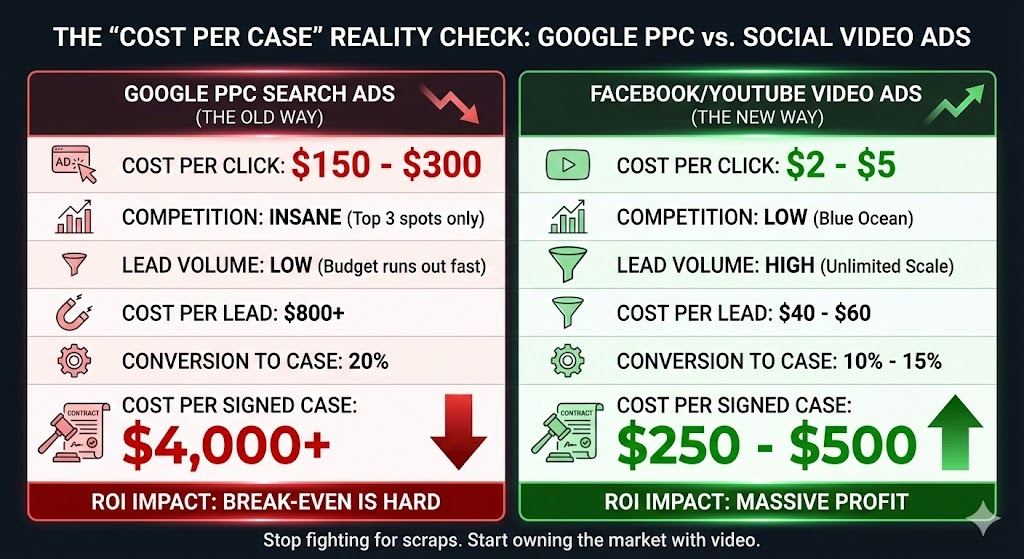
The Math: The Google Trap vs. The Social Goldmine
Google Ads is high intent, but the cost destroys your ROI. Facebook/YouTube ads are lower intent, but the volume and cost are unbeatable if you have the right funnel.
Let’s look at the actual math of acquiring a signed case.
Data Table: The “Cost Per Case” Reality Check
| Metric | Google PPC Search Ads (The Old Way) | Facebook/YouTube Video Ads (The New Way) |
| Cost Per Click | $150 – $300 | $2 – $5 |
| Competition | Insane (Top 3 spots only) | Low (Blue Ocean) |
| Lead Volume | Low (Budget runs out fast) | High (Unlimited Scale) |
| Lead Quality | High Intent | Requires Filtering |
| Cost Per Lead | $800+ | $40 – $60 |
| Conversion to Case | 20% | 10% – 15% |
| Cost Per Signed Case | $4,000+ | $250 – $500 |
| ROI Impact | Break-even is hard | Massive Profit |
By shifting your budget to “Disruption Marketing,” you stop fighting for scraps and start owning the market. Here is how I build the system.
Step 1: The "Niche Down" Video Ad Strategy
You cannot run a generic ad saying “Injured? Call Us!” on Facebook. People will scroll past it. It looks like a billboard.
To win on social, you need to call out a Specific Situation or a Specific Vehicle.
The “Motorcycle/Truck” Pivot: Instead of targeting “Car Accidents” (too broad), we target:
Motorcyclists: They are passionate. They hate distracted drivers.
Rideshare Victims: Uber/Lyft accidents are complex and common.
Delivery Truck Victims: Amazon/FedEx trucks.
The Video Hook Script (15 Seconds):
Visual: Dashcam footage of a truck cutting someone off (No gore, just shock).
Audio: “If you were hit by a commercial delivery truck in [City], do NOT sign the insurance check. They are offering you $5,000 when your case could be worth $100,000. Here is the trick insurance adjusters use against you…”
Why this works: It’s educational. It warns them about a “villain” (the insurance adjuster). It stops the scroll because it feels like insider advice, not an ad.
Step 2: The "Do I Have a Case?" Quiz Funnel
Do NOT send traffic to your firm’s homepage. It’s too cluttered. And do not ask them to “Call Now” immediately—that’s too high friction for social media.
I send them to a “Case Value Calculator” Funnel.
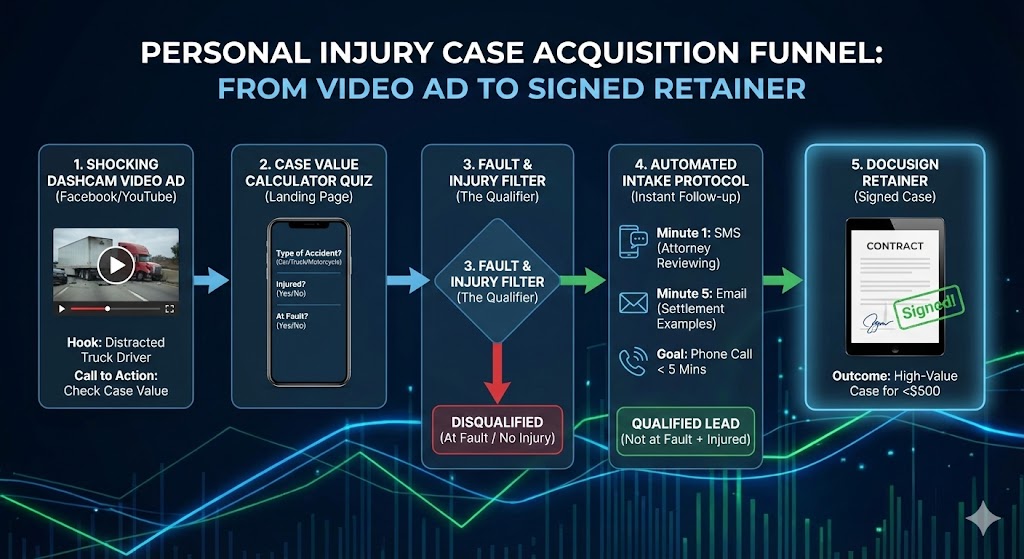
The Funnel Architecture:
Landing Page: “Injured in an Accident? Check Your Potential Settlement Value in 60 Seconds. Free & Confidential.”
The Quiz (The Qualifier):
Question 1: What type of accident was it? (Car, Truck, Motorcycle).
Question 2: Were you injured? (Yes/No).
Question 3: Did the police arrive? (Yes/No).
Question 4 (The Killer Question): Were you at fault? (If they say Yes -> Disqualify immediately. If No -> Continue).
Question 5: Do you already have a lawyer? (If Yes -> Disqualify).
The Result:
“Based on your answers, you may be entitled to significant compensation. Our Senior Attorney wants to review your file immediately.”
This funnel filters out the “at-fault” drivers and the “already represented” leads, saving your intake team hours of wasted time.
We use this exact same disqualification logic in our Exclusive Real Estate Leads Strategy. Just like we use a survey to filter out homeowners asking for full retail price, here we immediately disqualify drivers who are at fault. You only talk to qualified prospects.
Step 3: The "Instant Retainer" Automation
In Personal Injury, “Speed to Lead” is life or death. If you don’t call in 2 minutes, they will Google another lawyer.
We use automation to bridge the gap between “Lead” and “Signed Retainer.”
My Automated Intake Protocol:
Minute 0: Lead passes the quiz (Qualified: Not at fault, Injured).
Minute 1 (SMS): “Hi [Name], this is the intake team at [Firm Name]. Based on your quiz, it looks like the other driver was clearly at fault. I have the attorney reviewing your details now. Can you talk for 2 mins?”
Minute 5 (The ‘E-Sign’ Tease): Email subject: Your Potential Case Value. Body: “Here are recent settlements we won for similar truck accidents: $150k, $85k, $320k. We can’t promise these numbers without talking, but your case looks strong.”
The Goal: Get them on the phone within 5 minutes, explain the contingency fee (“We don’t get paid unless you win”), and send the DocuSign Retainer while they are still on the phone.
Step 4: Writing Human Copy and Selling the "Click"
Now that your infrastructure guarantees you will land in the primary inbox, you have to get the prospect to actually reply.
CEOs and Founders delete bad cold emails in 1.5 seconds. If your email is longer than 5 sentences, they won’t read it. If it contains bullet points of your services, they will delete it.
The Anatomy of a High-Converting Cold Email:
The Subject Line: Keep it boring and casual. “Quick question regarding [Company Name]” or just “Your outbound process.” Do not use capitalization or exclamation marks.
The Hook: Prove you actually researched them. “Hey John, saw you just hired three new SDRs in Chicago.”
The Problem/Offer: State the pain point simply. “Usually, when companies scale their sales team that fast, ramp-up time eats their margins. We built a system that cuts SDR ramp-up from 3 months to 3 weeks.”
The Call to Action (CTA): Do not ask for a 30-minute call. That is too big of an ask for a stranger. Ask for interest. “Worth sending over a short video breakdown?”
- When they reply “Yes, send the video,” you do not send them to a generic homepage. You send them to a highly engineered conversion asset. If you want to know exactly how to structure that video, read my blueprint on building automated funnels for high-ticket B2B leads.
Conclusion: Stop Paying the "Google Tax"
If you are a Personal Injury lawyer relying solely on Google Ads, you are renting your business from Google at a premium rate.
By implementing this Personal Injury marketing strategy on Facebook and YouTube, you tap into a “Blue Ocean.” You reach victims before they even think to search for a lawyer. You build a brand, you filter out the junk leads automatically, and you sign cases for a fraction of the cost.
Stop fighting the giants. Start outsmarting them.
Want Me to Build Your Case Acquisition Engine?
Creating compliant legal ads, setting up “fault-filtering” quizzes, and automating intake follow-ups is technical work. You should be deposing defendants and winning settlements, not fighting with Facebook Ad Policy.
I specialize in building case generation systems for aggressive PI Firms. Click below to book a Strategy Call directly with me.
- All Posts
- Knowledge Hub