
YouTube Ads for Solar Leads: The "Ugly Video" Strategy Generating 40%+ Lower CPAs While Competitors Fight on Facebook
By Deepak Jaiswal | Solar Marketing Strategy Expert Reading Time: 13 Minutes
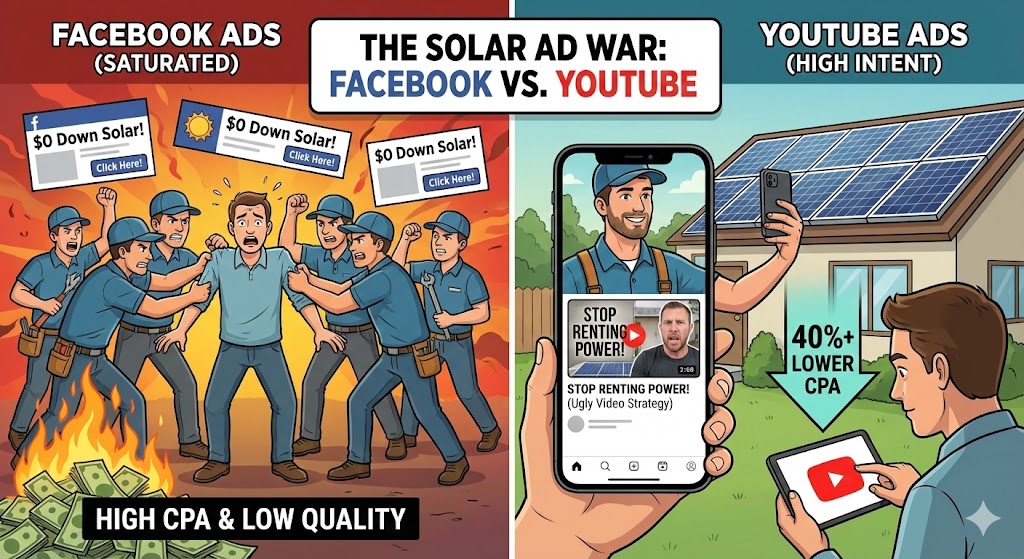
The solar industry has a massive “herd mentality” problem.
Five years ago, everyone rushed to buy shared leads from Angi. Then, they all rushed to run generic Facebook image ads. Now, your newsfeed is suffocated with identical ads screaming “Does your zip code qualify for $0 down solar??”
The result? Facebook ad costs are skyrocketing, homeowners have developed “banner blindness” to these ads, and lead quality is tanking fast. You are fighting in a red ocean, competing with 50 other installers in your city for the same distracted homeowner scrolling through cat memes.
If you want to generate high-intent YouTube ads for solar leads and drop your Cost Per Acquisition (CPA) by 40% or more, you need to go where homeowners are actively looking for answers, not just scrolling out of boredom. You need to be on YouTube.
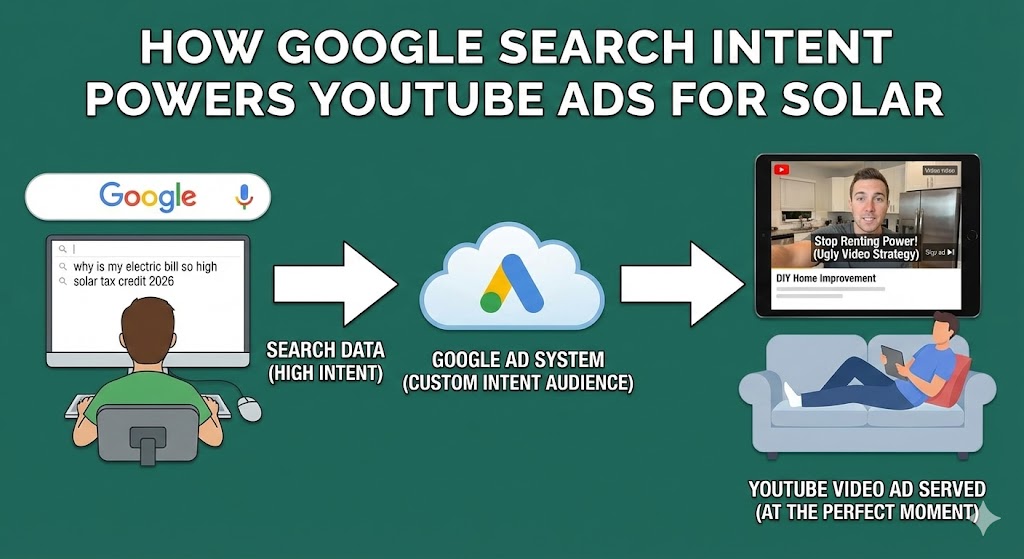
YouTube is the second largest search engine in the world, owned by Google. When a homeowner gets a massive $500 electric bill during a heatwave, they don’t go to Instagram to research solutions. They go to Google and YouTube and type in: “Why is my electric bill so high?” or “Are solar panels worth it?”
If your video ad appears right at that moment of high intent, you are not interrupting them; you are answering their prayers.
Why YouTube Beats Facebook for High-Ticket Solar
The fundamental difference between Facebook and YouTube is intent.
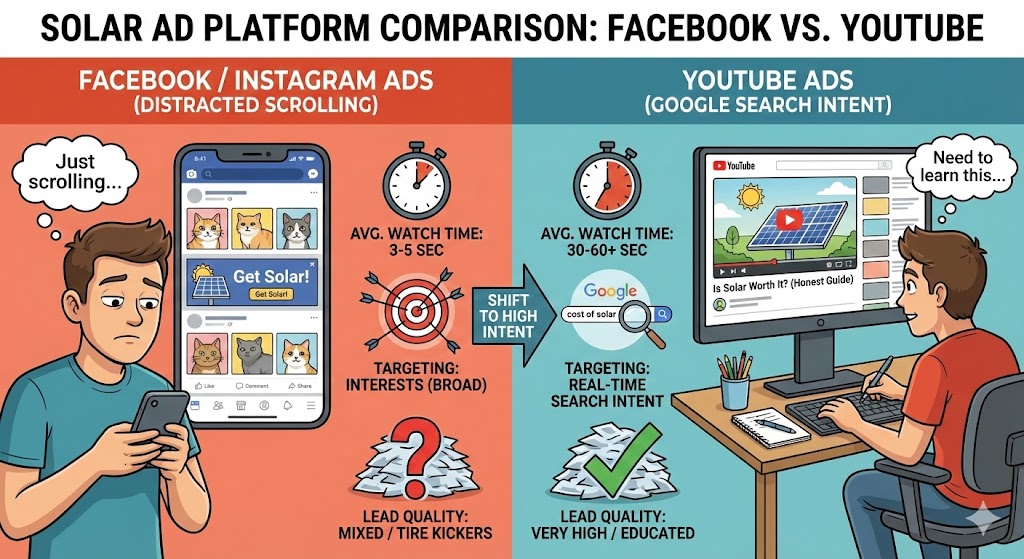
Facebook is “interruption marketing.” You are trying to stop someone from looking at photos of their cousin’s wedding. Their attention span is less than 3 seconds.
YouTube is “search-intent marketing.” The user is already in a learning mindset. They are sitting at their desktop or watching on their TV, ready to consume content. They have the patience to understand the complex financial value proposition of solar.
Data Table: The Solar Ad Platform Comparison
Let’s look at the raw data on why smart money is moving to YouTube.
| Metric | Facebook / Instagram Ads | YouTube Ads (Google) |
| User Mindset | Distracted, Scrolling, Bored | Focused, Learning, Searching |
| Average Watch Time | 3-5 seconds | 30-60+ seconds |
| Targeting Power | Interests & Demographics | Real-Time Search Intent (What they just typed into Google) |
| Competition Level | Extremely High (Saturated) | Low (Most installers are scared of video) |
| Lead Quality | Mixed (Lots of tire kickers) | Very High (Educated homeowners) |
Step 1: The "Ugly Video" Ad Strategy (Stop Being Polished)
The number one reason solar companies don’t run YouTube ads is fear. They think they need a $20,000 camera crew, drones, actors, and a professional studio script.
This is completely false. In fact, overly polished “TV commercials” perform terribly on YouTube. They look like ads, so people skip them immediately.
Authenticity wins. We call this the “Ugly Video” strategy. Some of the highest-converting solar ads running right now are shot on an iPhone, often in selfie mode, by a real person standing in front of a meter or a roof.
The winning 4-part script framework: YouTube Ads for Solar Leads.
Don’t try to be a movie director. Just follow this psychological framework used by top direct-response marketers:
The Hook (0-5 seconds): Call out the pain immediately. Do not show your logo.
Example: “Stop paying your utility company $300 a month for power you are just renting. It’s ridiculous.” (Shot selfie-style in front of an electric meter).
The Problem Agitation (5-20 seconds): Twist the knife.
Example: “Did you see the rate hike notice? Rates are going up again this summer. That $300 bill is about to be $450. And once you pay it, that money is gone forever.”
The “New Opportunity” Solution (20-45 seconds): Introduce the current incentives without being boring.
Example: “But homeowners in [Your State] with a credit score over 650 are using the current federal programs to swap that rising utility bill for a fixed solar payment that is usually lower than what they pay now. It costs $0 out of pocket to switch.”
The Call to Action (45-60 seconds): Tell them exactly what to do next.
Example: “I recorded a short video explaining exactly how the math works for homes in our area. Click the link below, answer three questions about your roof, and you can watch it instantly.”
It’s raw. It’s real. It feels like a friend giving advice, not a corporation trying to sell something. That is why it converts.
Step 2: Targeting Homeowners Who Are Actively Searching
This is where YouTube’s connection to Google becomes your unfair advantage. You cannot do this on Facebook.
We use something called “Custom Intent Audiences.”
You can tell YouTube: “Show my video ad ONLY to people who have gone to https://www.google.com/search?q=Google.com in the last 7 days and searched for these exact keywords:”
“cost of solar panels in [My State]”
“best solar companies near me”
“how does the solar tax credit work”
“why is my electric bill so high”
Think about the power of that. You are putting your “Ugly Video” right in front of someone who literally just asked Google for help with high energy costs. The intent is off the charts. This isn’t cold traffic; it’s pre-heated traffic.
Step 3: The VSL Landing Page (Don't Use a Basic Form)
Just like we discussed with other platforms, never send high-quality YouTube traffic to a generic “Contact Us” page. They just watched a 60-second video; they want more information, not less.
Send them to a Video Sales Letter (VSL) page or an interactive savings calculator. Give them the educational content you promised in the ad.
YouTube users are in “watch mode.” Let them watch. The VSL does the heavy lifting of educating the homeowner on net metering, tax credits, and installation processes. By the time they click the button below the video to book an appointment, they are 80% sold. Your sales team will love these leads because they don’t have to explain the basics of solar from scratch.
Conclusion: Own the "Blue Ocean" of Video
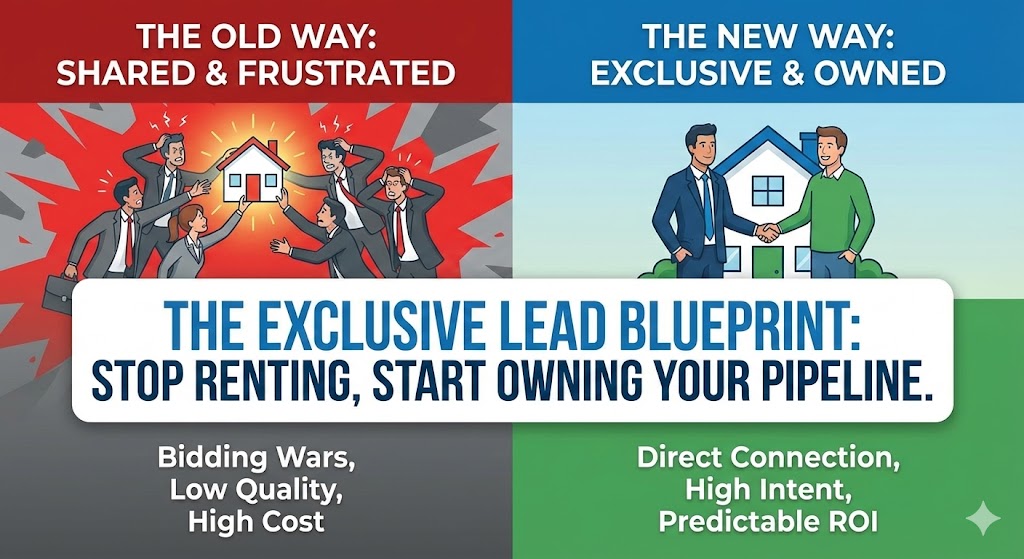
While your competitors are busy engaging in a pricing race to the bottom on saturated platforms, you have the opportunity to own the most powerful video platform on earth.
YouTube ads allow you to educate homeowners at scale, target them based on their real-time Google searches, and use simple, authentic videos to build massive trust before you ever speak to them. The result is dramatically lower CPAs and higher close rates.
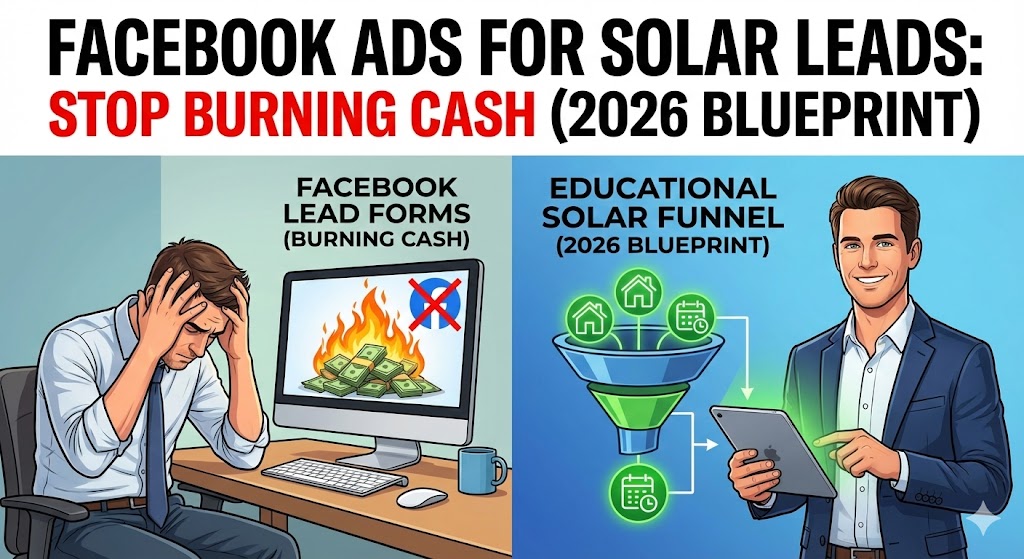
While YouTube is the king of educational intent, a truly dominant solar company uses an omnichannel approach. Once you capture their attention here, you should be retargeting your viewers with Facebook ads for solar leads to keep your brand top-of-mind everywhere they scroll until they are ready to sign the contract.
Stop being scared of video. Grab your iPhone, stand in front of a meter, and start hitting record.
Ready to Build Your YouTube Solar Engine?
Creating high-converting “ugly” video ads and setting up advanced Google intent targeting requires a specific skillset. If you want to skip the expensive learning curve and have my team build your entire YouTube acquisition machine, click below to book a Solar Marketing Audit.
- All Posts
- Knowledge Hub
Frequently Asked Questions
1. Are YouTube ads more expensive than Facebook ads?
On a “Cost Per Click” or “Cost Per View” basis, YouTube is incredibly cheap (often $0.05 – $0.15 per view). Your initial Cost Per Lead (CPL) might look slightly higher than Facebook—say, $100 instead of $60. However, because the intent is so much higher, your close rate doubles. This means your ultimate Cost Per Acquisition (CPA) for a signed solar contract drops by 40% or more.
2. Do I really need to be on camera?
Ideally, yes. People buy high-ticket home improvements from people they trust, not faceless corporations. Seeing a local expert face-to-face builds immediate credibility. If you are absolutely terrified of the camera, you can use “faceless” video ads with b-roll footage of local installations and a strong voiceover, but these generally convert 30% lower than authentic, “selfie-style” founder videos
3. Can I target specific homeowners and exclude renters on YouTube?
Yes. Google has the most powerful demographic data in the world. In your campaign settings, you can specifically check the box for “Homeowners” and exclude “Renters.” You can also layer on household income brackets (e.g., top 30% of earners in a zip code) to ensure you are only paying to show your video to people who can actually qualify for solar financing.
4. How long should my YouTube ad be?
For solar, the sweet spot is between 60 seconds and 2.5 minutes. You need enough time to hook them with the problem (high utility bills), educate them on the solution (current tax incentives or zero-down programs), and give a clear call to action. Anything shorter than 45 seconds simply doesn’t build enough value to justify a $30,000+ purchase.
5. What is the best "bidding strategy" for YouTube solar ads?
When starting out, use “Maximize Conversions” or “Target CPA.” You tell Google’s algorithm, “I am willing to pay $120 for a qualified lead,” and their system will optimize delivery to find the people most likely to fill out your VSL form at that price. Just ensure your conversion tracking pixel is set up perfectly on your landing page before turning this on.